
Green hydrogen is expected to play an important role in the future hydrogen value chain, but the reality is that sufficient infrastructure for immediate mass production is not yet in place. For this reason, blue hydrogen is the hydrogen produced in the most environmentally friendly way that the current hydrogen industry is paying attention to.
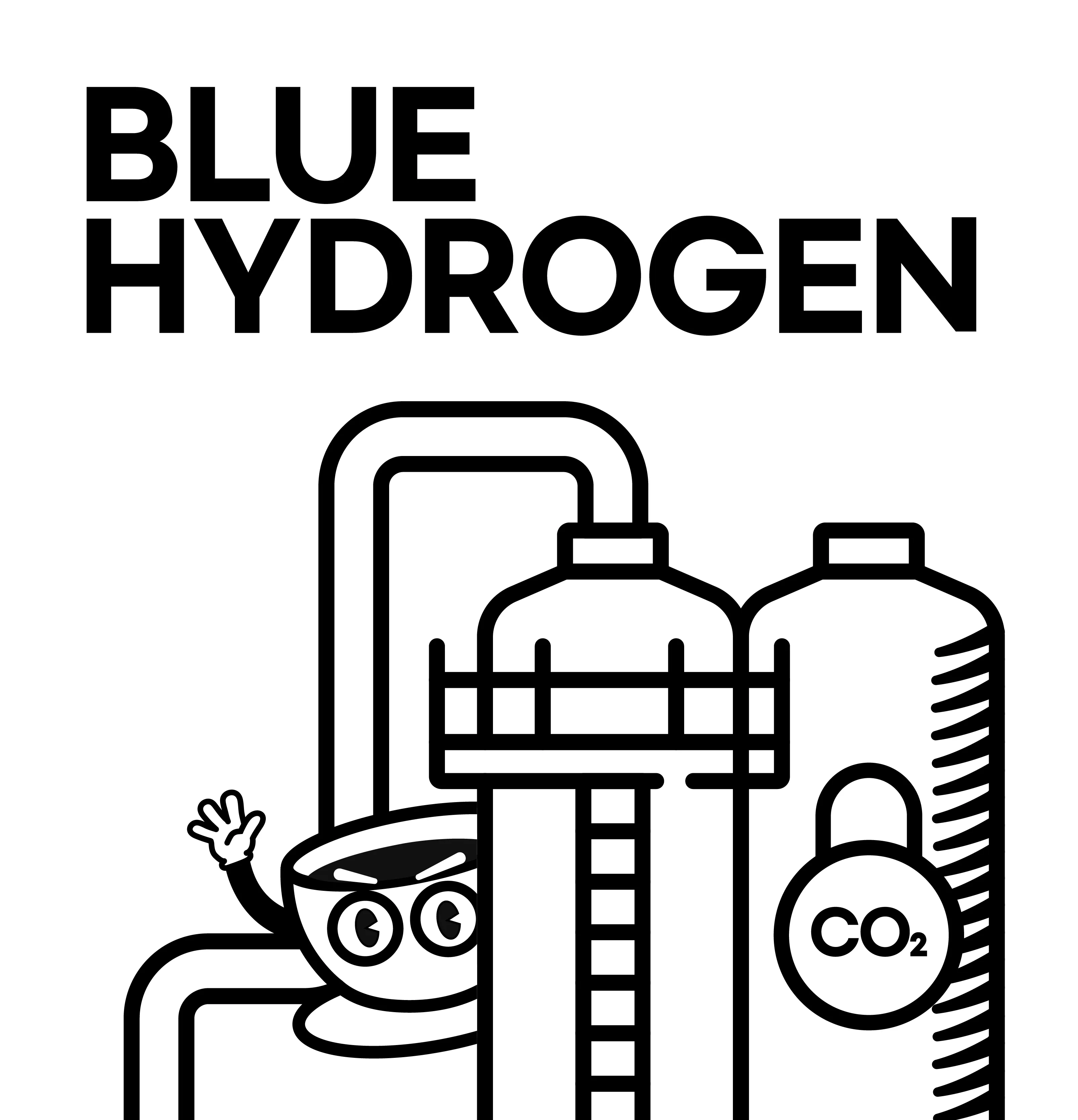
[Blue Hydrogen Ⓟ ESG.ONL/ESG Today]
To understand blue hydrogen, it is necessary to look at the process of gray hydrogen. The Global Hydrogen Review 2025 published by the International Energy Agency (IEA) analyzed that, despite the growth of low-emission hydrogen, the feedstock driving hydrogen production in 2024 was fossil fuels. According to the report, 290 billion cubic meters of natural gas and 90 million tons of coal were used to produce hydrogen. Gray hydrogen is precisely this method of producing hydrogen through fossil fuels. Fossil fuels such as oil, coke, and naphtha are supplied as raw materials in the production processes of petrochemical or steelmaking plants. In the process of converting fossil fuels into the target substances needed for these processes, hydrogen is generated as a by-product, and gray hydrogen is the collection and use of this by-product hydrogen as fuel. For this reason, gray hydrogen is sometimes called by-product hydrogen. Since gray hydrogen is primarily extracted from fossil fuels, it is difficult to evaluate it as environmentally friendly, and it emits carbon dioxide in the process of its generation. It also has the limitation that additional hydrogen production is difficult.
What compensates for the limitations of such gray hydrogen is precisely blue hydrogen. Blue hydrogen is obtained by reacting natural gas with steam, and is therefore called extraction or reformed hydrogen. When natural gas or lignite — a type of fossil fuel — is reacted with steam, hydrogen and carbon dioxide are generated, and at this point, the carbon dioxide is captured using CCUS technology, preventing the air pollution that occurs in the production process. Blue hydrogen is more environmentally friendly compared to gray hydrogen and can be mass-produced, making it discussed as the most realistic alternative for obtaining hydrogen until green hydrogen infrastructure is developed and deployed.
In fact, U.S. blue hydrogen production in 2025 is projected to increase nearly fivefold compared to 2024, and blue hydrogen production plants are increasing, centered on natural gas production regions or areas where various processes utilizing natural gas are concentrated. While the effectiveness and long-term stability of CCUS technology need verification, the shared opinion across the industry is that a transitional phase through blue hydrogen is necessary for the hydrogen ecosystem to stably take root while new and renewable energy and green hydrogen technologies mature.
by Editor O