
The EU Emissions Trading System (EU-ETS) is the world's first and largest carbon emissions trading scheme, launched by the European Union in 2005 to reduce greenhouse gas emissions. The ETS is a market-based policy instrument for reducing greenhouse gas emissions: governments set a total national emissions cap, then allocate permitted emission allowances (caps) to designated entities covered by the scheme. These entities receive emission allowances only within their designated limits.
History of the EU-ETS
When entities have surplus or insufficient allowances, they can trade them on the emissions trading market. Unlike a carbon tax — where the government sets the price — the ETS follows a market principle in which price is determined by supply and demand. Divided into Phase 1 (2005–2007), Phase 2 (2008–2012), Phase 3 (2013–2020), and Phase 4 (2020–2030), the EU-ETS has evolved through various trials and adjustments, and has contributed to a steady decline in greenhouse gas emissions since 2005.
// Phase 1 (2005–2007): Launched across 25 EU member states, the EU-ETS operated as a pilot scheme focused on energy-intensive industries. Free allocation was the baseline, with paid allocation capped at 5% — though actual paid allocation amounted to just 0.12%.
// Phase 2 (2008–2012): The EU-ETS began aligning its targets with the Kyoto Protocol, and trading was extended to international markets. The target was to reduce 2012 emissions by 8% from 1990 levels, with paid allocation capped at 10% — though actual paid allocation reached only 3.07%. Reduced demand for allowances due to the European financial crisis and economic slowdown was identified as the main driver of falling carbon prices.
// Phase 3 (2013–2020): Targeting a 21% reduction in greenhouse gas emissions from 2005 levels by 2020, Phase 3 set paid allocation at 100% for the power sector, 20% for industry, and 15% for aviation. National allocation plans from Phases 1 and 2 were abolished and replaced by a single EU-wide allocation system, signaling a shift toward more ambitious reduction measures.
// Phase 4 (2020–2030): Targeting a reduction in EU greenhouse gas emissions of at least 40% from 1990 levels. Regarded as a key instrument of the European Green Deal, the EU-ETS is a central component of Europe's sustainable growth strategy toward carbon neutrality.
In 2023, the EU proposed the introduction of the Carbon Border Adjustment Mechanism (CBAM) for certain high-carbon-risk product categories that had previously been protected through free allowance allocation. As a mechanism introduced to extend the EU-ETS and carbon neutrality goals globally, CBAM is a closely related keyword in the emissions trading system.
According to a European Commission announcement in April 2025, CO₂ emissions from industries covered by the EU-ETS fell by 5% in 2024 compared to the previous year. Emissions have dropped to half of their 2005 levels, putting the system on track toward the 62% reduction target for 2030 — with the power sector identified as the leading contributor to reductions. Recent EU proposals related to the ETS have also included measures to incorporate permanent carbon dioxide removal and to allow flexible adjustment of reduction targets across sectors where decarbonization is particularly difficult.
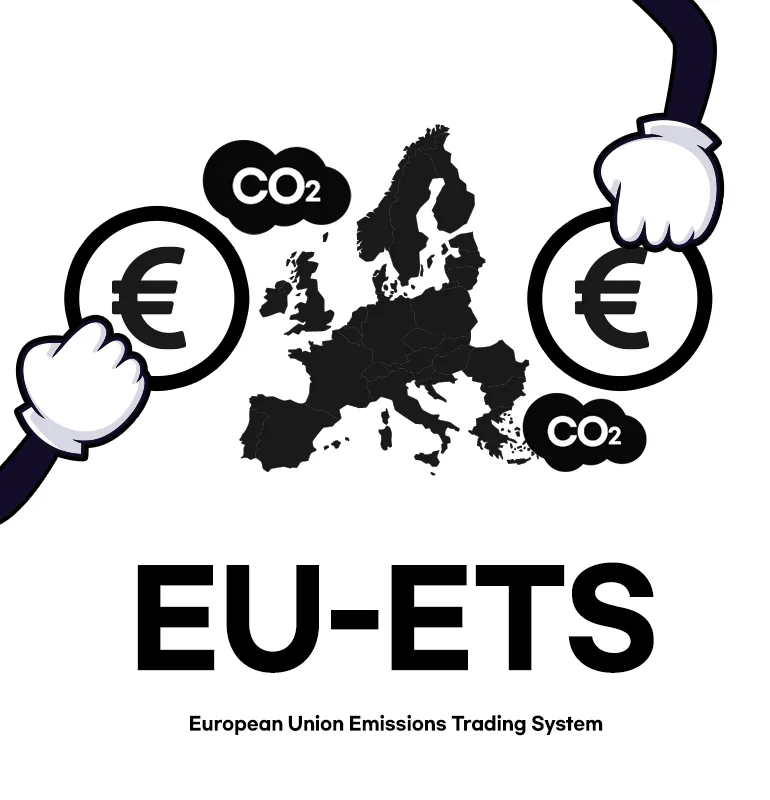
[EU-ETS — EU Emissions Trading System ⓒESG.ONL]
by Editor O