
A Green Swan refers to an unpredictable economic or financial crisis caused by climate change. The term first appeared in a report titled "The Green Swan: Central Banking and Financial Stability in the Age of Climate Change," published by the Bank for International Settlements (BIS) in January 2020. It is a concept derived from the "Black Swan" — the term for an unpredictable, extreme event — introduced by American economist Nassim Nicholas Taleb in his 2007 book of the same name.
The Black Swan originates from the moment in the 17th century when Europeans, who firmly believed that all swans were white, discovered black swans in Australia. People held the fixed conviction that all swans were white — yet something entirely unexpected and contrary to that belief appeared before them. Such shocking and unanticipated events came to be called Black Swans. The Green Swan and the Black Swan differ in several key respects.
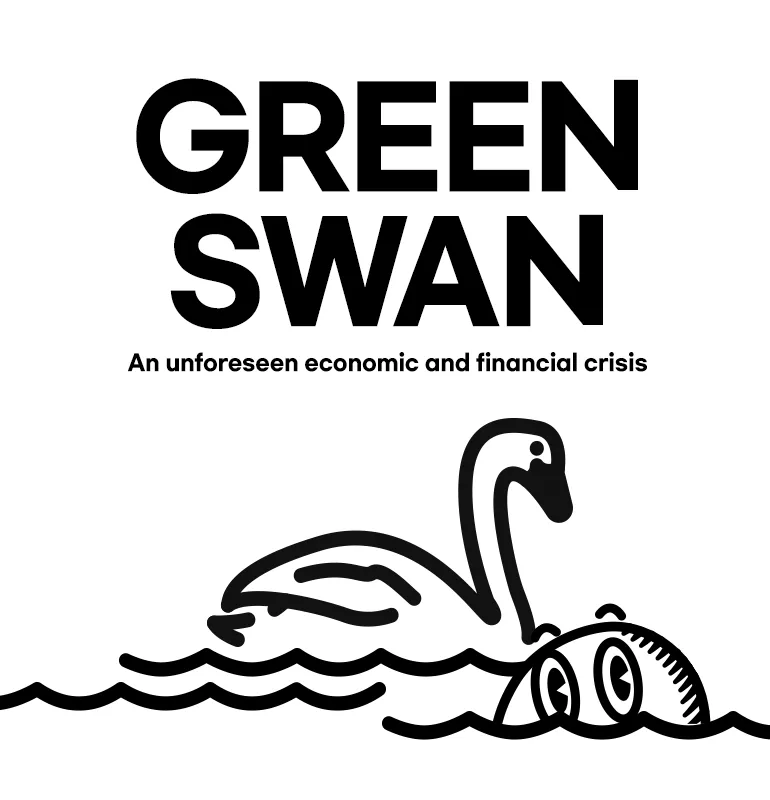
[Green Swan ⓒESG.ONL]
A Black Swan delivers an unexpected shock, but recovery is possible over time. A Green Swan, by contrast, is difficult to recover from. Once climate change raises the Earth's average temperature, bringing it back down again requires far more time. During the gradual process of cooling, other extreme weather events such as heatwaves and typhoons also occur, and socioeconomic damage becomes unavoidable. Moreover, returning the average temperature to its target level is nearly impossible, making it equally difficult to restore a state in which no damage remains for us to bear.
A Black Swan can only be confirmed and explained after an event has already occurred, whereas a Green Swan can be anticipated and warned against through the projections of experts including scientists, economists, and climate specialists. For example, the BIS report warned that climate change could trigger sharp price fluctuations in agricultural products and energy resources, and that reduced productivity — due to shortened working hours caused by heatwaves, among other factors — could lead to inflation and stagflation. It also projected that the growing frequency of rising sea levels, storms, floods, and heatwaves would increase the economic costs faced by central banks and financial institutions around the world.
If a Black Swan represents an economic loss from which recovery can be expected, a Green Swan represents global damage from which recovery is difficult — or impossible.
by Editor O