
A PowEr Purchase Agreement (PPA) is a system through which companies and institutions enter into long-term contracts with renewable energy generators to receive a stable supply of eco-friendly electricity, enabling them to predict energy costs and simultaneously achieve RE100 and ESG management goals. Expanding the adoption of renewable energy through various formats — including on-site (location-based), off-site (location-independent), direct, and third-party arrangements — PPA is attracting attention as a key instrument for realizing carbon neutrality, supported by government backing.
Through a PPA, both generators and consumers can obtain Renewable Energy Certificates (RECs), creating an incentive for the further spread of eco-friendly renewable energy. PPA electricity consumers generally include large corporations and public institutions. The greatest advantage of PPAs is predictability: purchasing companies can project their energy costs over the long term and lock in their renewable energy ratio, while generators can secure a buyer for their electricity in advance, enabling stable supply.
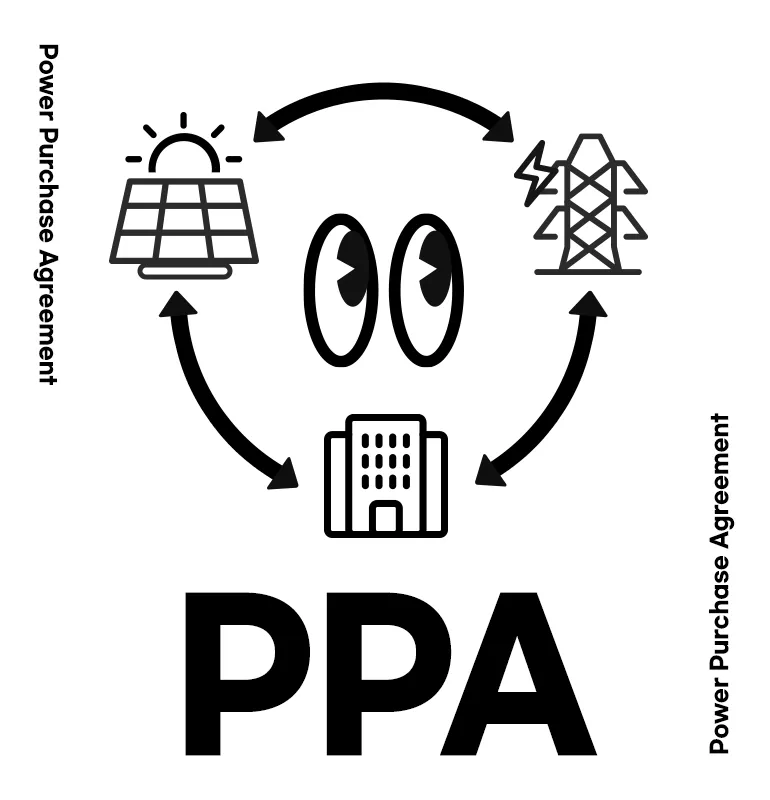
A PPA specifies the quantity of electricity to be supplied, the unit price, contract duration, transmission method, insurance, and other details. Depending on the method of supply, PPAs are classified as either on-site contracts — where generation equipment such as solar panels is installed directly at the consumer's premises — or off-site contracts — where electricity produced at an external power plant is supplied via the transmission grid. Companies and institutions can choose their preferred transmission method and electricity volume according to their needs. Direct PPAs, where a generator and electricity user enter into a one-to-one agreement, offer greater pricing flexibility, while third-party PPAs involve an intermediary such as KEPCO between the generator and user, enhancing transaction stability and distributing risk.
Contract types also include Physical PPAs — where actual electricity is supplied — and Virtual (Financial) PPAs — where only financial credits for the amount of electricity generated are traded, without physical power delivery. This allows for hedging against electricity price volatility. The government is encouraging PPAs among small and medium-sized enterprises through various forms of support including usage fee subsidies and fee waivers. As global companies' carbon neutrality commitments — such as RE100 — intensify, PPA is becoming a prerequisite for expanding renewable energy and driving change in the energy market.
[Related Article] [Sustainability Report Review] Steps Toward a More Beautiful World: Amorepacific]
[Related Article] [21st Presidential Election] How the Candidates View Climate and Renewable Energy Policy]
[Reference Article] The Secret of 'Dutch Bros,' Which Creates Better Jobs