

President Lee Jae-myung, just two weeks after his inauguration, attended the G7 Summit held in Canada last week, announcing an early debut on the international diplomatic stage. This summit attendance carries the meaning of informing the international community of the recovery of Korean democracy — having overcome political turmoil — and of its diplomatic stability. There was also active discussion of sustainable growth and ESG. The heads of state who gathered in one place for the G7 Summit discussed future-oriented policy measures such as an integrated approach to energy security and climate-change response, the expansion of renewable energy and enhancement of energy efficiency, the stabilization of critical-mineral supply chains, and the integration of AI and energy systems. Agenda items related to sustainable development, such as biodiversity conservation and sustainable finance, were also included.
The "ESG Theme" at the Center of the G7 Summit

Let us look at how this year's G7 Summit dealt with sustainability and ESG. This summit was conducted by adopting ISO 20121, the international standard certification for managing sustainable events in consideration of environmental sustainability, and by checking carbon-emission accounting, renewable-energy use, and zero-waste practices during the summit period. Operations that reduced single-use plastic use during the event and improved waste-management measures were also actively reflected. In addition to such practical efforts, the heads of state at the G7 Summit presented concrete policy recommendations for ESG-related fields such as energy transition, industrial decarbonization, sustainable finance, and biodiversity conservation. T7 (Think7), a private-sector expert group for proposing policy to the G7 Summit, also proposed ideas such as optimizing energy grids using AI, sustainable mining of critical minerals and the introduction of circular-economy models, and international cooperation to halt biodiversity loss.
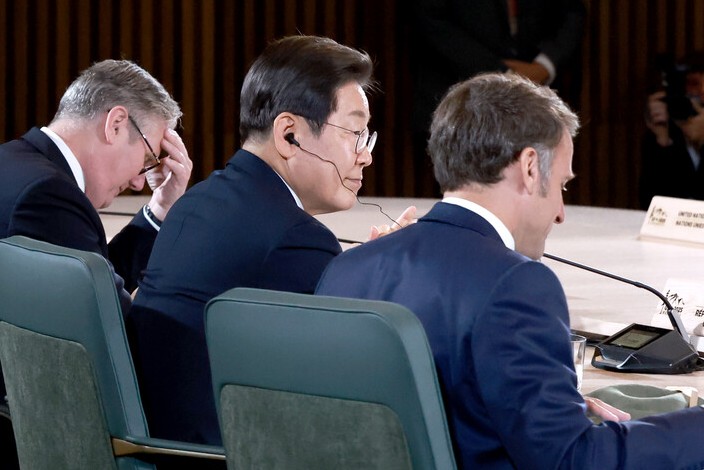
[Representatives of each country attending the G7 Summit © G7 joint press corps]
The Policy Proposals President Lee Jae-myung Announced at the G7 Summit

President Lee Jae-myung, who attended the G7 Summit, informed the international community of Korea's will to actively contribute to global energy security and sustainable development under the theme "the future of energy security." President Lee particularly emphasized the need to diversify energy supply chains and to integrate AI and energy in order to respond to the surge in power demand caused by the advance of AI technology, as well as climate change and geopolitical instability. He also proposed to the international community the innovative energy systems he had promised through his pledges — such as expanding the share of renewable energy using domestic resources, building an "energy highway" using high-voltage direct-current (HVDC) transmission networks, and introducing "microgrids" in which energy production and consumption take place at the local level. In fact, Korea plans to invest 14.8 billion dollars in renewable-energy research and development in 2025 to greatly increase the installation of solar and offshore-wind generation facilities, and it has also secured the world's second-largest position in lithium-ion battery production. The government is undertaking investment in clean-energy projects in emerging countries and the development of common standards for hydrogen infrastructure through a 5-trillion-won Green Transition Fund and Green Resilience facilities.
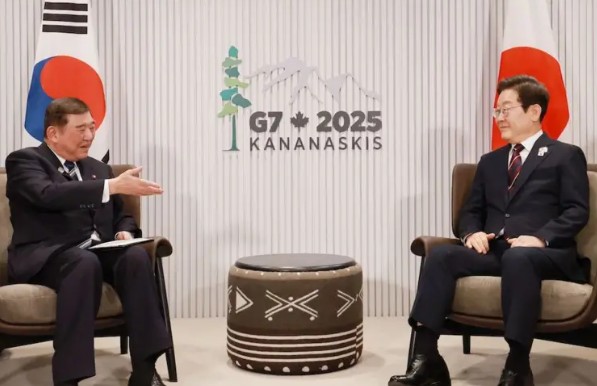
[President Lee Jae-myung with Japanese Prime Minister Ishiba Shigeru © BBC]
Our Challenge Unfolded at the G7 Summit, the World's Future
This G7 Summit was an occasion that laid the foundation for Korea to play a key role among global sustainability and ESG issues. It is a cornerstone for strengthening a leading position in the future industries dealt with at the summit. On the global diplomatic stage, Korea and the international community are expected to strengthen practical action centered on the agenda discussed at this summit. They will expand financial support so that the G7 countries — as well as the middle-power and developing countries that attended this meeting — can pursue policies, and will hurry to handle common tasks such as strengthening the resilience of global supply chains mired in a worldwide recession and accelerating industrial decarbonization.
[President Lee Jae-myung attending the G7 Summit © Yonhap News]
US President Donald Trump returned home hastily on the first day of the G7 Summit, saying it was to resolve the Middle East conflict, so a Korea-US summit unfortunately did not come to pass. However, President Lee Jae-myung strove to fill the diplomatic vacuum of the intervening period by conducting summit diplomacy with a total of nine countries, including South Africa, Australia, Japan, and Brazil. As discussion of ESG finds momentum again from the start of the popular-sovereignty government, Korea will build a new paradigm centered on sustainability and ESG on the international stage.
by Editor L