
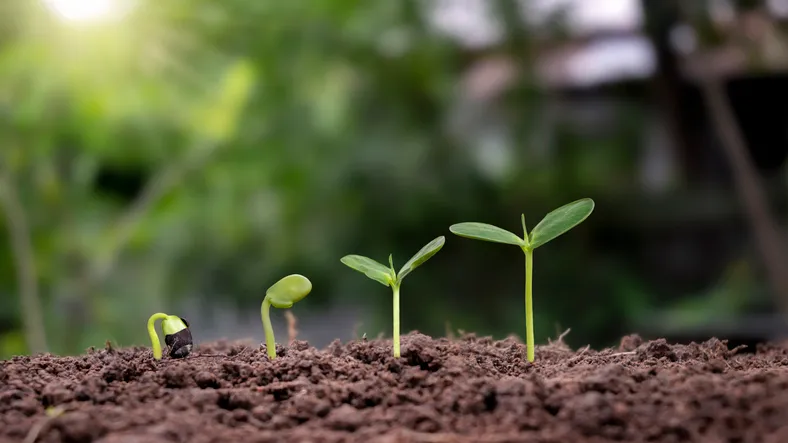
When March arrives, the earth awakens. The frozen soil thaws, and seeds prepare to sprout. March 11 ‘Soil Day’ is a statutory commemorative day established in 2015 with the purpose of widely promoting the preciousness of soil and protecting healthy soil. The date itself carries meaning: ‘3’ represents the three elements of heaven (天), earth (地), and humanity (人), as well as the three agricultures of farming, rural areas, and farmers; ‘11’ is derived from the Chinese character 土 (to, meaning soil), which separates into 十 (십, ten) and 一 (일, one), thus March 11 was designated as Soil Day. Yet every year when this day returns, a question arises: is this land that we tread upon every day truly okay right now?
Soil ≠ Just the Ground (X), It Is Something to Manage (O)
Soil is not just the ground. It is not merely an object of cultivation but the foundation of life that produces food, stores water, and absorbs carbon to respond to climate change. Though not easily visible, a healthy handful of soil is home to billions of microorganisms that decompose organic matter and supply nutrients to plants. When soil becomes contaminated, this cycle breaks, and the impact ultimately reaches our tables.
According to a survey by the Food and Agriculture Organization of the United Nations (FAO), 25% of the world’s soil is already in a severely degraded state. South Korea is no exception. Domestically, forest soil is quietly undergoing acidification. An analysis of agricultural land by the Jeju Agricultural Research and Extension Services found that the average soil acidity (pH — one of the important conditions for crop cultivation, as the availability of nutrients in soil varies depending on soil acidity) over the past 10 years (2014–2023) was 5.8, an improvement from the previous 10-year average of 5.4 (2004–2013), but orchards and greenhouse cultivation sites still averaged 5.6, failing to reach the optimal range (6–7). As long as conventional farming with continuous use of chemical fertilizers continues, the problem of agricultural soil acidification will not be easily resolved. Sustained nutrient and soil management is needed to improve soil acidification.
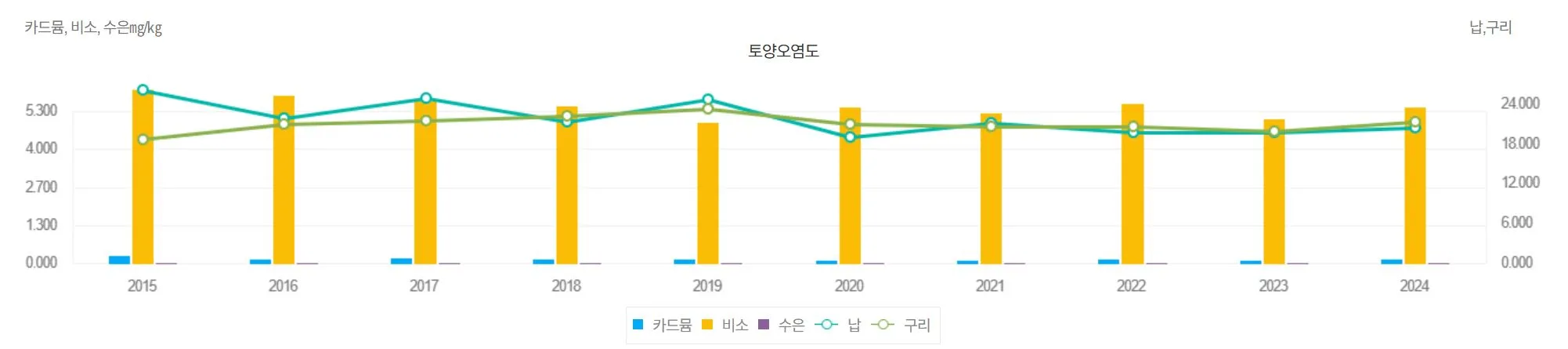
[Soil Contamination Status Graph © Ministry of Climate and Environment Soil Monitoring Network Survey Results]
Contamination in the Heart of the City: Yongsan Park Needing Site Remediation
Not only mountains and fields but urban soil is also becoming contaminated. The site where the Yongsan Children’s Garden now stands was where U.S. Forces Korea had been stationed for decades, and issues of oil spills and heavy metal contamination have been consistently raised. Toxic substances have indeed been detected within the garden in areas such as the General’s Quarters complex, baseball field, and sports field. According to a 2023 Korea Environment Corporation report, soil contaminants were also confirmed in approximately 5,000 m² of land surrounding six U.S. military bases including Camp Red Cloud, Gwangju Airfield, and Warrior Base. In effect, land whose fundamental safety concerns remain unresolved is now open to citizens.
Environmental groups are demanding that thorough site remediation work be carried out first for the returned U.S. military bases. Their position is that the process must go through preparatory stages including permit filings, facility demolition, and waste disposal, followed by remediation work (excavation and backfilling of contaminated soil, soil purification, groundwater purification), and finally post-verification procedures.
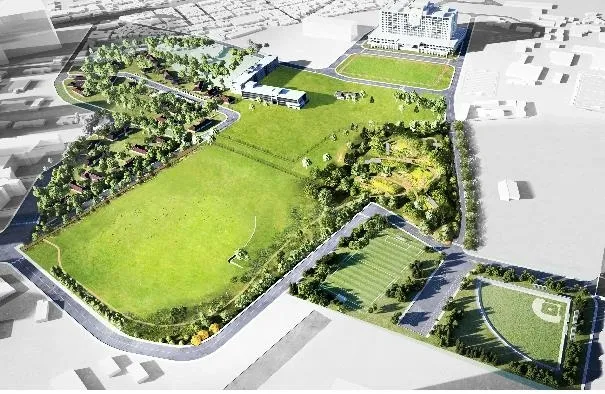
[Yongsan Children’s Garden Bird’s-Eye View © Ministry of Land, Infrastructure and Transport]
Contamination Beyond Concern: The Results of Our Soil Health Checkup
The government assesses the state of soil nationwide each year through two methods. One is the ‘Soil Monitoring Network,’ which surveys soil contamination levels at 1,000 fixed points across the country. The other is the ‘Soil Contamination Survey,’ which selects and intensively investigates areas with suspected soil contamination risk, such as near factories, industrial zones, and waste landfill sites. If the monitoring network is a ‘health checkup’ that regularly inspects general land, the contamination survey is akin to a ‘detailed examination’ that scrutinizes places already suspected of contamination.
According to the 2023 Soil Monitoring Network results, when 23 items including pH were analyzed at 1,000 points nationwide, all items were found to be within the soil contamination concern standards. However, in the Soil Contamination Survey, 48 out of 2,457 points nationwide (2.0%) exceeded the soil contamination concern standards. The figure of 2% may seem small, but it must be taken into account that the survey targets were areas already judged to have high contamination potential — factories, industrial complexes, abandoned mines, waste landfill sites, and the like. In other words, roughly 50 locations among high-risk areas exceeded the soil contamination concern standards.
The types of contaminants are also diverse. Twenty-three substances are designated and managed as soil contaminants, including cadmium, copper, arsenic, heavy metals, and benzene, phenols, and benzo compounds. Soil contaminants do not end as a mere ‘underground problem,’ as they can affect the growth of plants and animals as well as human health, requiring ongoing management.
For Soil Day Not to End as a Passing ‘Commemorative Day’
Soil contamination is invisible. It has no smell and does not cause immediate pain. That is why it has been neglected for so long, and by the time the problem surfaces, decades of contamination have already accumulated. On March 11, Soil Day, let us think about what we can do: reduce the use of chemical fertilizers and pesticides and choose organic produce. And take an interest in the status of soil contamination in our own region and raise our voices. Healthy soil does not protect itself. It is only protected when we pay attention.
by Editor L