

Bbegi, a bulky-waste disposal service accomplished with a single touch
A resource-circulation journey that begins not with consumption but with throwing away
Shopping, the Infinite Loop of Adding and Subtracting
In this world where the things to buy, the kinds of things to buy, and the ways to buy them are all diverse, shopping is a task that draws out desire to its extreme. Every day, through shopping, we confirm our own desires. The unrestrained maximalist runs into a limit at some point: storage space runs short. Now we even resolve that when we shop for one item, we will release one item at the same time.
Bbegi, Solving the Trash Problem Through Mobile
Now let's begin the story of the startup "Gatda." Ko Jae-seong, the CEO who founded "Gatda," discovered—while handling new-business analysis and business planning at an IT company—that a surprisingly large number of people do not know how to throw away bulky waste. He also confirmed that, even among those who know how to dispose of waste, many people around him had had inconvenient experiences because the process differs by local government and the method is complicated. To solve this problem, CEO Ko fleshed out a service by grafting IT onto the process of throwing away bulky waste. And, on the hypothesis that if the process of buying a sticker at a community service center, setting the bulky waste down at a loading spot, and attaching the sticker could be made simple, the deficiency many people feel in the waste-disposal process would disappear, he founded the corporation "Gatda" in 2018. He then launched "Bbegi," a bulky-waste collection platform that produces a waste-disposal estimate with a single mobile touch and connects users with professional waste-collection companies.
[Bbegi website main page ©Gatda]
The Bulky-Waste Problem, Whose Disposal Process Differs by Local Government
As of 2023, Korea's local governments nationwide number 226. According to a housing-conditions survey conducted by the Ministry of Land, Infrastructure and Transport in 2021, Koreans move an average of 3.6 times, meaning that over a lifetime Koreans must learn at least 3–4 ways of disposing of bulky waste. This is because the disposal process differs for every local government. Depending on the local government, the reporting method, the cost, and the cycle for bulky waste are all different. By handling on their behalf the complex application process and customer service managed by local governments, Bbegi created the effect of saving unnecessary time and reducing repetitive complaints. After starting service in Uijeongbu, Seongnam, and Goyang in May 2020, it now works with 71 local governments nationwide (as of November 2023), including Seoul and Gyeonggi. The number of users also approaches about 1 million.
"Connection" to Realize the Technology of Throwing Away Well
That is not the only difficulty in the bulky-waste disposal process. For various reasons, there are items that are too much to throw away alone. Capturing that deficiency, Bbegi launched the "Naeryeodeurim" (We'll Bring It Down) service, in which a verified Bbegi partner visits and throws the item away on the customer's behalf. If you enter the desired date and time through the Bbegi app, a Bbegi partner handles everything from disassembly to transport to disposal. At the initial service launch it was carried out through professional companies, but to create jobs for local youth and seniors, it recruited "Bbegi partners" within local governments. It later expanded to include participation by the general public, and Bbegi partners nationwide are continuously increasing. Safety is not neglected, either. For safe disposal, when signing up as a Bbegi partner, one undergoes three identity verifications (sex-crime record check, PASS, eKYC). Through the operation of Bbegi partners, users can throw away bulky waste more safely, conveniently, and at a reasonable cost, and a new kind of job—the Bbegi partner—was also created. Beyond this, through its app Bbegi is spreading better ways for people to throw things away, such as the "Bbegi Dictionary," an encyclopedia of correct sorting and disposal; "Free Secondhand Pickup," a novel free-sharing concept that turns into money; and "Secondhand Sale," which sells, by bid to Bbegi partners, appliances too good to throw away.
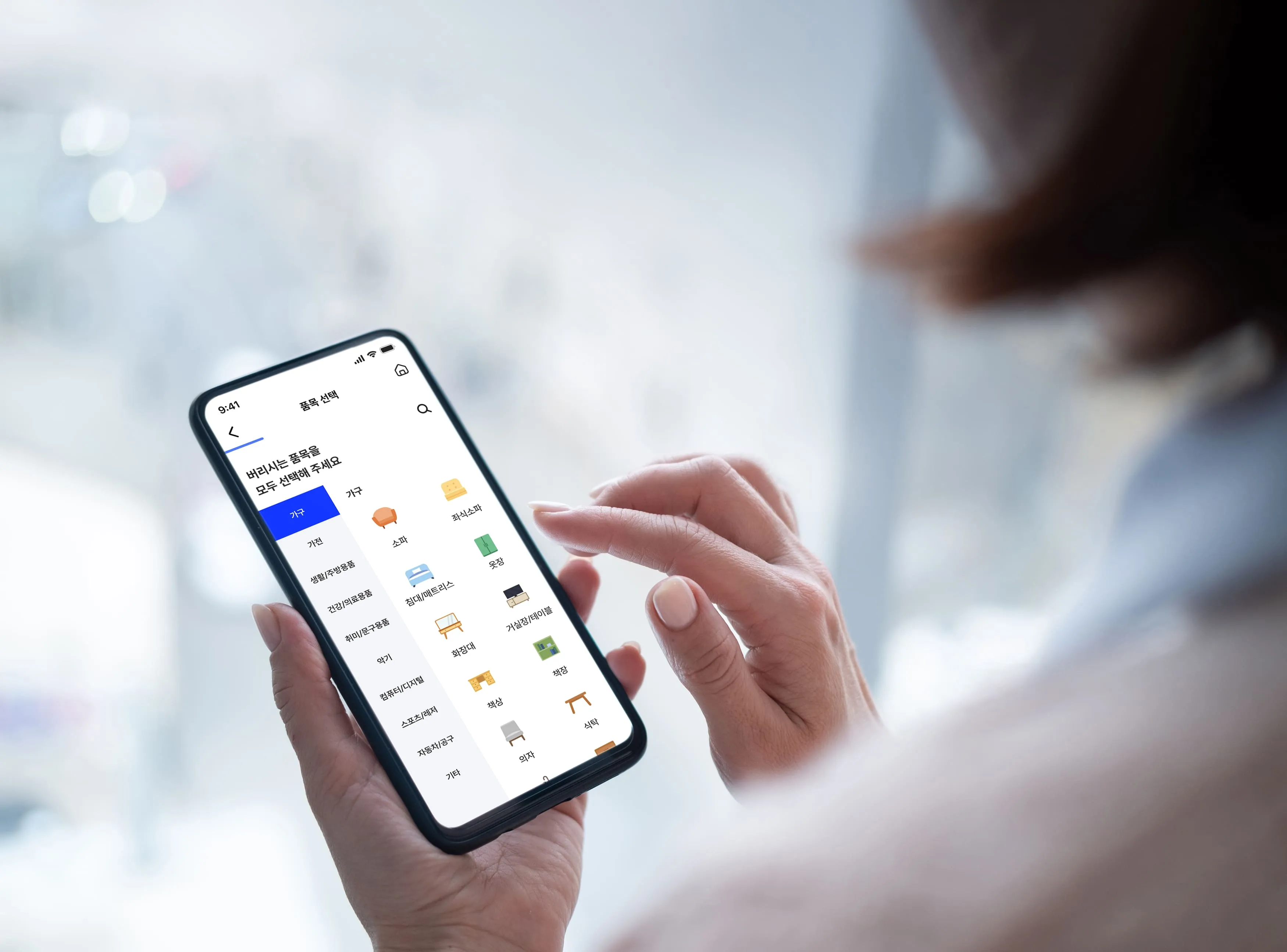
[On the Bbegi app, you can select the items to throw away ©Gatda]
The Loop of Circulation That Begins in the Process of Throwing Away
As explained earlier, Korea's bulky-waste collection process is not standardized, and because it goes through local processing after disposal, data is said to hardly exist. When using the Bbegi service, at the time of a collection request in the app, you take a photo and generate the product's barcode to create a bulky-waste primary code. The code is then used to collect data by local government. Because of this, the exact number of disposals, the items, and the cost required for processing can be calculated. Local governments that work with Bbegi provide, on the basis of this data, a "carbon-emission reduction report" for their planning of waste-related policy. In addition, through agreements with maker brands—where consumption begins—that provide Bbegi points allowing users to throw away previously used products when purchasing a product, it is building a virtuous loop of consumption and release.
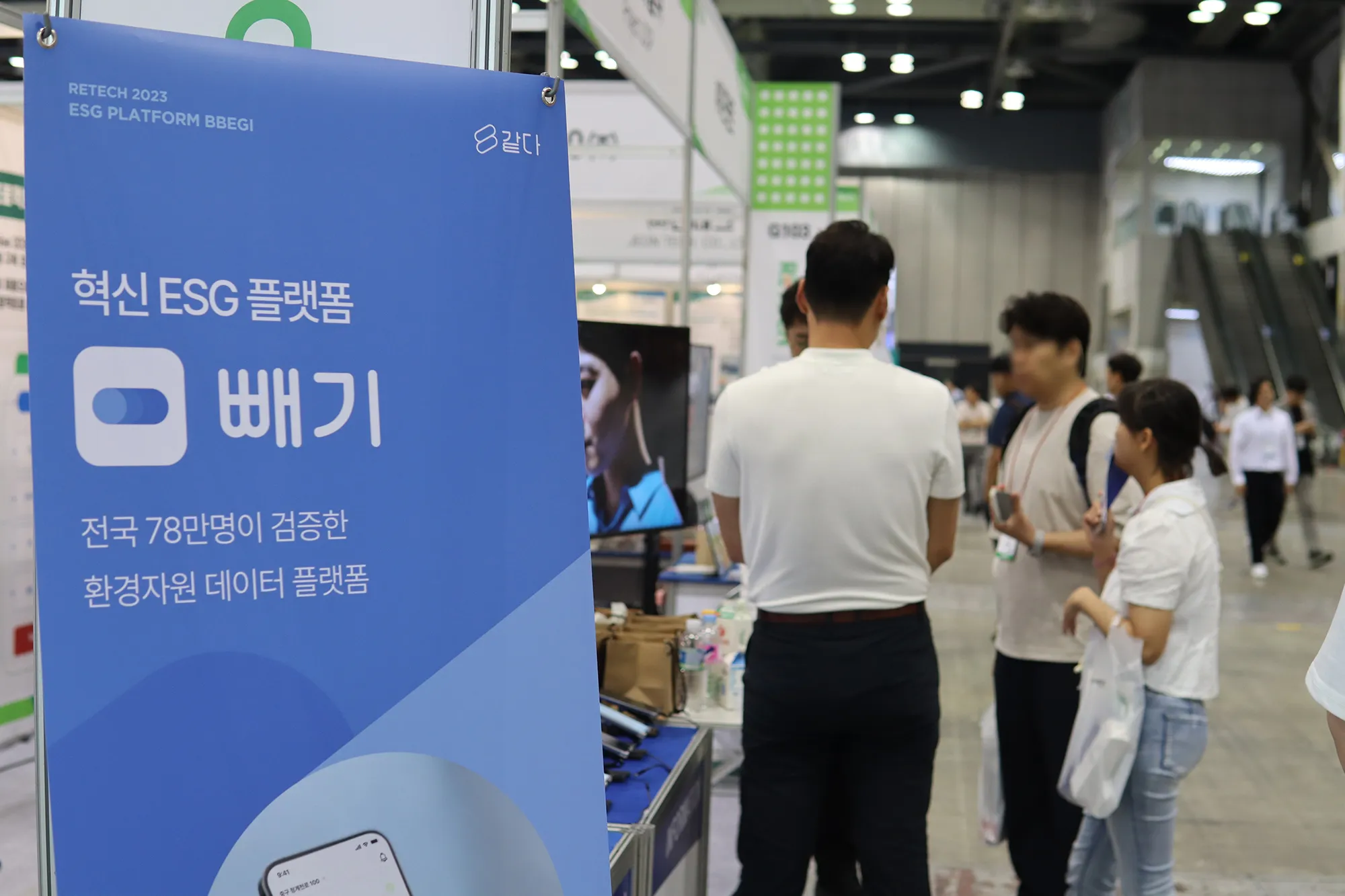
[Bbegi taking part in an ESG conference ©Gatda]
For a World Without Trash
This is the mission that Ko Jae-seong, the CEO of Gatda, which operates Bbegi, created when he founded the company. The roughly 20 people who agreed with that mission are processing the world's trash through the Bbegi service today as well. Not stopping at simply connecting waste, it is also preparing a carbon-trading platform that can measure, track, and sell an individual's carbon footprint through AI and object-recognition technology.
Our Identity, Expressed Through Throwing Away
In modern society, consumption is even said to represent an individual's identity itself. In addition to this, throwing away, too, will become a way of representing an individual's identity. "Gaining" and "releasing" are inevitably connected. That may be why Gatda is focusing on what is thrown away and the way it is thrown away. We hope more companies like "Gatda" will create ESG value in overlooked areas.
by Editor L