
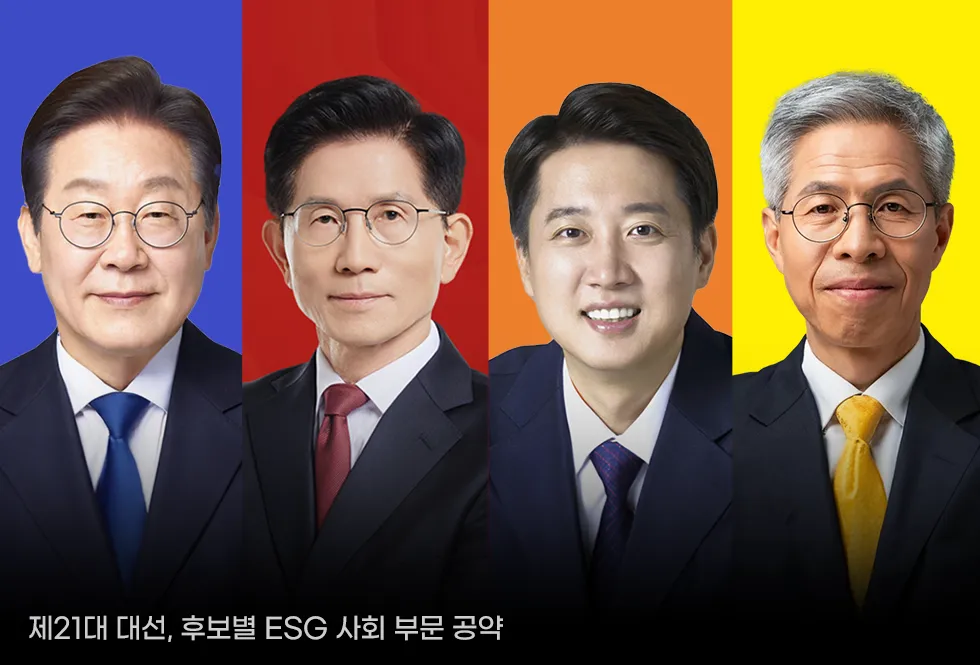
At last, tomorrow is the day of the 21st presidential election. Regarding the situation of holding an earlier-than-scheduled presidential election, the international community has offered commentary from various perspectives on the power of democracy and the public sphere that Korean society has shown. Will Korean society be able to keep protecting the policy realization of ESG, which had been solidifying its place as a standard of national competitiveness and social trust? The candidates are appealing for voters' choice, expressing their own and their parties' stances on various social values such as labor, safety, gender equality, and regional balance. Democratic Party candidate Lee Jae-myung and Democratic Labor Party candidate Kwon Young-guk revealed active stances on strengthening labor rights and protecting the socially disadvantaged, while People Power Party candidate Kim Moon-soo and Reform Party candidate Lee Jun-seok focused on labor-market flexibility and decentralization.
ESG.ONL would like to look at the social-policy pledges among each party candidate's ESG policies, through which we can anticipate the society of the next five years we will live in.

[Democratic Party candidate Lee Jae-myung © Lee Jae-myung's Facebook]
Lee Jae-myung, Seeking to Protect Working People Through Strengthening Labor Rights and Improving Working Conditions
Wage systems and labor-management relations improvement for labor-rights innovation
Candidate Lee Jae-myung emphasized that improving the wage system is also necessary, and presented a pledge to introduce a phased 4.5-day workweek (a 36-hour work system) without a wage reduction, with the goal of achieving actual working hours below the OECD average by 2030. This is the will to improve Korea's long-working-hours practice and guarantee work-life balance. He also promised to improve the system so that "atypical workers (delivery and platform workers, special-type employees, freelancers, the self-employed)," who had not been covered by the existing Labor Standards Act, can also receive legal protection, saying he would reflect the changed labor-market environment and achieve the social value of "guaranteeing the rights of everyone who works."
Candidate Lee, who says he will create a "society where labor is respected," also promised to re-push the "Yellow Envelope Act (amendment of Articles 2 and 3 of the Trade Union Act)." This law is pursued with the aim of improving inequality in labor-management relations by letting subcontractor workers also negotiate directly with the prime contractor, and preventing the company from filing retaliatory damage claims against disputes and legal strikes arising in this process. This bill, which has already gone through two proposal processes in the National Assembly, was scrapped in the previous administration when the president exercised a veto; Candidate Lee strongly advocates this policy to guarantee labor rights and improve labor-management relations.
He also spoke of a plan to realize the "equal pay for equal work" principle — an unresolved task of our society — through a "wage-disclosure system" by job, rank, and gender.
Successive accidents, improving citizens' working conditions and welfare
There is a strong perception that repeatedly occurring industrial accidents are also man-made disasters that could have been avoided. He announced a direction of strengthening safety measures across the entire construction-work process so as to fundamentally reduce industrial accidents. To raise the quality of life of Korean workers, who spend among the longest working hours in the world, concrete welfare proposals are also presented — pursuing a "national vacation-support system" policy, and encouraging "workation" (a combination of "work" and "vacation," i.e., "remote work at a vacation spot") by connecting local governments and companies.

[People Power Party candidate Kim Moon-soo © Kim Moon-soo's Facebook]
Kim Moon-soo: Labor-Market Flexibility, Improving the Business Environment, and Support for Youth, Women, and Regions
Supporting growth engines through a "business-friendly environment"
Candidate Kim Moon-soo puts forward business-friendly policies that consider practicality — "labor-market flexibility and business-environment improvement," "support for youth and women," and "strengthening decentralization." First, for labor-market flexibility, he stated that he would ease the rigidity of the 52-hour workweek and activate telework and flexible-work systems so that, under labor-management agreement, both workers and companies broaden their options. For small and medium-sized enterprises, his position is to ease or exempt the application of the "Serious Accidents Punishment Act" to reduce companies' realistic burden. Pointing to regulatory issues as a factor hindering corporate investment, he plans to enact a "Free Economy Innovation Framework Act" for new-industry and new-technology fields to overhaul them. Besides this, he announced pledges for creating a "business-friendly environment," such as cutting corporate and inheritance taxes and indexing comprehensive income tax to prices.
Sustainable-society solutions through decentralization and youth-and-women policies
Candidate Kim Moon-soo, who approaches our society's various agendas centered on practicality and growth, shows a balanced approach through decentralization and youth-and-women policies for social inclusiveness and sustainable development. Candidate Kim spoke of various balanced-regional-development pledges — a decentralization constitutional amendment, the transfer of central authority, region-specialized development, the nationwide expansion of the GTX, and the complete relocation of the National Assembly to Sejong City. His explanation is that resolving inter-regional imbalance will make the nation's balanced growth possible.
For youth, the "3.3.3 Youth Housing" plan stands out. Candidate Kim promised to ease the housing burden by having the government support young people's housing costs for a total of nine years — three years of marriage, three years for the first child, and three years for the second child. He also seeks to contribute to expanding women's labor-market participation and improving families' quality of life by resolving the workplace wage gap for women, and supporting the re-employment of career-interrupted women and "work-family balance" through expanding the "gender-equality hiring-target system." Besides these, Candidate Kim also put forward his own solutions to youth and women's issues, such as a second reform of the National Pension, expanding large-corporate open recruitment, reviving the military-service bonus-points system, and introducing a voluntary military-service system for women.

Reform Party candidate Lee Jun-seok © Lee Jun-seok's Facebook
Lee Jun-seok, Emphasizing Efficient Strengthening of Industrial Competitiveness and Social Reform
Securing industrial competitiveness through labor-market flexibility including the wage system
Candidate Lee Jun-seok, who points to the inefficiency of a single nationwide minimum-wage system and argues that the authority to set the minimum wage should be transferred to local governments, stated that he would grant local governments the autonomy to adjust the minimum wage by up to ±30% according to regional economic conditions. He also presented a pledge for "support for reshoring (relocation of production facilities back home) companies" that, only for "companies returning to national industrial complexes," would "allow foreign workers to be paid wages lower than the minimum wage for ten years." The aim is to bring companies that went abroad back home. This pledge, presented as a measure to secure industrial competitiveness, drew public attention for its unconventionality — in that it violates International Labour Organization (ILO) conventions and is a discriminatory policy that removes the incentive for migrant workers to work in Korea — but could not avoid criticism that its feasibility is low.
Reformist social-development measures beyond the traditional concept of social inclusion
Candidate Lee Jun-seok's regional-differentiation bills also include corporate tax. He presents, as a balanced-regional-development policy, applying the tax system differentially by region and expanding local governments' discretion over attracting investment and creating jobs. He criticizes working-hour reductions such as the four-day workweek or 4.5-day workweek — which, since social discussion began, were also included in Candidate Lee Jae-myung's pledges — as "populist" policies pandering to public popularity, and emphasizes that structural reform such as productivity and technological innovation should be prioritized. The point is that our society's economic activity should be changed based on efficiency-strengthening policies such as small government, regulatory innovation, and shortened approval procedures, for an environment where companies work well. There are also worker-oriented policies, such as introducing a "worker representative system" so that the diverse voices of working people, including women and non-regular workers, can be reflected.

[Democratic Labor Party candidate Kwon Young-guk © Kwon Young-guk's X (formerly Twitter)]
Kwon Young-guk, Seeking to Lead a Coexistence Economy Based on Guaranteeing Workers' Rights
Protecting workers' rights by securing the right to industrial safety and the right to equality
Candidate Kwon Young-guk foreshadowed an expansion of labor-related policy — strengthening the "Occupational Safety and Health Act" to fundamentally reduce recurring serious accidents and safety accidents, and protecting vulnerable groups such as subcontractor and non-regular workers to ease inequality within the labor market. Like Candidate Lee Jae-myung, he promised the passage of the "Yellow Envelope Act." He also presented many substantive measures for strengthening workers' rights, such as expanding the "right to immediately stop work" for dangerous work to subcontractor and non-regular workers, and strictly holding employers responsible in the event of a safety accident. He revealed the stance that he would also guarantee the rights of "platform workers (those who work based on delivery apps, secondhand-trading apps, and transport apps)," who have been excluded from labor rights including the Labor Standards Act.
In addition, Candidate Kwon stated that he would make it mandatory for companies to disclose key indicators such as employment rates by gender, the ratio of managers, wages, and the ratio of those on parental leave, so that companies realize gender equality in the labor market. Through this, the point is that companies raise their transparency and sense of social responsibility and create a substantively gender-equal working environment.
Strengthening state guarantees, such as jobs for which the state takes responsibility
Among Candidate Kwon Young-guk's policies, the state-responsibility job-guarantee system is a policy to guarantee citizens' right to work. It is a plan to greatly expand public investment to create public jobs for care, medical care, safety, and climate-crisis response, and to solve the employment problem. This policy, also reported as a "Swedish-style youth job-guarantee system," has the goal of raising the current 3% mandatory-employment ratio for unemployed youth to 10%. To realize tax justice, he also announced a policy of raising inheritance and gift taxes.
The presidential candidates' social-sector policies are not limited to welfare or labor-related topics. This is because the environment surrounding the nation's sustainability, securing global trust, and the quality of life to be provided to future generations holds countless agendas. Each candidate's policies and vision will have a direct impact on creating the standards by which to consider how to approach those countless agendas.
Tomorrow, on the main polling day of the 21st presidential election, we can choose what standards and values we will bring to the countless problems our society will solve going forward. The wise choice of each and every voter will create a new path for Korean society. Be sure to exercise your right to vote — a precious right as a democratic citizen — and let us open the start of the new government together.
by Editor L