
In 2013, the film "The Attorney" surpassed 10 million viewers, and in 2022 the drama "Extraordinary Attorney Woo" saw its domestic ratings soar to nearly 20% and drew great popularity abroad as well. The reason a trial as drama is attractive is not simply genre fun. It is because a courtroom dispute is a narrative that most vividly reveals the themes of social justice, institutional contradiction, and the protection of the weak's rights, while at the same time containing the catharsis in which conflict is dramatically resolved through a verdict. The history of content that takes courtroom narrative as its material goes far back to ancient times. Trials presided over by gods in the Greek tragedies of the BC era, or the Judgment of Solomon handed down in the Bible, were the first scenes in which human society tried to resolve conflict through law and justice. This tradition continued into the early Hollywood era of the 1930s–40s, and the courtroom established itself as a stage with powerful appeal in film and drama.
In Korea, as democratization progressed in the 1980s, the independence of the judiciary was institutionally guaranteed, and due process and legalism began to settle into daily life. As litigation became a relatively familiar subject to citizens, films and dramas began to use courtroom scenes as the climax of dramatic tension, and entering the 2000s, full-fledged courtroom works featuring lawyers and judges as main characters gained popularity, and over time the courtroom work firmly established itself as a genre. At the same time, it became a genre that reflects the changes in society.
Watching "Woo," I was greatly moved and inspired. Seeing the news that Season 2 was confirmed and going into production, I wrote a proposal email to the head writer asking them to deal with climate litigation. It was because the thought came to me that, since what moves us as we watch courtroom dramas is, in the end, the fight for justice and rights, the case that best suits that stage in reality right now is precisely climate litigation. Putting on the courtroom, beyond the rights and wrongs of a particular individual, generations and society as a whole, and further the future of the Earth and humanity — could there be any story more dramatic than this? Unfortunately, at that time I did not receive a reply.
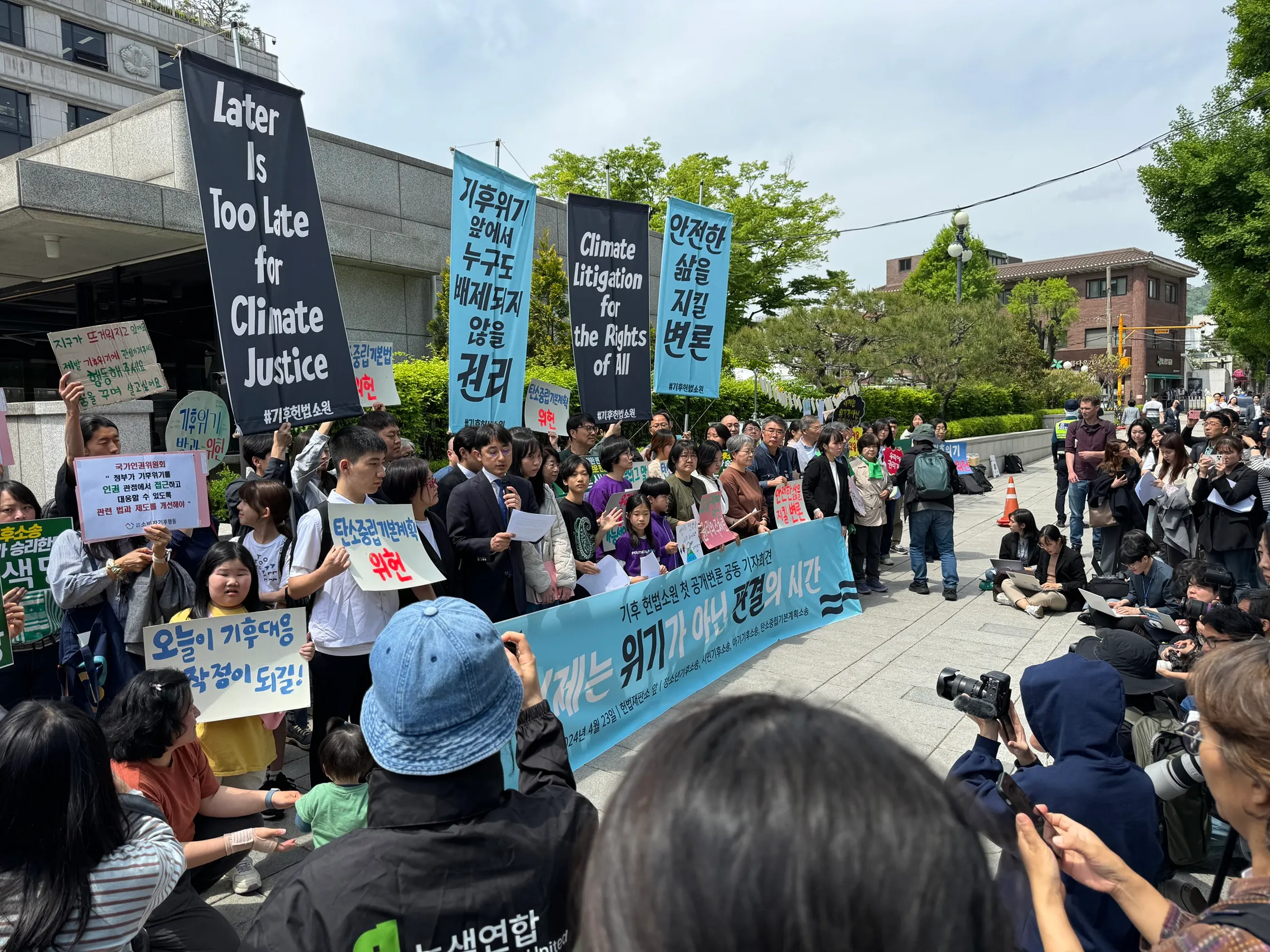
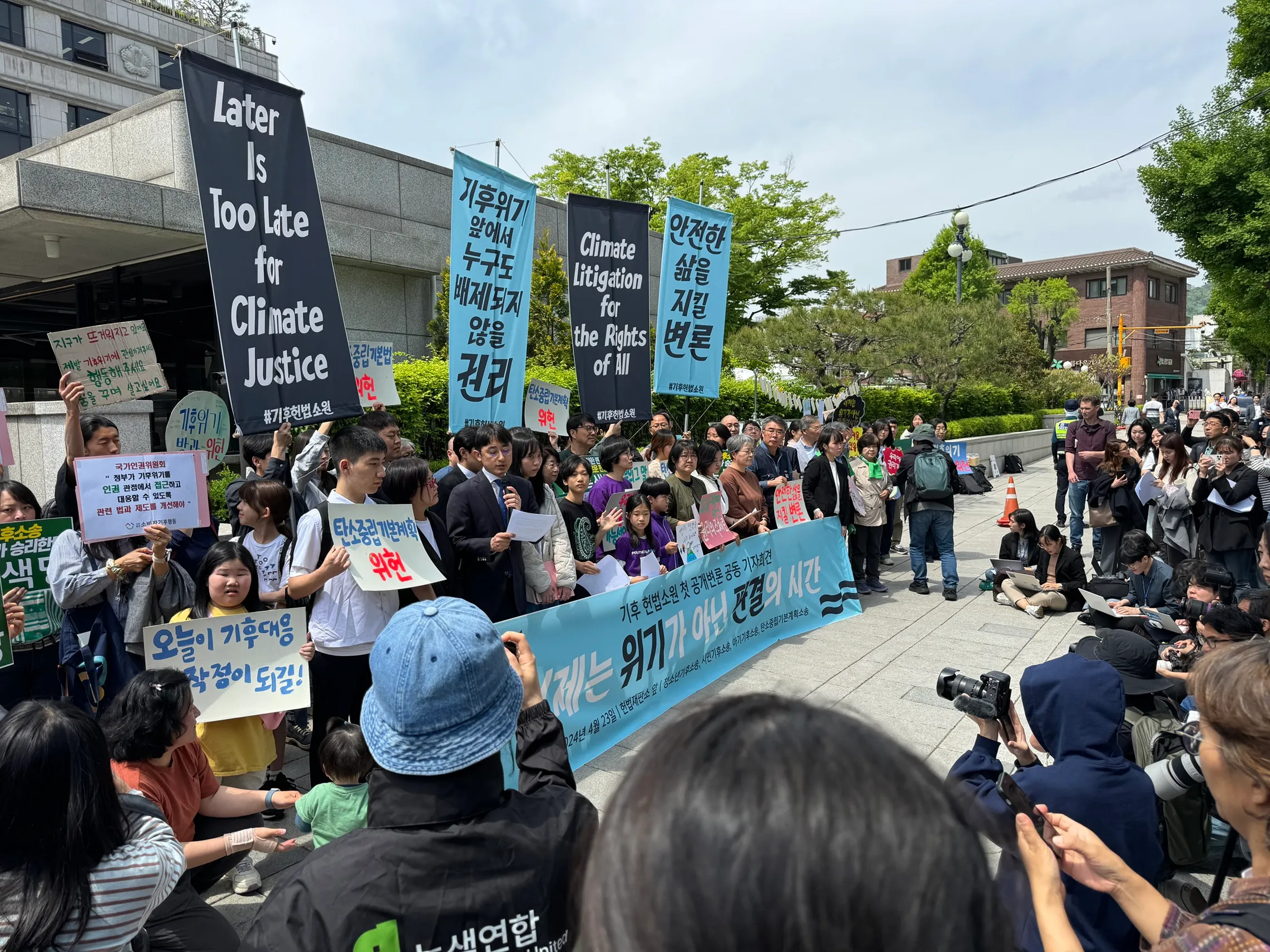
[The joint press conference for the first public hearing of the climate constitutional complaint © Solutions for Our Climate]
In the era of the climate crisis, demands containing the implementation of carbon neutrality and everyone's sustainability are also emerging clearly in the form of litigation. Courts around the world are facing lawsuits with no precedent or case law — claims that greenhouse-gas emissions have infringed on life, liberty, and property rights, or that sea-level rise has infringed on cultural rights or the right to housing. The climate problem has aspects that are unfamiliar or vast to handle within law's traditional framework. But because a challenge of the times that cannot be turned away from is dissolved within it, the majority of climate lawsuits are treated as significant not only by each country's judiciary but also in the media.
Symbolic climate lawsuits are appearing in Korea too. There was a constitutional complaint filed against the state, with young people and various citizens as complainants, arguing that the government's response to climate change was not sufficient and thus infringed on the basic rights of citizens, including future generations. In August 2024, the Constitutional Court ruled that the level of the government's climate-crisis response partly violated the Constitution. This ruling was assessed as a historic milestone in climate litigation, both in Korea and internationally.
This past August, too, a climate lawsuit that drew social interest appeared. Six farmers from across the country who grow apples, rice, tangerines, peaches, strawberries, and more filed a lawsuit for damages against the Korea Electric Power Corporation and five power-generation subsidiaries over harm caused by the climate crisis. This is greatly significant in that it is the first civil lawsuit in Korea to directly hold the corporate group with the largest greenhouse-gas emissions legally responsible for climate damage in the agricultural sector. Depending on the judiciary's judgment, it means that going forward, high-emitting companies — that is, the parties who actually contributed to the climate crisis — could directly or indirectly compensate those who suffered harm.
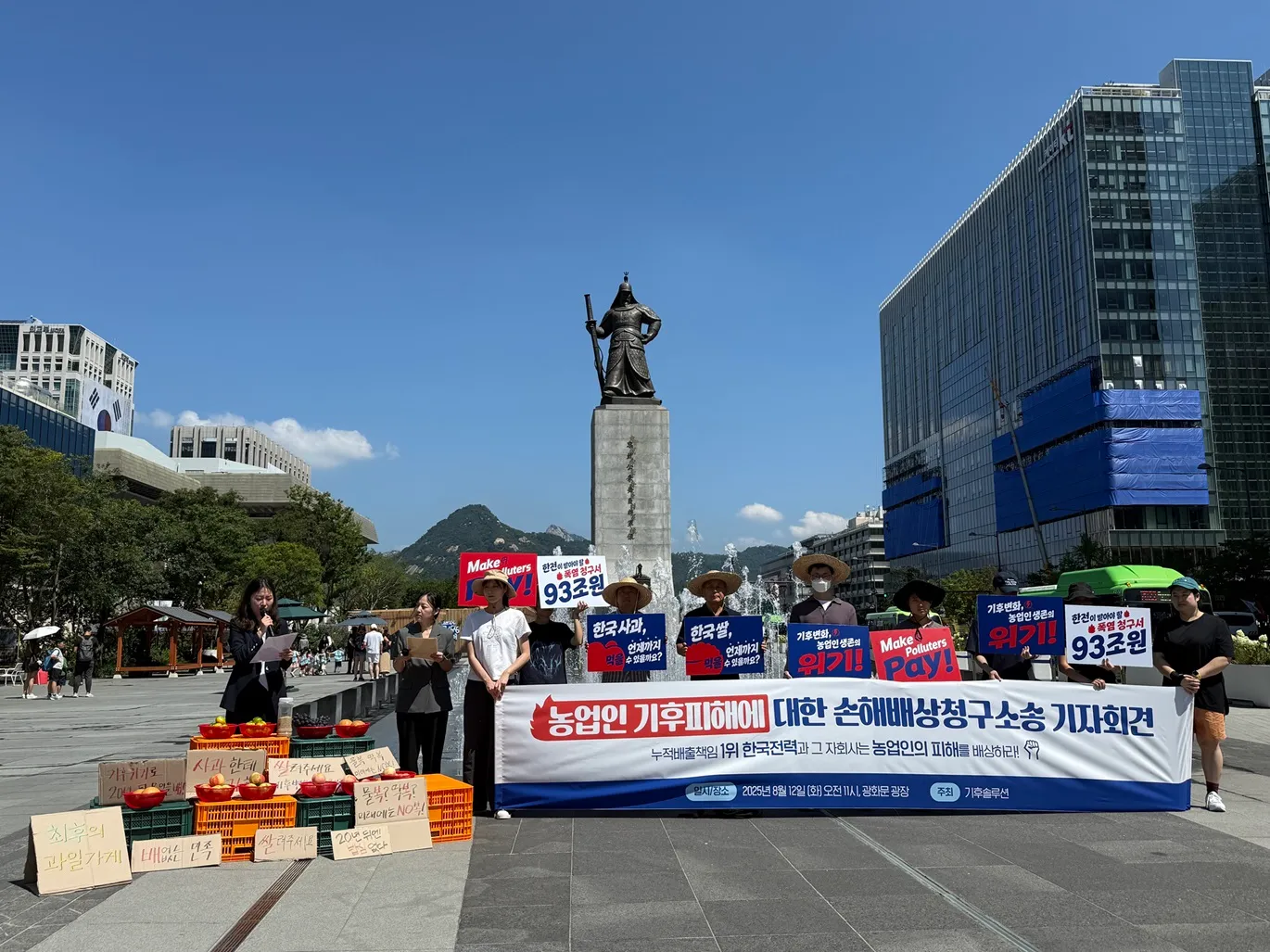
[The press conference for the farmers' climate-damage compensation lawsuit held at Gwanghwamun © Solutions for Our Climate]
The reason climate litigation is special does not lie simply in distinguishing the fault of one individual or company. Different in form though they are, climate lawsuits all converge on one question: the question of what kind of society we will move toward now. The inadequacy of the climate-crisis response, the responsibility of high-emitting companies, and the question of future generations' rights are all questions asking what kind of society we will move toward now. In that it is a verdict staking complex interests, a long-term time axis, and the fate of society as a whole, climate litigation is in itself a new narrative that can contain genre tension and emotion.
Recently, the JTBC drama "Esquire" ended amid great viewer response. At the base of each episode's case was "love" in a broad sense. PD Kim Jae-hong explained the drama as "a drama that deals with law but ultimately talks about people." In fact, climate litigation is no different. The actions of farmers and fishers who lose their livelihoods due to the climate crisis, and of young people who worry about the future, also ultimately arise from the heart of wanting to protect people and lives. If today's conflict and tomorrow's hope intersect on the stage of the courtroom, that alone can make a story with enough resonance. This time, I intend to pester the production team to deal with climate litigation. If I use as a weapon the old connection continued since university days, might I not expect a slightly different result?
By Kim Won-sang (Media Communications, Solutions for Our Climate)