
Business As Usual (BAU) refers to an estimate of the total volume of greenhouse gases projected to be emitted in the absence of deliberate measures to reduce them. For example, a 2030 BAU figure represents the total greenhouse gas emissions expected in 2030 if current trends continue without any intentional reduction efforts.
A BAU projection assumes that current policies, economic activities, energy consumption, technological levels, and environmental management practices remain unchanged — without any specific policy intervention or structural transformation. In environmental, energy, and climate change modeling, a BAU figure serves as the "baseline state" before any intervention, functioning as a reference point against which the effects of additional policies or technological innovation can be compared. It enables the forecasting of future trends in greenhouse gas emissions, resource consumption, and economic growth, and allows for the assessment of the negative impacts that would be expected in the absence of any change.
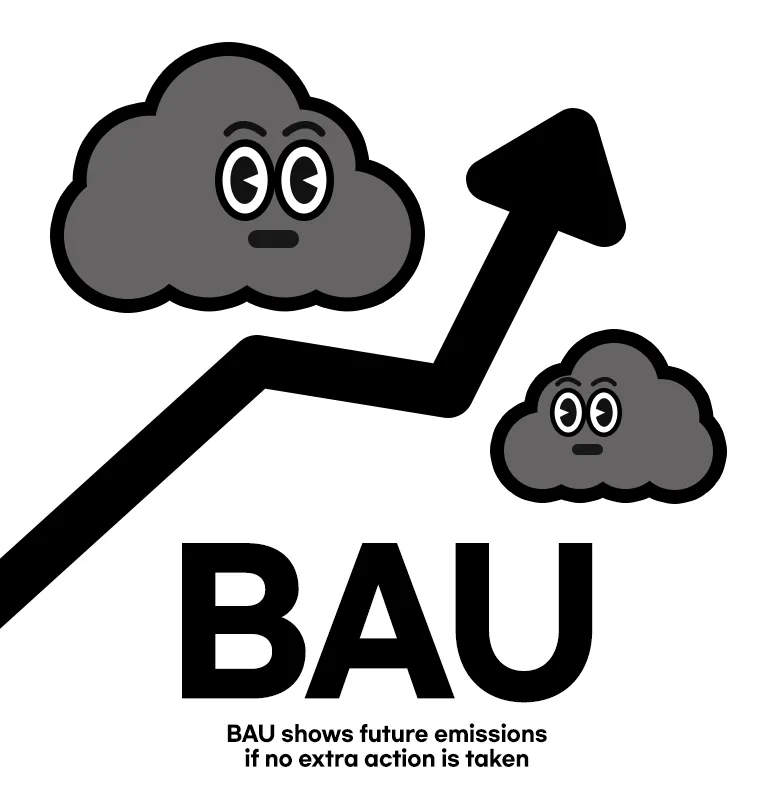
[BAU — Business As Usual (Greenhouse Gas Emission Projection) ⓒESG.ONL]
In June 2015, South Korea set a target of reducing its 2030 greenhouse gas emissions by 37% compared to the 2030 BAU projection of 850 million tonnes. The implementation plan at the time called for domestic reductions of 25.7% and international reductions of 11.3%. Following a revised 2030 Greenhouse Gas Reduction Roadmap announced in 2018, South Korea changed its 2030 target in December 2020 from a BAU-based approach to an absolute emissions reduction approach. The new target was set at a 24.4% reduction from 2017 emission levels — a move seen as adopting the internationally credible absolute quantity standard.
Although BAU projections carry greater uncertainty compared to absolute emission figures, they will continue to serve as a useful reference for anticipating future changes and identifying the need for policy responses and technological innovation.
by Editor O