
Polycrisis refers to a phenomenon in which crises of different natures — such as climate, economic, and geopolitical — occur simultaneously, creating damage greater than the sum of the individual shocks.
The concept of polycrisis was first introduced by French thinker Edgar Morin in his 1990s works Terre-Patrie (Homeland Earth) and Pour une politique de civilisation. It gained global attention in 2023 at the World Economic Forum Annual Meeting in Davos, Switzerland, when Columbia University historian Adam Tooze defined polycrisis as “a state in which shocks interact, making the whole more threatening than the sum of its parts.”
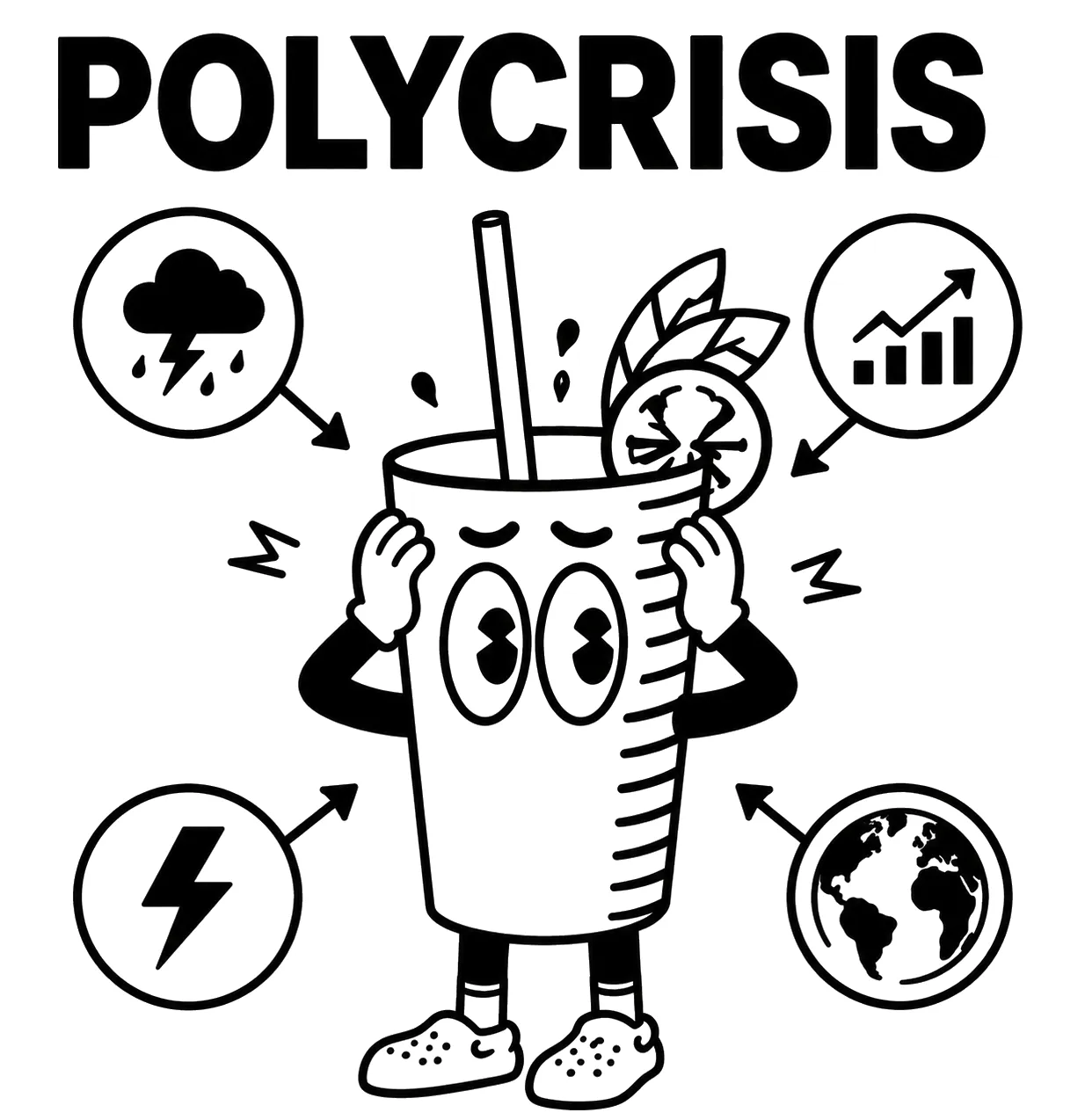
[Polycrisis(Polycrisis) © ESG.ONL/ESG Today]
The core of polycrisis lies in the chain reactions between crises. For example, when extreme weather events reduce food production and geopolitical conflicts simultaneously destabilize energy supply, inflation accelerates. Any single crisis might appear manageable in isolation, but when multiple crises converge, they generate pressures far stronger than each individual shock. According to Adam Tooze, the current polycrisis phase can be traced back to around 2008 and onward. At that time, the financial crisis, Russia’s invasion of Georgia, the collapse of the WTO Doha Round, and the failure of the Copenhagen climate negotiations unfolded simultaneously, laying the foundation for today’s polycrisis.
In the past, issues such as carbon emissions or occupational accidents could be managed individually. However, in a polycrisis environment, climate risks lead to supply chain disruptions, which in turn trigger social conflicts and financial losses. As a result, demands are growing for companies to identify and disclose the entire process. Accordingly, corporate resilience — the ability to absorb shocks and recover quickly — is emerging as a new criterion in ESG evaluation.
by Editor O