
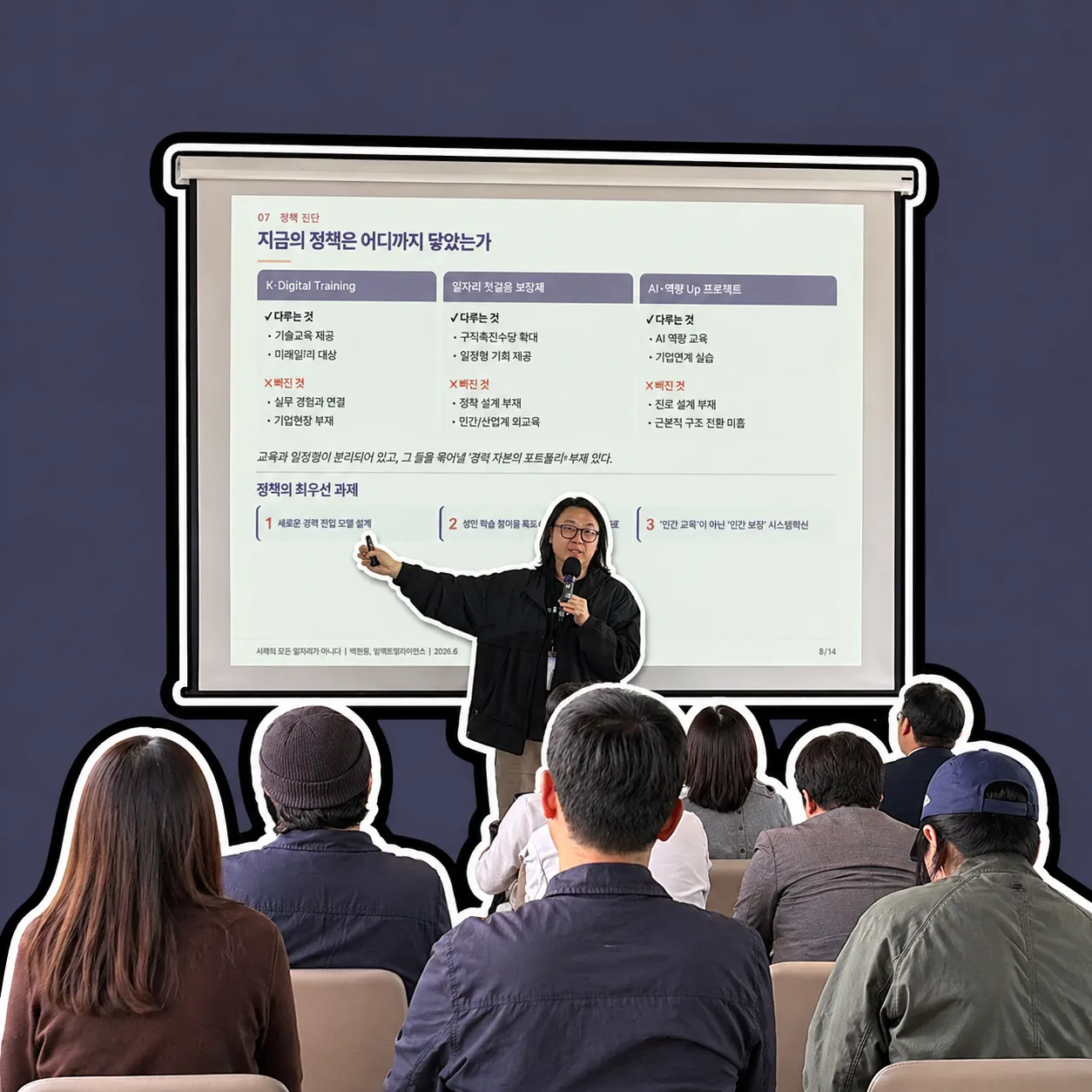
The discussion that AI Transformation (AX) replaces jobs is no longer unfamiliar. The ‘AI Basic Society Action Seminar,’ held on April 23 at Seongsu Heyground hosted by the Underdogs Impact Alliance, went a step further. At the seminar, the conversation centered on who is being left behind in this transition and whether the newly opening jobs are genuinely open to everyone.
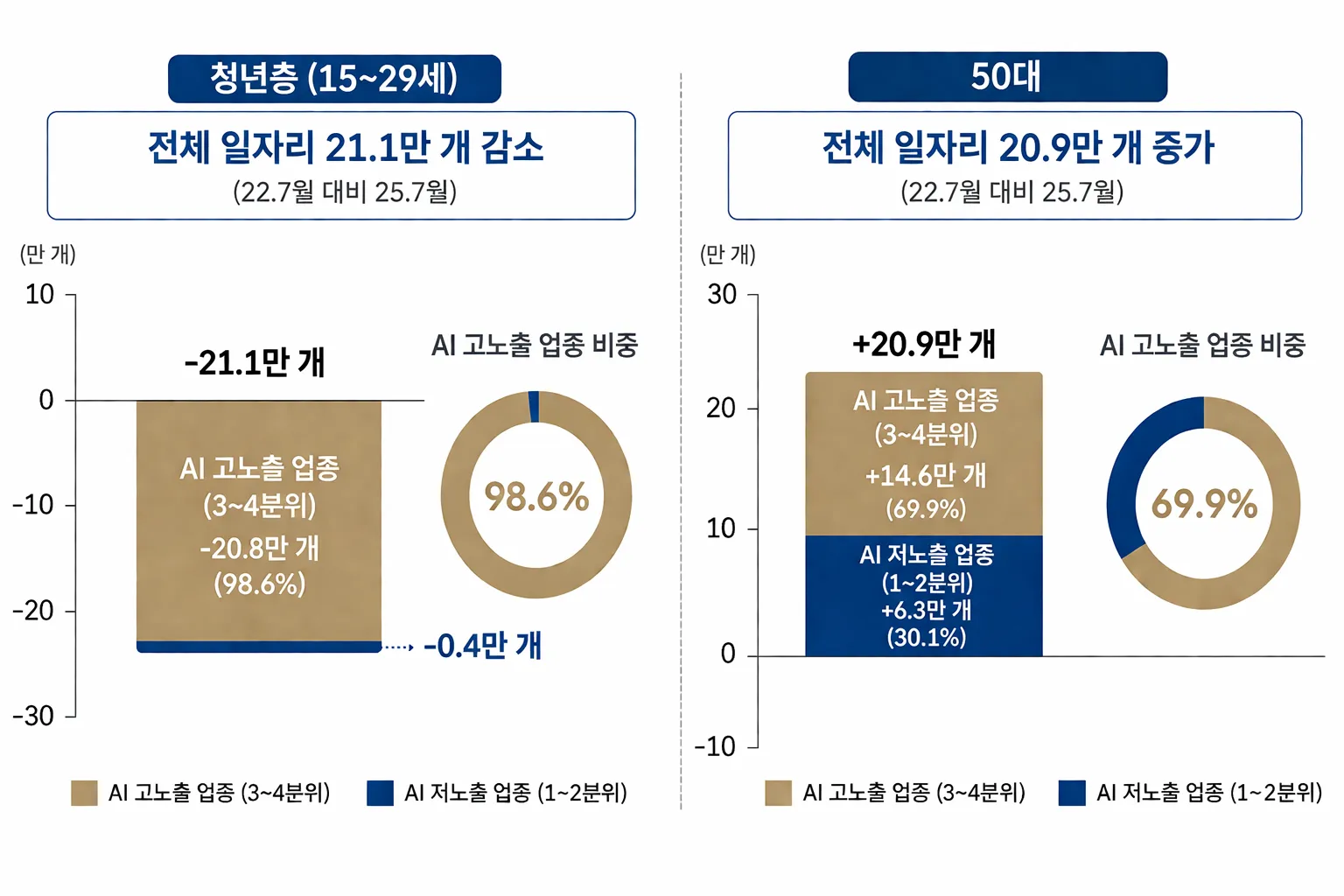
[Bank of Korea analysis data © Based on Bank of Korea data/ChatGPT]
According to Bank of Korea analysis, from July 2022 to July 2025, youth jobs in their 20s and 30s decreased by 211,000, while jobs for those in their 50s increased by 209,000 during the same period. A striking 98.6% of the decline was concentrated in industries with high AI exposure. It was not that the total volume of jobs had vanished, but that a generational shift had occurred. In a Stanford University seminar this past January, Harvard Economics Department graduate students Hosseini and Reitinger presented the results of an analysis of resume data for 62 million workers across 620,000 U.S. companies. They found it significant that the jobs AI is replacing first are not low-difficulty ‘easy work’ but rather ‘junior work.’ Tasks considered junior work — such as standardized document editing, information retrieval, and entry-level coding — are not simply easy tasks. They are the process through which new hires first learn the organization, make mistakes, receive feedback from senior colleagues, and build their professional instincts. That process is quietly disappearing.
What the AI Basic Society Asks
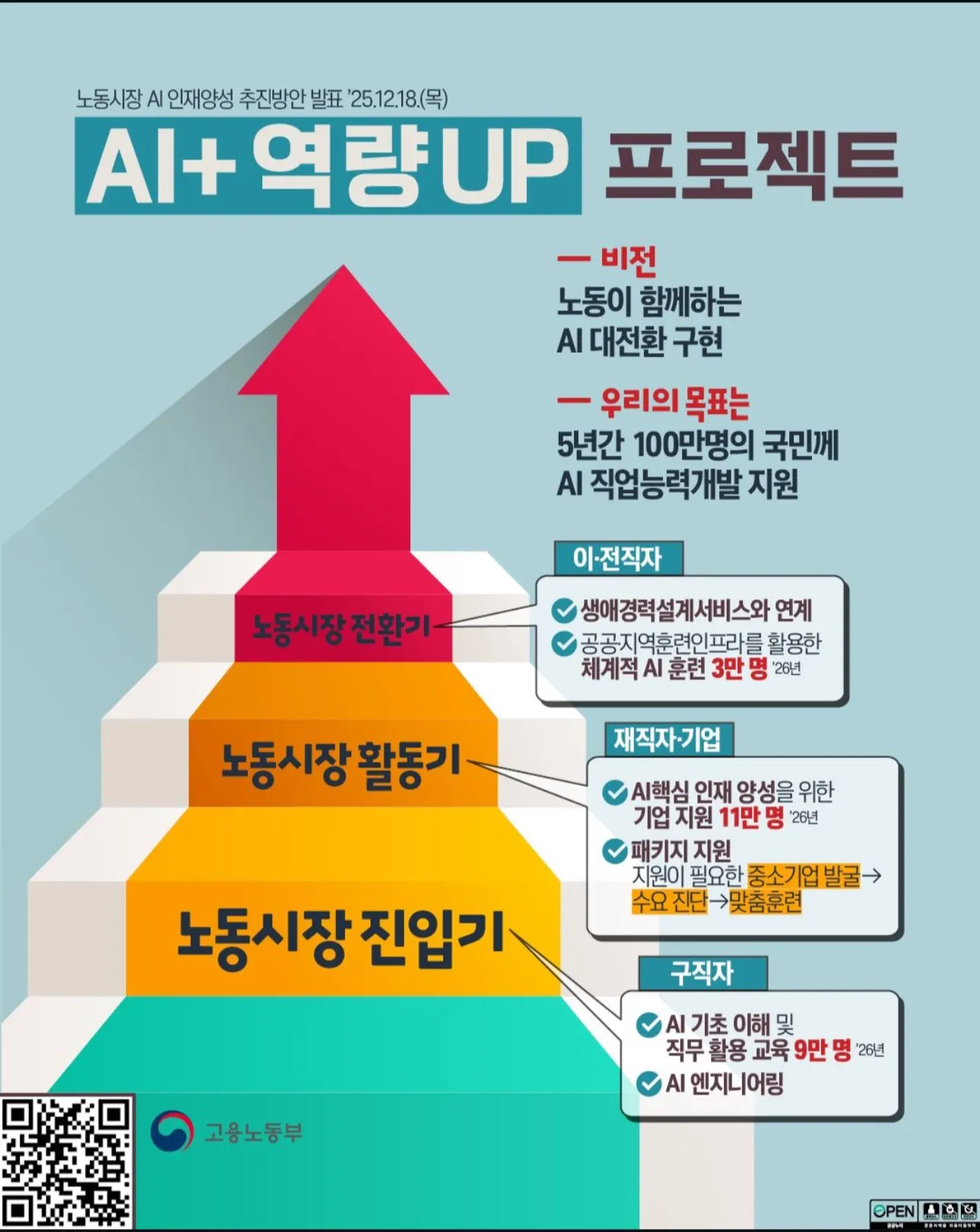
[AI+ Skill Up Project ©Ministry of Employment and Labor Instagram]
The ‘AI Basic Society’ promoted by the government is a vision of making AI a public infrastructure for all citizens, not just a tool for some experts. The Ministry of Employment and Labor plans to support the AI vocational skills development of one million people in the labor market over the next five years, and to invest a total of KRW 254 billion in 2026 to train approximately 240,000 AI personnel. This spans the entire life cycle, from jobseekers to current employees to career changers. At the seminar, shortcomings regarding this policy were aired. It was noted that while current policies reach the point of connecting education provision to work experience, what comes after is left to individuals. Programs are multiplying without a designed connection from internships — where career capital actually accumulates — to employment, and from employment to growth.
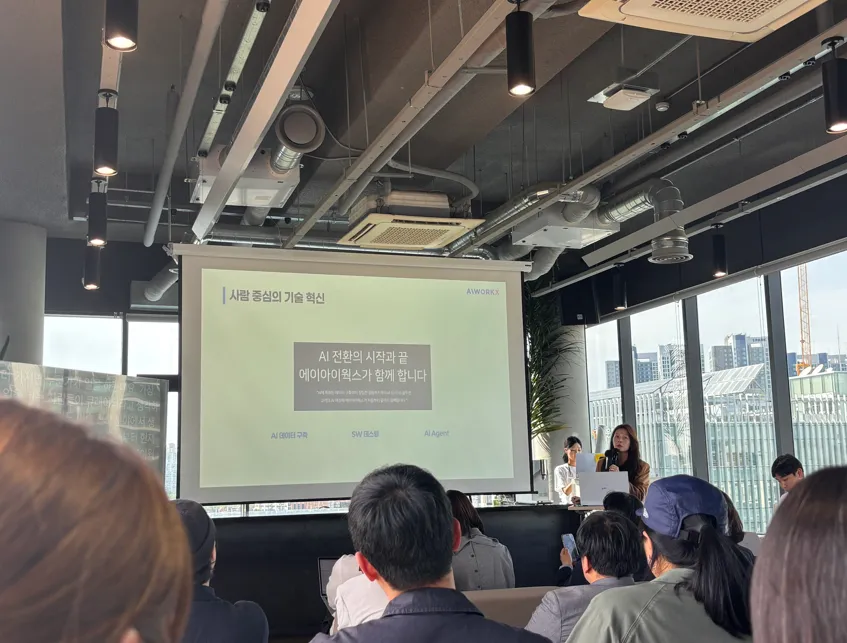
[AI Works Curator Lee Hye-min speaking on ‘Inclusive AX Job Creation for Vulnerable Groups’ © ESG.ONL]
Nevertheless, there are already parts that are working on the ground. AI Works is implementing a roadmap that transforms the job functions of workers with disabilities — who had mainly handled simple repetitive tasks — through the stages of AX education, intellectual property creation, and revenue model proliferation. It is an example of redefining the automation of repetitive tasks not as a threat but as a catalyst for transition. At regional youth startup sites, AI agents have begun to supply resources that previously did not exist. In environments with no developers, no designers, and no mentors, AI is taking over coding, marketing, and market research, and a change is emerging in which the execution capability gap between the capital region and local areas is narrowing.
Models That Must Be Built on the Ground
However, for such experiments to become the standard rather than the exception, the role of companies must change. The AI utilization rate stands at 49.2% for large enterprises versus 4.2% for SMEs — a twelvefold difference. Given that 89.1% of all workers in South Korea are employed by SMEs, this gap is effectively a gap in overall productivity. This is why it is critical for companies to open their AI infrastructure and training programs to SMEs and local communities.
Social jobs in the AX era are not a substitute for low-value-added jobs. They are jobs that bridge the technology gap, maintain services in which human interaction is key, and support the transition of vulnerable groups. The OECD has analyzed that social economy organizations can serve as a ‘buffer zone’ for the employment of vulnerable groups during the AI transition. What must be designed now is not the total volume of jobs, but pathways through which people can grow. For the AI Basic Society to become a society for everyone, those pathways must not be open only to certain groups.
by Editor N