

The Ministry of Environment has been expanded and reorganized into the ‘Ministry of Climate, Energy and Environment.’ The establishment of the ‘Ministry of Climate and Energy’ (hereinafter the Climate Ministry), one of the key presidential campaign pledges of President Lee Jae-myung, was decided in the form of transferring the energy policy of the Ministry of Trade, Industry and Energy (hereinafter the Industry Ministry) to the Ministry of Environment. At the launch ceremony held on October 1, Minister Kim Sung-hwan, in his inaugural address that opened with the severity of the climate crisis, expressed his ambition to achieve a ‘great transformation into a decarbonized green civilization centered on renewable energy’ rather than fossil fuels, creating a sustainable future.
The newly launched Ministry of Climate, Energy and Environment is receiving both expectations and concerns. Various voices are heard, from the prospect that effective climate crisis response will become possible to the problems anticipated in the transfer of energy policy. Let us examine the expectations and concerns regarding the Climate Ministry in more detail.

[Ministry of Climate, Energy and Environment Ⓟ Ministry of Climate, Energy and Environment]
What Has Changed from the Ministry of Environment
The Climate Ministry is a department that combines the climate policy coordination function of the Ministry of Environment with the energy function. While the Ministry of Environment had a structure of one Vice Minister and three offices, the Climate Ministry was reorganized into a structure of two Vice Ministers and four offices, having transferred most of the functions of the Energy Policy Office under the Second Vice Minister of the Industry Ministry. The Resource Industry Policy Bureau, which handles resource security and oil, gas, and coal-related affairs, remains under the jurisdiction of the Industry Ministry, while the Climate Ministry manages renewable energy and nuclear power, which are classified as ‘carbon-free power sources.’ However, nuclear power export affairs remain with the Industry Ministry, while the Climate Ministry is responsible for nuclear power construction and operation. Meanwhile, the Ministry of Trade, Industry and Energy was renamed the Ministry of Trade and Industry.
To summarize, the Climate Ministry now oversees carbon neutrality, renewable energy expansion, and power supply and demand coordination, on top of the existing functions of ecological conservation, pollution management, and environmental regulation. In addition, the Climate Response Fund and the Green Climate Fund, which were under the jurisdiction of the Ministry of Economy and Finance, have been transferred to the Climate Ministry, enabling it to design the entire process of climate crisis response and execute budgets.
Why the Ministry of Climate, Energy and Environment Is Needed Now
In the first half of this year, global renewable energy generation surpassed coal-fired generation for the first time. While many countries are increasing their renewable energy generation, South Korea’s share of renewable energy generation stood at 10.5% as of 2024, still at the lowest level among OECD countries. The Nationally Determined Contribution is at a low level compared to advanced countries, but even this is expected to be difficult to achieve, and in the Climate Change Performance Index, it ranked 63rd among 67 countries.
One of the causes cited is the gap between the ministry in charge of climate crisis response affairs and the ministries responsible for greenhouse gas emission sectors. The Industry Ministry manages the energy sources that account for 76.2% of greenhouse gas emissions, but given the nature of the ministry, it is difficult to prioritize carbon neutrality, while the Ministry of Environment, which responds to the climate crisis, cannot control other ministries. A clear example is the case in which the Ministry of Environment and the Carbon Neutrality and Green Growth Commission requested the Industry Ministry to increase the proportion of new and renewable energy in the 10th and 11th Basic Plans for Electricity Supply and Demand, but the Industry Ministry repeatedly refused.
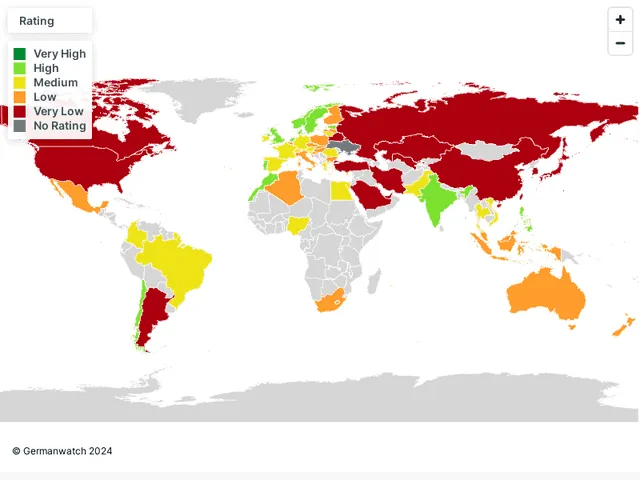
[Climate Change Performance Index (CCPI) Ⓟ CCPI]
As the climate crisis worsened, energy demand continued to increase due to the AI industry and other factors, and concerns emerged that the delayed transition to renewable energy would also affect industrial competitiveness. Accordingly, President Lee Jae-myung had shown his will to solve the problem by putting forward the pledge to ‘establish the Ministry of Climate and Energy’ since his time as a candidate. The process was not smooth. Various reorganization proposals were put forward regarding the form of the new ministry — such as newly establishing the Ministry of Climate and Energy, transferring the energy sector to the Ministry of Environment, or transferring the climate sector of the Ministry of Environment to the Industry Ministry — and debate continued as the process faced difficulties. While many sympathized with the need for the Ministry of Climate and Energy, social discussion continues even on the finalized form.
Cases of Integrating Government Ministries for Climate, Environment, and Energy
We were not alone in carrying these concerns. Among OECD countries, 15 have established ministries that integrate climate, environment, and energy, 3 have integrated climate and energy, and 20 operate them separately. The new government’s ‘Industrial Policy Promotion System and Government Reorganization Plan,’ announced last May, stated that four countries that newly established ministries in which energy and climate policy are integrated, like the current Climate Ministry, showed results in which the greenhouse gas emission reduction rate increased from an average of 5% to 18% in the five years before and after the establishment of such ministries.
Denmark, a representative success case of establishing a Ministry of Climate and Energy, established the ministry in 2007 and supplied 50% of its total power generation from wind by 2020. It developed the industry by consolidating wind power generation permits into a single window to reduce procedures and proceeded toward carbon neutrality. Germany, cited as a failure case, launched the Ministry for Economic Affairs and Climate Action in 2021, integrating the climate policies of the Federal Ministry for Economic Affairs and Energy and the Ministry for the Environment, but energy costs surged and manufacturing competitiveness weakened, leading to a reversion to its pre-reorganization form. The United Kingdom, which achieved coal phase-out as the first G7 country in 2024, is mentioned as both a success and failure case. In 2008, the UK established the Department of Energy and Climate Change and achieved results, and the policy framework of that time is still maintained today. However, in 2017, this department was merged with the Department for Business, Innovation and Skills to simultaneously manage industrial and energy policy, and it was criticized for causing energy cost and security problems and weakening manufacturing due to the Russia-Ukraine war. Currently, it is again separated and operated as the Department for Energy Security and Net Zero (DESNZ).
In this way, the integration of energy- and climate-related ministries is not a finalized policy but a new attempt that must be managed to produce policy effects tailored to each country’s circumstances.
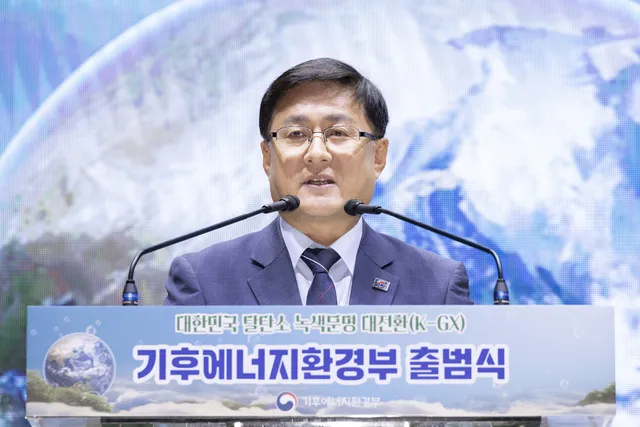
[Minister Kim Sung-hwan at the Launch Ceremony of the Ministry of Climate, Energy and Environment Ⓟ Ministry of Climate, Energy and Environment]
The Path the Climate Ministry Must Take, Beyond Concerns and Expectations
There are three major concerns shared by the ruling and opposition parties, industry, and environmental groups regarding the launched Climate Ministry. First, the Climate Ministry has been simultaneously charged with the conflicting policy objectives of ‘climate and environmental regulation’ and ‘energy industry promotion,’ and both could end up fizzling out. Second, with the Industry Ministry continuing to handle nuclear power export affairs, domestic energy industry policy and overseas nuclear power exports will be dualized, with confusion expected. Third, carbon-based power sources and carbon-free power sources are organically connected, as are electricity (generation) and gas (resources), yet dividing the managing ministries impairs policy coherence and reduces effectiveness. In addition, environmental groups are concerned that the Climate Ministry, by taking on industrial promotion functions, will see regulations weakened and is likely to focus on energy transition policy. The industry sector reacted against the recently raised NDC target of the Climate Ministry, also anticipating higher electricity costs.
While many express concerns, there is also the positive outlook that the Climate Ministry will prepare climate crisis response measures that consider greenhouse gas reduction, renewable energy expansion, and ecosystem conservation together, and that as a responsible ministry has been created, faster execution will follow. Regarding electricity costs, which many are concerned about, it is also possible to anticipate that stable operation will ultimately become possible through the decline in renewable energy unit costs and the expansion of the power grid. Immediately after its launch, the Climate Ministry’s minister visited the Taean coal-fired power plant, which is scheduled to be decommissioned, and demonstrated the will to transition to decarbonized new and renewable energy. It remains to be seen whether the Climate Ministry can, as its name suggests, become a true control tower for responding to the climate crisis at the balance point between climate and energy.
by Editor L