
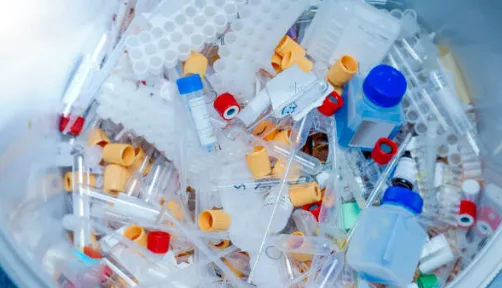
The greenhouse gases emitted by the global healthcare sector account for approximately 4.4% of net emissions. ‘Medical waste,’ which makes up roughly 5% of those emissions, refers to waste discharged from healthcare institutions and veterinary hospitals that poses a risk of infection. While this may seem like a small percentage, its environmental impact is significant.
Let us imagine visiting a hospital for a cold. After the consultation, how much disposable waste was generated? A mask, syringe and needle, the vial containing the injection solution, the bag that held the sterilized medical instruments, and alcohol swabs — the amount visible to the naked eye alone is considerable. It is also easy to imagine that countless amounts of medical waste are being generated in the unseen spaces of the hospital.
Medical Waste Treatment Through Incineration and Sterilization Shredding
South Korea’s medical waste regulations are somewhat stringent compared to other countries. In 2022, domestic medical waste generation was approximately 230,000 tons, of which 97.5% was incinerated. There are currently 13 medical waste incinerators nationwide. While not a small number, there are no incinerators in Seoul or Jeju, where the most medical institutions are concentrated, leading to significant carbon emissions and infection risks from the long-distance transportation of medical waste. Building new incinerators is also difficult due to resident opposition. Some argue that with medical waste generation decreasing to 190,000 tons as of 2024, there is now some slack in incinerator operations. However, compared to a decade ago, the volume has increased by 23%, so reducing medical waste and pursuing eco-friendly treatment remain issues requiring deliberation.
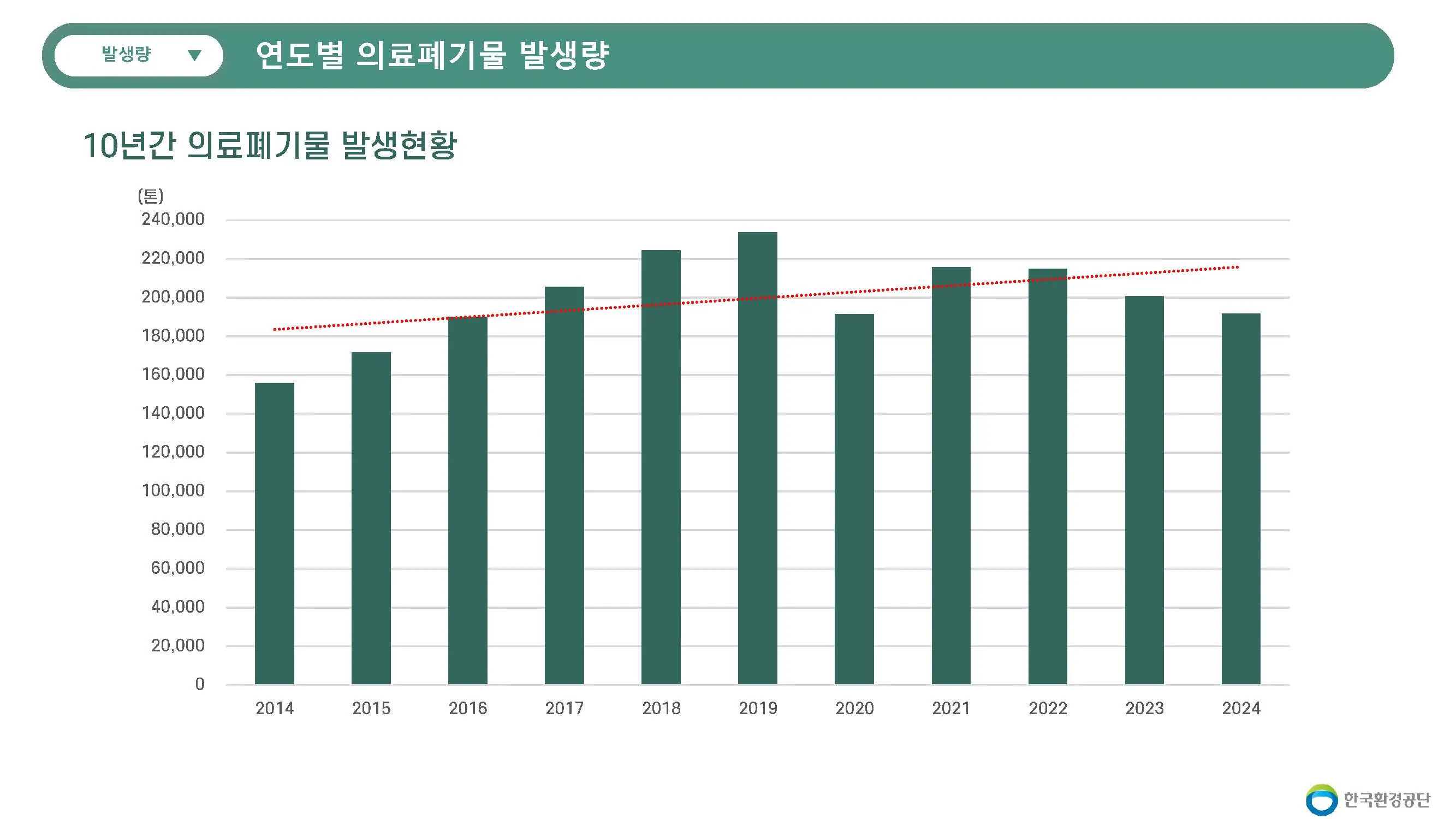
[Medical Waste Generation Trends in South Korea Over the Past 10 Years © Korea Environment Corporation]
Beyond incineration, another treatment method is sterilizing medical waste at high temperature and pressure, then shredding it and discharging it as general waste. This method can reduce greenhouse gas emissions by approximately 70% compared to incineration. Overseas, methods such as high-pressure sterilization or chemical treatment of medical waste are common. In South Korea, this method had been used at only four large hospitals, but with the recent adjustment allowing sterilization shredding facilities to be installed even at small and medium-sized hospitals, various domestic research teams and companies are actively developing related technologies.
Proper Segregation: The First Step to Reducing Medical Waste
What everyone emphasizes for reducing medical waste is proper segregation. The WHO has also highlighted segregation, noting that approximately 85% of hospital waste is non-hazardous. In 2019, the Ministry of Climate, Energy and Environment estimated that medical waste could be reduced by about 20% through proper segregation.
Domestic hospitals are undertaking various efforts to reduce medical waste, with Samsung Medical Center as a representative case. According to the 2025 Samsung Medical Center ESG Report, the hospital reduced medical waste by a remarkable 791 tons. Compiling the content shared by hospital officials at a forum and the ESG report, first, at nursing stations where nurses handle their tasks, packaging for medical supplies — which accounted for a large share — was segregated as general waste.
Additionally, upon confirming that 70–80% of the contents in medical waste bins placed at each bed were general waste, the positions of general waste bins and medical waste bins were changed. Through such simple methods, the hospital reduced the amount of medical waste generated in a short period. Furthermore, based on nurses’ input that a significant amount of recyclable medical waste or general waste is generated among operating room waste that is conventionally treated as medical waste, Samsung Medical Center is currently conducting a pilot test on the segregation of operating room medical waste.

[Samsung Medical Center © Samsung Medical Center]
From Disposable to Reusable: The Eco-Friendly Transformation of Medical Settings
Most gowns worn by doctors and nurses in operating rooms are disposable. The WHO has stated that there is no difference in safety, including infection rates, between disposable and reusable medical gowns. Reusable gowns are already widely used overseas. The University of Maryland Medical Center has been using reusable gowns since 2000, reducing medical waste by 690 tons. The domestic company SteriCare, which provides hygiene services to medical institutions, has also developed reusable gowns from new medical materials and supplies them to domestic hospitals.
Changes toward the reuse of medical devices are also underway in endoscopy rooms. The medical communities in Europe and the United States began analyzing the environmental impact of endoscopy procedures around 2020. The annual carbon emissions of gastrointestinal endoscopy units across the United States alone amount to 86,000 tons, and an average of 3 kg of medical waste is generated per bed per day. To address this, Europe has issued the ‘Green Endoscopy Guidelines,’ which refer to activities that minimize environmental pollution by reducing the medical waste, carbon emissions, and energy consumption generated during gastrointestinal endoscopy procedures.
Domestically, the Korean Society of Gastrointestinal Endoscopy has followed suit by launching a Green Endoscopy TF to reduce medical waste generated during endoscopy procedures and is running an eco-friendly endoscopy campaign. The content of the campaign includes thoroughly disinfecting and reusing the tubes used for endoscopes, and guiding Koreans — who undergo an unnecessarily high number of endoscopies — to receive only the necessary examinations appropriate to their life stage. The domestic Green Endoscopy TF aims for a strategy of pursuing sustainable endoscopy examinations through eco-friendly endoscopy.
Not all of us can be well-versed in the specialized field of medical procedures. Yet we cannot afford to lose interest, because its impact is connected to the health and lives of all of us. If we understand and welcome the efforts being made in the field, change in hospitals and policy institutions can also begin.
by Editor L