

The bustling March campus filled with students returning for a new semester has passed, and April, when cherry blossoms bloom and fall, has arrived. In this season of new beginnings, ESG Today met with members of the ‘Seoul National University Society for Sustainable Business Management (SSBM)’ — the only ESG-specialized academic society at Seoul National University — to hear about their activities and what they have learned from studying corporate ESG.

From CSR Origins to an ESG-Specialized Academic Society
Since its founding in 2006, SSBM has been analyzing corporate activities from a student’s perspective and pinpointing the current state of ESG management. SSBM’s roots lie in an academic society called ‘SNU CSR,’ which studied corporate social contribution. Entering the 2020s, as ESG emerged as a keyword across the business landscape, the scope of research broadened to encompass both CSR and ESG, and the name was changed to the current SSBM. The approximately 20 members of SSBM conduct up to 12 sessions per semester to study ESG.
The sessions conducted by SSBM are broadly divided into four stages. The first is the ‘ISSB Disclosure Session.’ Reflecting the recent trend in which ESG disclosure is being legally mandated under International Sustainability Standards Board (ISSB) standards, the disclosure session devotes two weeks to studying ISSB disclosure standards.
SSBM has built a unique position bridging academia and industry through ongoing industry-academia collaboration with major companies such as Samjong KPMG, KB Financial Group, and CJ CheilJedang. Since all of the society’s sessions are designed with the final stage — industry-academia collaboration, i.e., hands-on experience — in mind, the second session, ‘ESG Management Strategy Study,’ brings together past and current cohorts of members to create and solve ESG problems relating to management strategies by industry sector.
In the third session, key companies are selected by industry sector and ‘corporate ESG analysis reports are written.’ The reports primarily evaluate the key ESG issues of companies that have recently attracted notable attention, conducting in-depth analysis centered on corporate sustainable management policies. The final stage of the sessions is ‘industry-academia collaboration.’ After completing industry-academia collaboration — an opportunity to empirically unpack the content studied over the semester — one semester draws to a close.
In addition to these main sessions, the society’s activities also include ‘guest lectures by external speakers.’ These are occasions to hear lectures on ESG practice from company professionals and engage in Q&A; last semester, ESG experts from companies such as HD Hyundai Oilbank and ERM gave lectures.
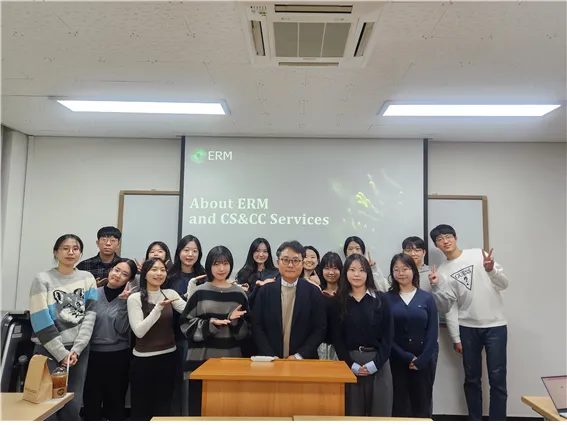
[Guest lecture by an external speaker (ERM Korea Partner Shin Eon-bin) © SSBM]
Experiencing ESG in the Field: What Industry-Academia Collaboration Has Left
For university society members, industry-academia collaboration — working alongside corporate practitioners — inevitably carries special meaning. SSBM President Moon Han-bit, who participated in the CJ CheilJedang collaboration, revealed, “Before becoming a society member, I vaguely imagined an industry-academia collaboration project as something like an internship experience. But having gone through it, what the corporate contacts actually wanted from us was the perspective of students,” acknowledging the gap between a student’s approach and a corporate approach.
Vice President Lim Jae-young, who took part in the Samjong KPMG collaboration, also noted, “It is easy to assume that ESG strategy is usually aimed at achieving a leading position within the industry, but I learned that this is not necessarily always the case.” It was a fresh discovery for the students that among companies pursuing ESG consulting, some approach ESG at the level of mere regulatory compliance, or as a means to explain ESG regulatory compliance to the board, rather than aiming to lead the industry through ESG.
Member Moon Na-young, who participated in the Sopung Ventures collaboration, said, “It was refreshing to be able to experience the startup ecosystem, the investment perspective of venture capital, and ESG approaches that are normally difficult to observe directly.” President Moon Han-bit summarized that industry-academia collaboration was a time that provided not only experience but also assistance in setting the direction of research from the perspectives of corporate management and ESG management.

[SSBM President Moon Han-bit discussing industry-academia collaboration © ESG.ONL]
Capturing the State of ESG: The Society Journal <Sustainability Review>
SSBM also publishes what it has learned through study sessions in its journal. Members of SSBM regularly publish the society journal Sustainability Review (SR). Members themselves write and edit articles on topics closely tied to ESG, such as COP30 and RE100. SR primarily covers issues that have recently drawn social attention — such as Commercial Act amendments or changes in labor issues following the introduction of AI — as well as topics that individual students find difficult to study alone. For instance, Vice President Lim Jae-young, who recently contributed an article on the European Sustainability Reporting Standards (ESRS) to SR, explained the editorial direction, saying, “While ISSB is the usual focus for disclosure standards research, with ESRS being introduced in Europe but still not applied by any domestic company, it was a difficult topic to study together with society members. That is why I took it up as a topic for SR.” He added that members also contribute to SR by developing topics covered in their various major courses.
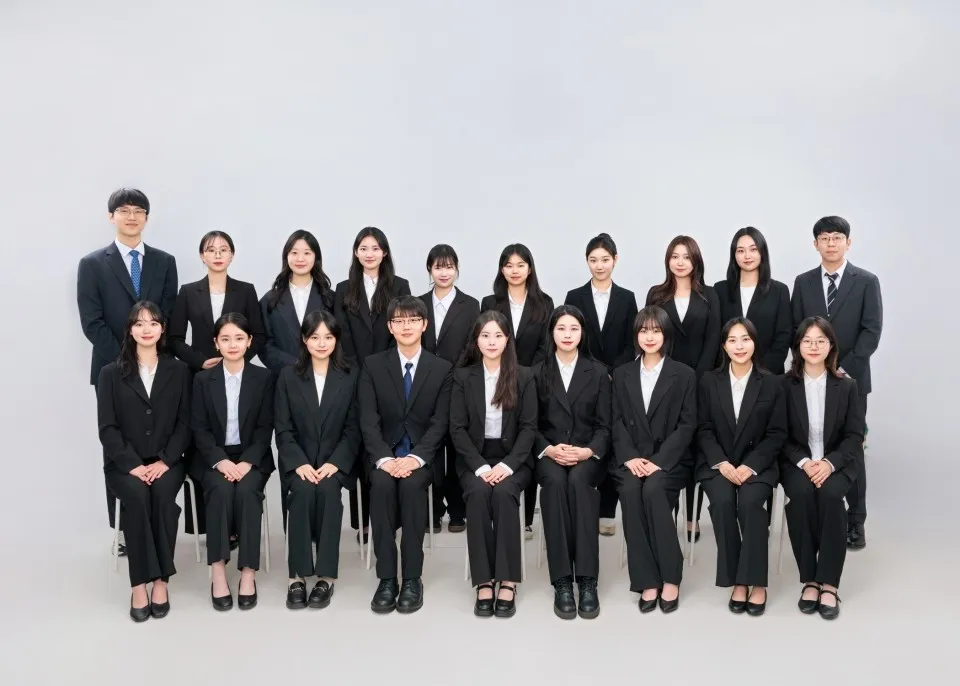
[SSBM group photo © SSBM]
Beyond Theory, Broadening Horizons
President Moon Han-bit explained the reason for participating in the society: “In university courses, the focus is on theory rather than practice, so there are inevitably limits to what one can learn. Activities at SSBM provide a great opportunity to satisfy the thirst for both theory and practice.” Considering that most society members are keenly interested in the consulting industry and the companies with which they have conducted collaborations, and that they are concretizing their career paths by expanding into those companies after industry-academia collaboration, these students are poised to grow into the talent that will create and lead ESG practice at companies in the future. Vice President Lim Jae-young added, “I came to feel that realizing ESG at the corporate site ultimately requires financial performance to back it up, and now I am accumulating financial knowledge,” explaining that society activities are simultaneously broadening career paths and horizons.
In South Korea, it is still difficult to say with confidence that ESG is perceived as a key indicator influencing corporate value. The SSBM members’ aspiration to hasten the day when ESG is regarded as being as important as financial metrics in corporate management stands not on grandiose slogans but on the practical sense honed at the sites of industry-academia collaboration and the knowledge they have meticulously built up. When the steps they are now preparing accumulate and ESG becomes the authentic language of the corporate field, how will our business environment change? The first page of that transformation is being written by today’s university students.
by Editor L