
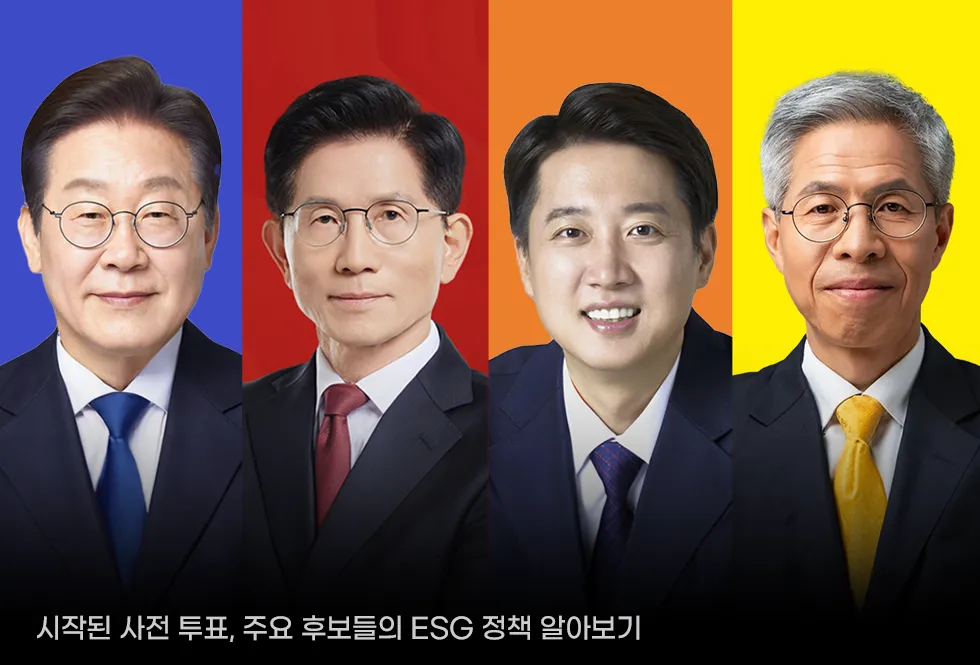
Ahead of the 21st presidential election on June 3, the candidates' policies naturally include ESG. Amid discussion of the climate crisis — now a reality before our eyes — and renewable-energy policy for carbon neutrality, interest cannot help but concentrate on the Environment-related ESG policy direction each party's major candidate holds. At this point, when making sustainability disclosure mandatory is also emerging as a key policy task, the "Korea Sustainability Investing Forum (KoSIF)" sent an "ESG·Climate·Renewable Energy Policy Questionnaire" to each party's presidential candidate and disclosed the candidates' responses on May 26.
The questionnaire consisted of asking, on 7 key policy tasks such as enacting a Framework Act on ESG, making sustainability disclosure mandatory, and reflecting climate risk by financial institutions, whether the candidate was for or against and their concrete implementation plans. Candidate Lee Jae-myung and Candidate Kwon Young-guk submitted official answers, but the camps of Kim Moon-soo and Lee Jun-seok, who had withheld a statement of position on ESG policy as a whole, did not submit answers. ESG.ONL has organized, in an easy-to-understand way, the ESG-related positions even of the candidates who did not submit answers, adding their existing statements and pledges related to climate and renewable energy.
Lee Jae-myung, Seeking to Secure a Sustainable Future Through Active ESG Policy
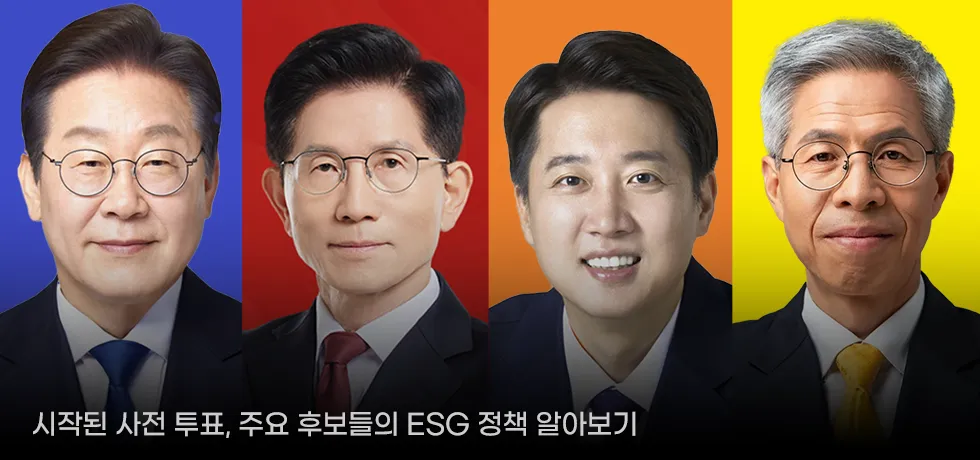
Democratic Party candidate Lee Jae-myung, together with Candidate Kwon Young-guk, expressed intent to actively pursue ESG policy. First, Candidate Lee expressed strong will to make ESG policy a key task of national innovation, and presents climate-crisis response, industrial transition, and balanced regional development as measures to add to our society's sustainability.
An eco-friendly economic transition adding corporate responsible management and Green Finance
Candidate Lee Jae-myung promised to "realize ESG information disclosure." The point is to make it mandatory for listed companies with assets of 2 trillion won or more to disclose ESG information first. Through this, he said companies would not hide their impact on society and the environment but transparently reveal it before citizens and investors, completing responsible management. He also revealed the goal of having global climate leadership by encouraging an eco-friendly transition across industry and society to build circular-economy infrastructure. Policies such as expanding "RE100 industrial complexes (industrial complexes operated on 100% renewable energy)" and introducing a "sunlight and wind pension system (a system for sharing renewable-energy generation profits with local residents)" also fit this context, aiming to make both regions and industry agents of the eco-friendly transition.
Along with a circular-economy infrastructure plan, there is also a policy to change the flow of money in the financial sector toward eco-friendliness. He is pursuing the introduction of a financed-emissions reduction indicator that has financial institutions carefully assess the risks from climate change when lending or investing, and take responsibility even for the greenhouse-gas emissions of the companies they invest in. That is, it is a strategy to accelerate the green transition of the economic sector by inducing more funds to flow to eco-friendly industries and companies. His will is also clear to strengthen the institutional foundation — enacting a Framework Act on ESG, amending the Stewardship Code (the responsible-investment principles of institutional investors), and establishing a Green Finance Corporation — so that ESG management and green finance take root as a national standard rather than a temporary trend.
An energy-network plan to strengthen global climate leadership and companies' eco-friendly competitiveness
Candidate Lee Jae-myung plans to hasten carbon neutrality by completely abolishing coal power by 2040 and expanding electric vehicles, reducing fine dust, and expanding Biodiversity protection zones. In addition, he pledged the goal of reducing greenhouse gases by 2030 and securing global climate leadership, such as by hosting "COP33 (the UN Climate Change Conference)" in Korea. It is his aspiration to have the Republic of Korea leap forward as a leading nation guiding the world in the era of the climate crisis.
There is also a policy to open the way for renewable energy by building an energy highway. It is the conception of newly installing a power grid that can send electricity produced from renewable energy such as solar and wind quickly and efficiently anywhere in the country, and a plan to create a "self-reliant energy society" structure by making a regionally self-sufficient renewable-energy system that can produce energy to be consumed directly within the region. Candidate Lee stated that he would also lead the strengthening of companies' eco-friendly competitiveness by improving the "PPA (power purchase agreement) system," in which companies sign direct contracts with renewable-energy generators.
[Comparison table of each party's answers to the ESG-policy inquiry © Korea Sustainability Investing Forum (KoSIF)]
Kim Moon-soo, an Advancement Strategy and Energy Mix Relying on the Role of Autonomy and the Market
People Power Party candidate Kim Moon-soo did not respond to the inquiry on "the climate crisis and renewable energy." However, one could confirm the candidate's thinking on policies related to the Environmental sector of ESG, such as strengthening energy infrastructure.
Candidate Kim, emphasizing the role of autonomy and the market on ESG issues, is maintaining a deferring attitude of "deciding after gathering the opinions of stakeholders once the ESG disclosure standards are announced." Candidate Kim has a strong tendency to view ESG as a supplementary means for economic growth and strengthening industrial competitiveness, and tends to raise questions about the global ESG trend — a concern over feasibility. For example, regarding "RE100," he expressed a skeptical position, saying it is a good slogan in itself but virtually impossible.
An energy mix centered on nuclear power rather than expanding renewables
To realize carbon reduction in the energy field, the candidate also revealed a plan to expand the share of nuclear power among energy supply sources to 60% — rather than expanding renewable energy — through measures such as building and commercializing six large nuclear reactors and one small modular reactor (SMR) and extending the lifespan of aging reactors. Candidate Kim's position is to further strengthen industrial competitiveness through such cheap electricity supply based on nuclear power. He did not answer about the realistic limits of nuclear power, such as the treatment of high-level spent nuclear fuel.
Lee Jun-seok, Aiming First at Education and Awareness Improvement for Climate Policy
Reform Party candidate Lee Jun-seok did not put forward an official questionnaire answer or a concrete policy roadmap on ESG policy. He did not state an official position on the "Korea Sustainability Investing Forum"'s 7 ESG policy tasks either, and the term ESG cannot be found in the presidential debates or his policy-proposal document. Instead, Candidate Lee and the Reform Party focus on industrial competitiveness, education, and awareness improvement in climate and environmental policy. The Reform Party's campaign committee emphasized that "the most important thing in solving climate and environmental problems is education and awareness improvement in which all generations can participate," presenting as a key task the strengthening of basic environmental education such as waste-separation education and climate-sensitivity education in kindergartens and elementary schools. Also, according to the perception that "climate is industrial competitiveness itself," he pointed out that insufficient "RE100" preparation could create constraints on exports, and mentioned the need for various energy-transition strategies rather than a single method such as solar or ocean power.
Proposing a gradual approach considering the burden on industry
Candidate Lee Jun-seok proposed gradual promotion, considering the burden on industry and realistic conditions from realizing the energy-transition strategy. He stated that discussion is needed on realistic burdens such as increases in industrial electricity rates in the process of implementing climate policy, and his position is to disclose related detailed policies later. Overall, he did not present concrete ESG policies, but an industry-friendly approach considering realistic burdens appears likely to be a major standard for establishing his policies.
Kwon Young-guk, Climate-Crisis Response and Transition to a Just Decarbonized Society
Democratic Labor Party candidate Kwon Young-guk is the candidate who put forward the most active and concrete position on ESG among the candidates. Candidate Kwon fully agrees with the 7 ESG policy tasks presented by the Korea Sustainability Investing Forum, and presented a concrete roadmap to also expand mandatory ESG disclosure for unlisted large corporations in 2027.
A bold energy-transition policy putting forward exact target timelines
Candidate Kwon Young-guk promised to establish a "Ministry of Climate and Energy" overseeing climate, energy, and industrial policy, and to set up a presidential "Committee for Transition to a Decarbonized Society" and a National Assembly "Climate Economy Committee." He also stated that, with the goal of achieving carbon neutrality by 2050, he would sharply raise the "Nationally Determined Contribution (NDC)" to 70% by 2035. Bold energy-transition policies putting forward target timelines are a feature of Candidate Kwon's policies — a ban on new coal-fired power plant construction in 2030, a declaration of coal phase-out in 2035, achieving a 60% share of renewable-energy generation, a ban on the sale of fossil-fuel cars from 2035, and the closure of reactors reaching their design lifespan and the halt of new reactor construction.

A climate transition encompassing even the protection of the socially disadvantaged
Candidate Kwon Young-guk presented, as his core vision, important considerations of ESG such as a just transition and the realization of climate justice. He plans to enact a "Just Transition Act" and an "Energy Welfare Act" to support the groups harmed in the energy-transition process. He also seeks to pursue the expansion of social safety nets and green-finance infrastructure together — expanding green investment equivalent to 4% of the economy each year, and strengthening the Korea Development Bank's role as a green investment bank. Candidate Kwon also advocates a nuclear phase-out, opposite to Candidate Kim Moon-soo's nuclear policy.
[21st presidential election promotional poster © National Election Commission]
Looking at each party's presidential candidate's opinions on climate and renewable-energy-related ESG policy, one can confirm that clear differences are revealed among the candidates in concrete will to implement and in direction. Regarding this, Korea Sustainability Investing Forum Secretary-General Lee Jong-oh pointed out, "The Democratic Party and the Democratic Labor Party generally revealed clear positions on major ESG policies, but it is a very regrettable point that the second-largest party in the Assembly, the People Power Party, and the Reform Party did not submit official answers." Whatever the outcome of this presidential election, we hope that, on ESG-related matters requiring bipartisan handling, policies for a sustainable society will be realized through constructive discussion and responsible legislation and implementation.

by Editor L