
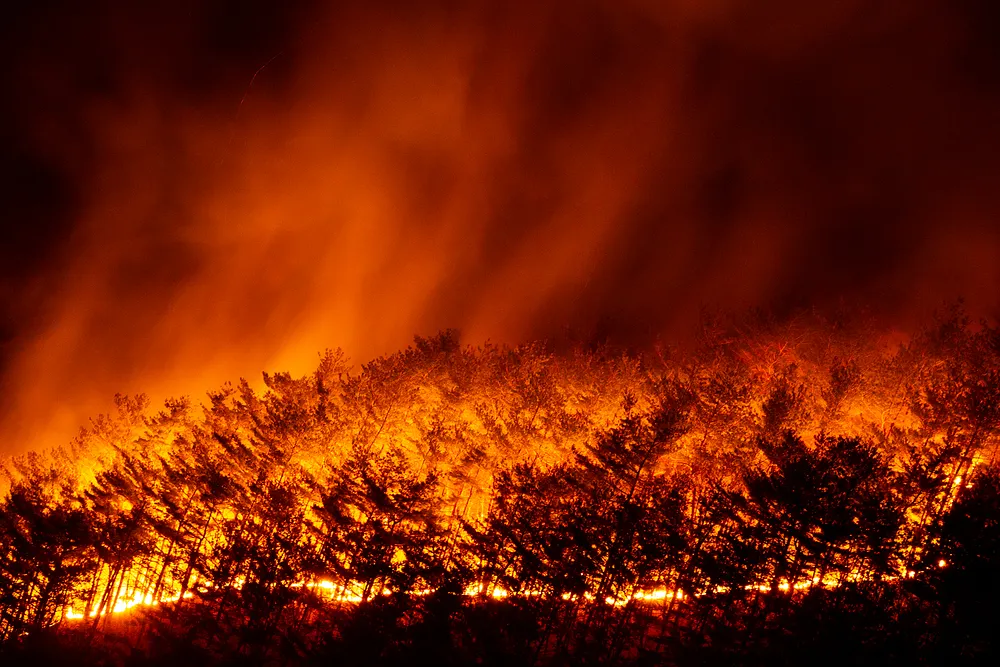
With the passing of Gyeongchip (Awakening of Insects), the air is turning to spring. News of spring festivals is coming in from all around, but the disaster authorities’ tension over wildfire risk is higher than ever. Statistics from the past 10 years show that approximately 55.5% of all wildfires occur between March and May, with March alone accounting for the highest share at around 25.4%. The scale of wildfire damage is also gradually increasing, with the proportion of large-scale wildfires exceeding 100 ha (approximately 300,000 pyeong) on the rise. What warning are spring wildfires sending us?
Why Do Wildfires Intensify in Spring?
On March 21, 2025, flames that started near Jirisan National Park in Sancheong-gun, Gyeongsangnam-do spread terrifyingly. The wildfire, which lasted over ten days, reduced 260 ha of forest in Korea’s first national park, Jirisan — an area equivalent to about 360 football pitches — to ashes. Four people lost their lives in the firefighting effort, and 57 structures including homes and temples were damaged. Indirect damage also occurred as smoke spread widely, sharply increasing fine dust concentrations in surrounding areas.
Along with wildfire damage, the region suffered another disaster. Just months after the forest was damaged, in July 2025, record-breaking torrential rains triggered successive landslides and flooding. The mountain ridges that had lost their forests to the flames could not hold the rainwater, and the soil simply washed away. The large-scale wildfire that occurred last March was an event that went beyond a mere regional disaster, showing just how powerless humans can be in the face of nature.
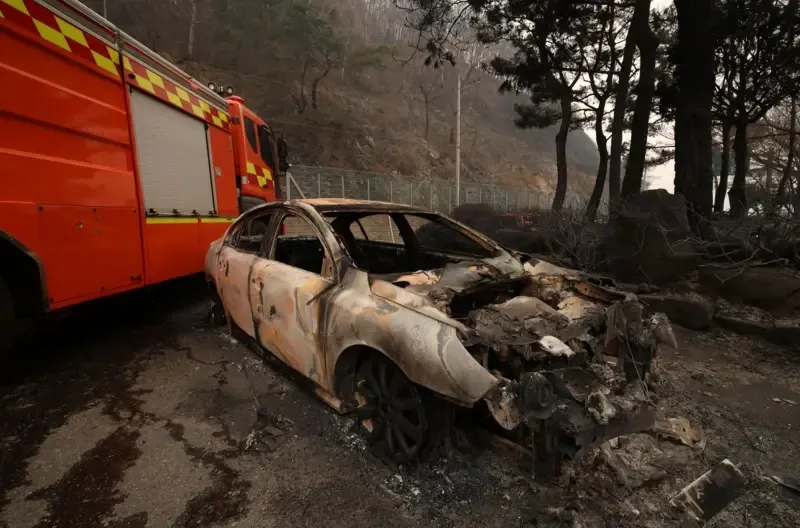
[Passenger car destroyed by the Sancheong-gun wildfire in Gyeongnam © News1]
According to Korea Forest Service statistics, among the causes of domestic wildfires, ‘accidental fires by mountain visitors’ — where hikers, grave visitors, and others who enter the mountains accidentally start fires — account for the highest proportion at about 30%. The remaining causes, such as waste incineration and the burning of rice paddy and field edges, also mostly originate from human activities. Particularly in spring, fallen leaves accumulated over the winter remain in a dry state, and with farming activities ahead of the agricultural season combining with increased numbers of hikers, the wildfire risk grows even greater.
Three factors — weather, fuel, and topography — determine how a wildfire that has started will spread. Among these, the greatest factor intensifying spring wildfires is ‘weather conditions.’ In spring, the Korean Peninsula frequently experiences a pressure pattern in which a high-pressure system sits to the south and a low-pressure system to the north. The westerly winds formed between them become even hotter and drier as they cross the Baekdudaegan mountain range. When dry air and strong winds meet, even a small spark can spread into a massive wildfire in an instant.
‘Climate Abnormalities’ Are the Main Cause of Recent Wildfires
While the direct causes of wildfires mostly begin with human carelessness, the scale and frequency of recent large-scale wildfires have reached a level that is difficult to explain simply as human error. The massive Australian wildfires known as ‘Black Summer’ continued from the fall of 2019 through the spring of 2020, leaving enormous damage. Police in New South Wales, Australia, took legal action against a total of 183 people, including 53 who violated fire prevention provisions and 47 who discarded cigarette butts or matches.
However, according to BBC reporting, fires caused by arson accounted for only about 1% of the total. The main cause was spontaneous ignition due to extreme drought. At the time, Australia was experiencing its worst prolonged drought, recording its lowest precipitation since 1965, with temperatures exceeding 40°C in some regions. Wildfires are now disasters directly linked to climate change, going beyond the dimension of forest management and prevention. Although wildfire damage continues to occur, we are still failing to address the root cause.
Post-Wildfire Forest Restoration Must Consider Ecosystem Structure and Diversity
Wildfires are not a problem that ends with extinguishment. Restoring the damaged forest remains an important task. Since the massive East Coast wildfire of 2000, South Korea has actively utilized artificial reforestation in its forest restoration process. Artificial reforestation is a method in which burned mountain areas are cleared, and fast-growing saplings such as pine trees are planted to restore the forest. However, debate over the effectiveness of this restoration method has continued in recent years.
The mountain area of Okgok-myeon, Gangneung-si, Gangwon-do, which suffered approximately 1,033 ha of damage from a 2019 wildfire, has been used as a case study site to compare artificial reforestation and natural restoration methods. When the site was surveyed six years later, in the natural restoration area, oaks had grown to a height of 4–5 meters and the forest had recovered quickly, whereas in the artificial reforestation area, planted trees had either died or showed stunted growth.
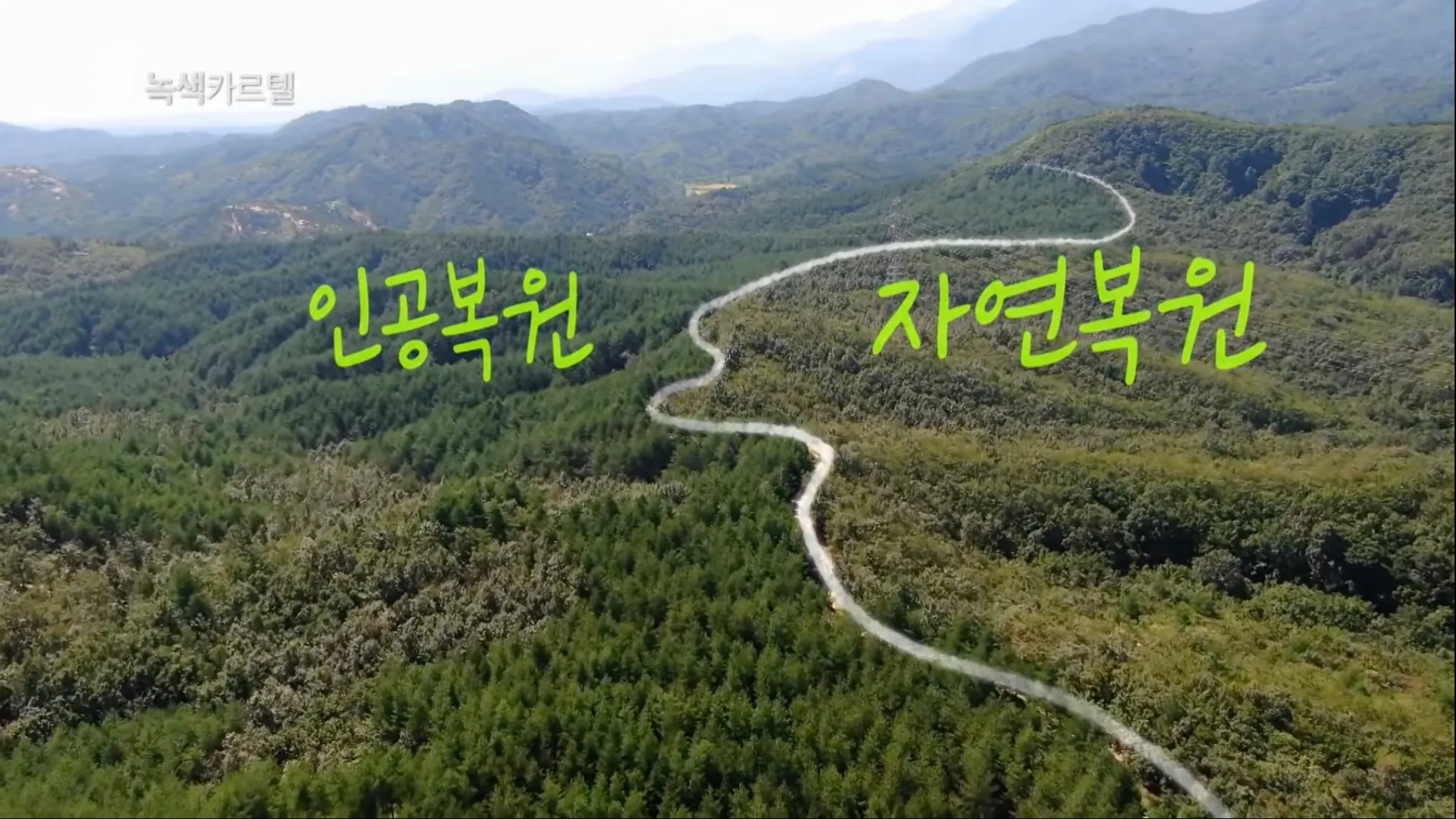
[Artificial Reforestation vs. Natural Regeneration © KBS Window Episode 444 Green Cartel]
The environmental group Green Korea United also confirmed that natural vegetation recovery was actively underway in its survey of areas damaged by the 2025 Gyeongbuk wildfire. In this way, forest restoration is a long-term task that must take into account ecosystem structure and diversity. Nevertheless, in some areas, pine-centered reforestation continues for economic reasons such as pine mushroom production. We need to reflect on whether we are pursuing short-term gains while overlooking the recovery of the forest.
Wildfires are no longer a problem of distant regions. The news of large-scale wildfires in recent years may be the starting point of the disasters that the climate crisis will bring about. Such disasters can reach beyond the stories of unfamiliar strangers in the Southern Hemisphere to come near our neighbors, our families, and ourselves.
Whether March, when spring begins, remains a season of anticipation or repeats as a memory of disaster has yet to be decided. What is clear is that wildfires make unmistakably plain the fact that a changing natural environment cannot be overcome by human strength alone. The landscape of the spring we will greet will be determined by the way we treat our forests and our response to the climate crisis.
[Related Articles]
The Climate Crisis: Fanning the Flames of a Burning House
A New Type of Disaster Created by Climate Change: The Threat of ‘Flash Droughts’