
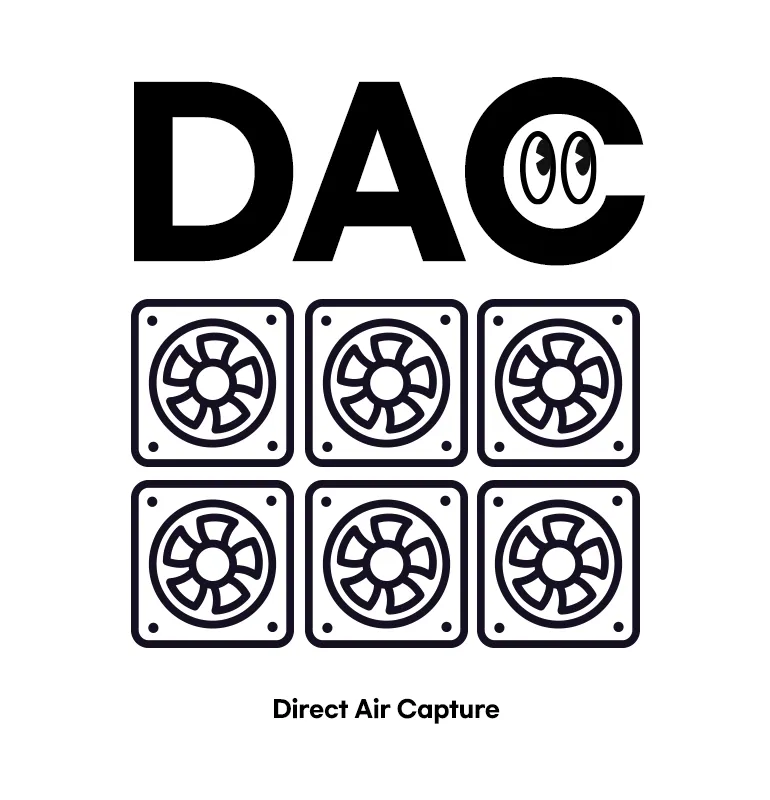
Direct Air Capture (DAC) is a technology that directly captures carbon dioxide from the atmosphere — using large fans installed outdoors to extract CO₂ from the air, much like an air purifier filters out dust.
As carbon neutrality pledges have spread worldwide, technologies for reducing carbon dioxide emissions continue to advance rapidly. Originally applied to purifying the exhaust from factory chimneys, DAC has gained popularity because — unlike that earlier application — it can be installed virtually anywhere, not just at specific facilities such as industrial smokestacks. Its ability to capture carbon dioxide even from ordinary ambient air, where CO₂ concentrations are relatively low, has further heightened interest in its potential for everyday applications.
DAC operates through two main methods. The first is filter adsorption, in which air is passed through a specially designed adsorbent filter to separate out carbon dioxide. The filtered air is then heated to 100°C, at which point the CO₂ is released for capture. A leading company using this approach is Swiss firm Climeworks, whose facility "Mammoth," built in Iceland, operates using geothermal energy for heating — making it an eco-friendly system.
The second method is chemical liquid capture. Air is passed through a potassium hydroxide (KOH) solution, which chemically absorbs the carbon dioxide. In this process, the solution must be heated to as high as 900°C to extract the CO₂. Canadian company Carbon Engineering uses this approach to produce liquid fuel.
The captured carbon dioxide has a range of applications: it is supplied to Coca-Cola's factory in Switzerland, used as a component of synthetic fuels for aircraft and automobiles, administered in greenhouses to accelerate crop growth, and even injected into the ground to form rock.
While DAC's ability to capture carbon dioxide without requiring factory chimneys has made it highly attractive, the technology faces significant cost challenges — capturing one tonne of CO₂ currently costs between USD 600 and 1,000, meaning that capturing the annual emissions of a single vehicle costs approximately KRW 600,000. Energy consumption is also a concern: a single DAC facility can consume as much electricity as an entire small city, making improvements in energy efficiency essential. With this in mind, companies in the field are focused on driving down costs to approximately USD 100 per tonne by 2030. South Korea began full-scale research and development in 2023 and is working to develop lower-cost technologies as well.
With the promise of erasing past carbon emissions and generating clean energy for the future, DAC is a technology worth staking the planet's future on. Should the industry succeed in resolving the cost and energy challenges, it holds genuine potential as a solution to the environmental crisis.
[Related Article] [Climate Tech Brand & ESG] Climeworks: Giving CO₂ a New Role]
[Related Article] [International Trends] Toward Gigaton Carbon Removal: 'Mammoth' Goes Online]
[Related Article] [ESG & Expo] Osaka Expo 2025 Opens: A Window into the Sustainable Future]
[Reference Article] Toward Gigaton Carbon Removal, "Mammoth" Begins Operation