
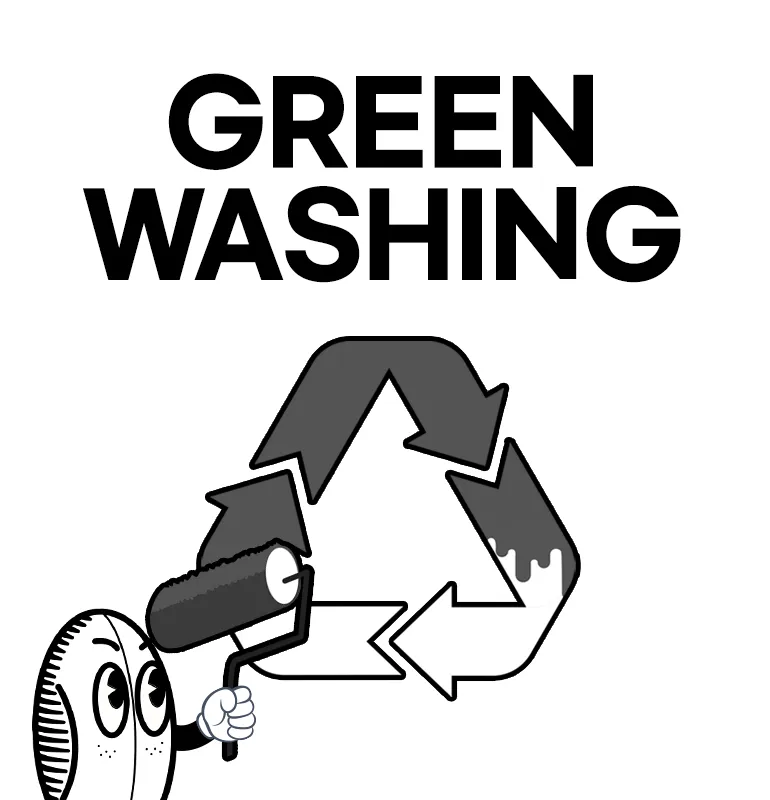
GrEenwaShing refers to the practice of "disguised Environmentalism" — in which a company falsely promotes or exaggerates an eco-friendly image to deceive consumers, without genuinely pursuing environmentally responsible management. The term is a compound of "green," meaning nature, and "washing," meaning whitewashing or deception. Even where a company genuinely aspires to environmentally positive activities, excessively inflating its claims or using imagery designed to fabricate a green image can qualify as greenwashing.
How can greenwashing be identified? A good starting point is skepticism toward the use of terms such as "eco-friendly" or "zero carbon" without specific figures or certifications to support them. The claim "contains naturally derived ingredients" can be made even if those ingredients account for as little as 0.1% of a product's composition — checking the ingredient list is therefore an effective way to assess whether a product is genuinely eco-friendly. It is also worth asking whether advertising features images of forests or animals unrelated to the product itself, or whether eco-friendly technology applied to a limited product range is being presented as if it applies across an entire lineup. Watching out for proprietary certification marks created by the company itself — rather than recognized third-party certifications — is another useful check.
The EU introduced the Green Claims Directive in 2024, prohibiting the use of vague environmental terminology and making it mandatory to substantiate claims across a product's full life cycle and to use credible certification labels. From 2026, this will be tightened further, with an outright ban on eco-friendly claims lacking scientific basis — requiring companies to cooperate in ensuring greater transparency around carbon neutrality assertions. In South Korea, companies found to have engaged in greenwashing face significant public backlash and boycott campaigns, making it all the more important for businesses to develop genuinely eco-friendly products and provide transparent information — free from any suspicion of greenwashing.
[Related Article] [International Trends] Revisiting the Greenwashing Debate Through an ESG Lens
[Related Article] [Interview] Attorney Hong Seung-pyo, Espée & Lancée: "Trump's Tariff Shock and the EU's CBAM — At the Crossroads of ESG Management"
[Related Article] [Today's ESG Keyword] Greensumer
[Related Article] [ESG & Brand] Sustainable Fashion: Our Choice for the Future