
This past April 20 was the Day of Persons with Disabilities, marking its 45th anniversary this year. From a running festival where people with and without disabilities take part together, to communication innovation using AI technology—ESG.ONL looked back on the Day of Persons with Disabilities and examined cases in which companies strove to practice "barrier-free" approaches, drawing closer to the lives of the socially vulnerable.

[Barrier-free running: participants in the 2025 Kiwoom Run ©Big Walk]
Kiwoom Securities: the "2025 Kiwoom Run," a Start of Change Running Together
At the "2025 Kiwoom Run," held on April 19 at Yeouido Hangang Park in Seoul, 2,025 runners took part and became one, running without a boundary between people with and without disabilities. The "Together Runner" system of this event—sponsored by Kiwoom Securities and organized by "Big Walk," an IT-based social enterprise that converts step counts into donation points—was special. Participants volunteered to become running mates for the mobility-impaired who face physical difficulties, and ran together. Throughout the venue, all the elements essential to being barrier-free—wheelchair transport vehicles, dedicated changing rooms, sign-language interpretation, and more—were provided, adding to participants' convenience. In particular, the visually-impaired running crew "VMK" completed the run as guide runners, proving a "running culture that excludes no one" and "in which everyone is the main character."

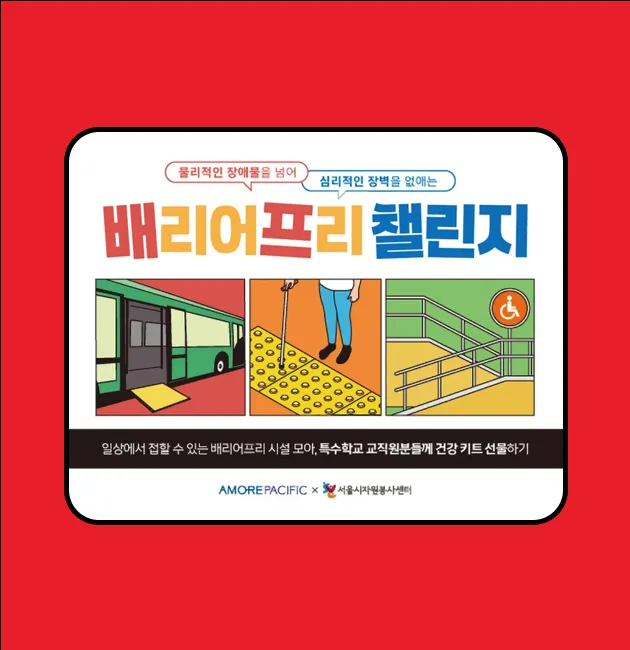
[The barrier-free experience campaign "Baep Challenge" ©Amorepacific]
Amorepacific, Which Ran the "Baep Challenge" to Experience Everyday Barriers
From March 24 to April 20, Amorepacific partnered with the Seoul Volunteer Center to run a barrier-free facility-exploration program. Through Seoul's volunteer portal "MOA," citizens verified photos of barrier-free facilities and experienced things like following a visually-impaired person's travel route and using wheelchair parking spaces, confirming the convenience and problems of facility use for users with limitations such as people with disabilities and the elderly. In addition, Amorepacific broadly spread the campaign's meaning—providing extra gifts to the top three people who discovered the most barrier-free facilities, and donating "Todak-Todak Kits," bundles of health-functional foods, to 300 teachers at special schools in Seoul.

[The barrier-free app-development contest ©Hyundai AutoEver]
Hyundai AutoEver: the "Barrier-Free App-Development Contest," Tearing Down Barriers with Technology
Hyundai AutoEver held the "Barrier-Free App-Development Contest," which has run since 2017 and entered its ninth year this year. Through the contest, Hyundai AutoEver supports the development of technology that contributes to resolving the physical and social discrimination faced by socially vulnerable groups. Through this contest—hosted by the Community Chest of Korea's Seoul branch and organized by the nonprofit corporation Green Light—a total of 66 applications have been developed so far. Representative examples include "QooZMi," which supports communication between people with developmental disabilities and their guardians, and "Susu-Banggwan," a math-problem voice-conversion app for the visually impaired. This year as well, once the final 10 teams are selected during June, they will concentrate on development from August to December, and early next year, along with the completion of the services, an outcome-sharing session and awards ceremony will be held to unveil fresh barrier-free technologies. Recruitment for this "Barrier-Free App-Development Contest" runs from April 22 to May 21, and university and graduate students can participate in teams of three.
The "barrier-free" that companies realize is built on the triangular axes of participation, experience, and technology. Kiwoom Securities' Kiwoom Run broke down physical boundaries and inspired a sense of community; Amorepacific's "Baep Challenge" broadened civil society's empathy by directly experiencing everyday barriers; and Hyundai AutoEver's app-development contest presents technological breakthroughs that solve problems in the lives of the socially vulnerable. Companies' moves show a concrete way of practicing "living together" for the continuation of our society within ESG management. Now is the time for corporate social responsibility not to stop at acknowledging "difference," but to fill that difference together and seek to pave new roads.
by Editor N