
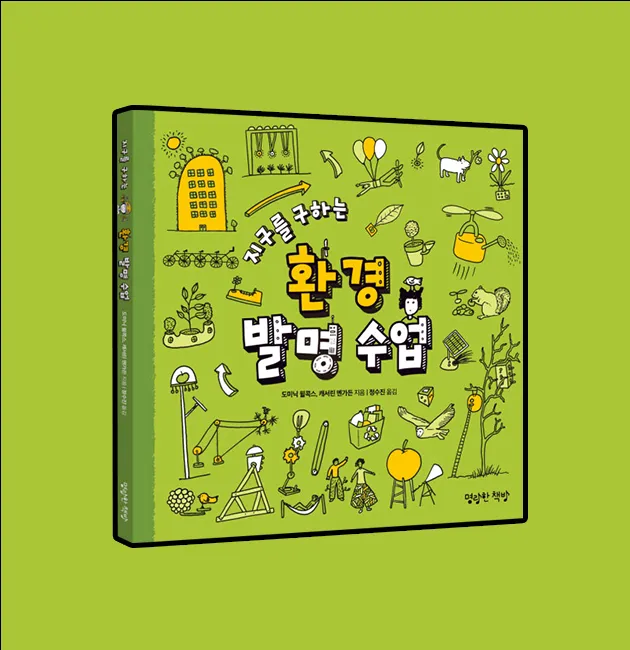
In this era of climate crisis, "An Environmental-Invention Class That Saves the Earth"—a book that helps children find fresh ideas to solve environmental problems themselves—has been published. Let us open this book, full of a special quality that makes you look forward to the next page each time you turn a leaf, with its free illustrations and photo composition designed to let readers infinitely expand their boundless imagination.
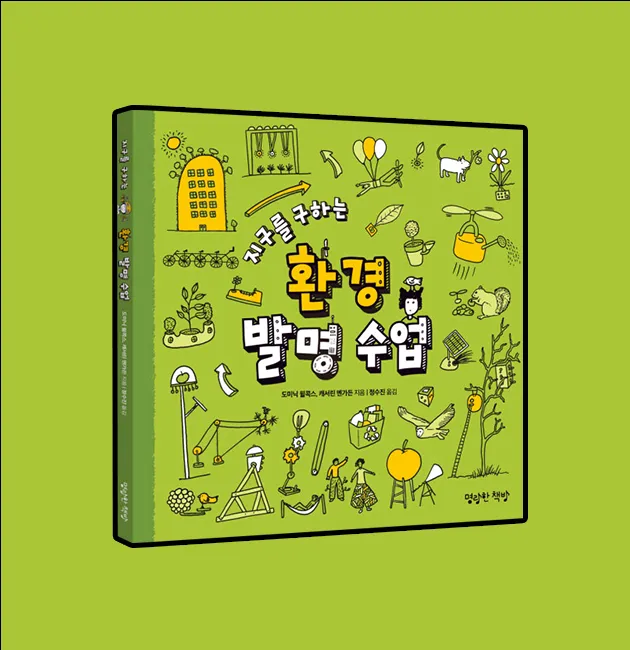
[Ideas to save the Earth are all around us ©’Myeongnanghan Chaekbang’]
"An Environmental-Invention Class That Saves the Earth"—created by Dominic Wilcox, inventor at "Little Inventors," a company that brings children's creative ideas to life, and Katherine Mengardon, its head educator—gathers the imaginings created by Little Inventors and children. As children observe and explore in everyday life blended with nature, they turn the ideas that come to them into writing, drawings, or models, add the opinions they have shared with family, friends, and schoolteachers, and submit the ideas to the Little Inventors website. Little Inventors then selects the good ideas among them, turns them into inventions, and makes them known to the world.
Showing the entire process—from conception to realization—of the ideas gathered through Little Inventors, this book places its emphasis on letting readers go beyond simply acquiring environmental knowledge to build the ability to act by pondering a sustainable future. Children's original ideas—a flowerpot that moves following the sunlight, a magic cleaner that gathers trash in the sea, an umbrella that purifies rainwater—also stimulate readers' imagination. Each environmental-invention idea is guided so that it can be examined in more detail by scanning a QR code, going beyond the page.
Examined closely, this book is designed to cultivate the creative thinking, community capacity, and ecological sensitivity that our curriculum emphasizes. Rather than for a child to read alone, it is a good book for parents, teachers, and friends to read together—pondering environmental problems from many angles and discussing the new solutions each has devised. This book kindly provides idea notes to use in such discussions, leading everyone to conceive their own invention.

[An example of the flowerpot-that-moves-following-the-sunlight invention ©’Myeongnanghan Chaekbang’]
This book has one more merit: it also presents ways to put the ideas into practice. The ideas of the child inventors introduced in this book begin from environmental problems in daily life. The children's ideas—conceiving inventions on themes such as everyday recycling, water saving, and energy reduction—make adults repent of their own lack of imagination. The story of "biomimetic invention"—exploring the ecology and ways of life of living things in nature, such as spider webs, the flapping of bees' wings, and the spreading of seeds, and creating something new by imitating nature—lets child inventors nurture great dreams.
"An Environmental-Invention Class That Saves the Earth," a convergence-education book spanning various fields such as science, environment, and art, is a book that can build a challenging spirit and confidence toward invention by leading children to come up with and develop ideas in a systematic way of thinking. As you marvel at the environmental problems and ingenious ideas seen through children's eyes, you naturally come to realize why adults must ponder a sustainable future and hand down a safe Earth to children. Let all children and adults living in this era of climate crisis read this book and recharge the strength to overcome the crisis.
by Editor N