
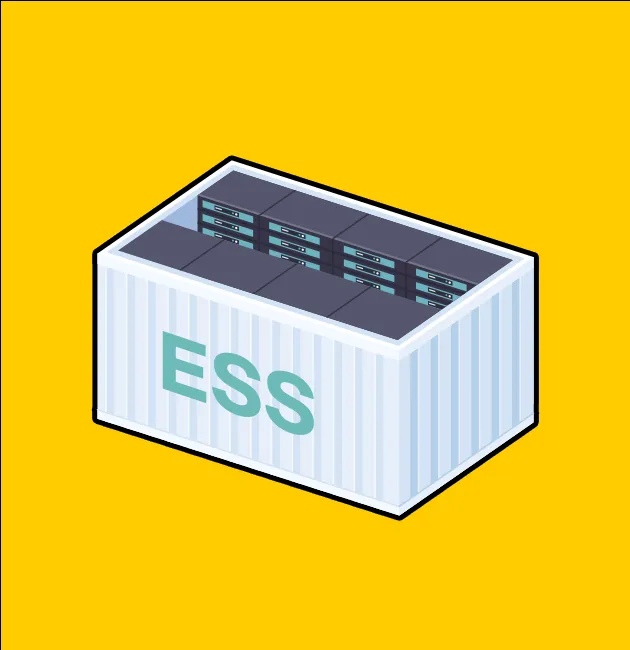
Energy obtained through sunlight and wind has the variable of being generated intermittently, so power production is irregular. For this reason, an "ESS (Energy Storage System)"—which stores the electricity produced and supplies it when needed—is necessary.

[An ESS that stores wind and solar energy ©LG Energy Solution]
Driven by government policy support, ESS saw one wave of an investment boom, but after 2017, more than 50 ESS-related fire incidents occurred domestically, and interest slowed. The causes of the fires were internal battery defects and operational problems in the charging and discharging processes. Due to the successive fire accidents, the number of ESS installations in Korea also plunged. But as a result of efforts to strengthen safety, the ESS battery market is rising again.
Companies Responding to Tariffs by Entering the U.S. ESS Market
Many of our companies are entering the U.S. market as they seek countermeasures to the tariff problem. "LG Energy Solution" recently signed a partnership with "Delta Electronics," a global energy-management company in the U.S., to supply residential ESS batteries from 2025 to 2030. LG Energy Solution has already supplied batteries to "Vistra Energy Corp.," a U.S. power-generation company that operates "Moss Landing," the world's largest ESS facility. In addition, it plans to operate—from 2025—the plants it is currently building to produce ESS batteries in states such as Arizona and Michigan.
"Hanwha Qcells," a comprehensive renewable-energy solutions company, is also in an important position in the U.S. renewable-energy market. Hanwha Qcells is currently pushing the "Atlas ESS Project," which is creating a standalone ESS complex of 4 gigawatt-hours (GWh)—the world's largest on a single-site basis—in Arizona, and it is set for completion this June. It is also carrying out a renewable-energy-supply project for the U.S. IT company "Meta," building an ESS complex in Borrego Springs, California. Such advances by our companies onto the American continent are expected to show the utility of responding to rising ESS demand within the U.S. and of reducing tariffs.
Our Companies Handling the Growing Demand of the European ESS Market
At this point, along with companies advancing into North America, companies advancing into Europe must also be examined. Europe is interested in energy issues in the aftermath of the Russia-Ukraine war. Against this backdrop, the use of renewable energy and the ESS to store it have clearly emerged as important industries. "Samsung SDI" operates a battery production facility in Hungary. On top of this, it is investing about 1 trillion won more to expand its production scale. Hungary in particular is a supply-hub region for ESS within Europe, and "SK On (formerly SK Innovation)" also operates two production facilities in Hungary. In Hungary, our companies provide high-quality ESS equipment and are meeting European market demand—expanding market share with products of guaranteed safety and efficiency.
Recently, LG Energy Solution has begun business in earnest not only in the U.S. but also in Europe. On the 24th of last month, LG Energy Solution met the good news of being selected as a major partner in a large-scale ESS project pushed by "PGE (Polish Energy Group, Poland's state-owned power corporation)." With this, our companies have become able to greatly contribute to expanding the ESS supply chain in the European market. In tandem with the trend of the expanding renewable-energy market in Europe, interest and investment in ESS are expected to continue going forward.
Strengthening Safety and Technological Innovation
That ESS plants are newly built or expanded in places such as the U.S. and Europe is welcome news, but the news that our ESS technology is evolving into advanced technology with heightened safety is also encouraging.
"LS Electric" developed an "all-in-one ESS platform" based on real-time data analysis to strengthen the safety of ESS. It monitors the state of the ESS in real time and can prevent fire accidents by detecting abnormal temperature rises or voltage and current anomalies. In particular, using AI algorithms, it optimizes the timing of charging and discharging and extends battery life, maximizing safety.
"Samsung SDI" also developed a system that directly sprays a fire-suppression agent when a fire occurs inside a battery module, immediately blocking the spread of fire, and "Hanwha Aerospace" and "SK Enmove" even developed the world's first non-flammable ESS. In Hanwha Aerospace's case in particular, it has the advantage of being usable in various industrial fields, such as ESS for marine vessels.
Because ESS is a core technology that lowers dependence on fossil fuels, it is both an essential solution for the carbon-neutral era and a core technology leading the renewable-energy era. Now the fruits of the technology-development efforts our companies have poured into the safety problem are also appearing. For the time being, we can expect to watch our country's ESS technology establish itself as an efficient energy-storage solution and be active in the global market.
by Editor N