
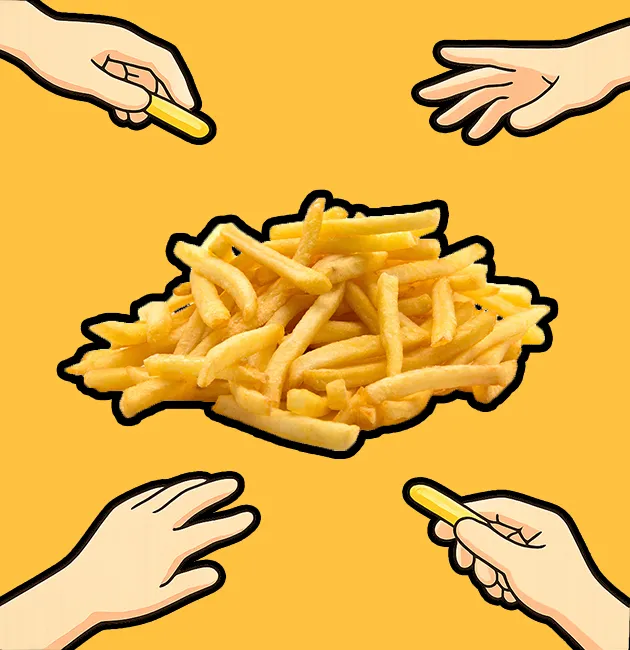
Just a few years ago, gatherings formed naturally without any special occasion. Simply because they lived in the same neighborhood, children gathered in alleyways to play, and even children a bit lacking in skills joined in under the name ‘kkakdugi’ (an informal term for a substitute player). But gatherings in this era have a different character. They must be sought intentionally, their purpose is clear, and the longevity of the relationships has shortened. Compared to the past, when gatherings took place within the fairly sturdy frameworks of blood ties, regional ties, and school ties, today’s gatherings are exceedingly loose. Even among people who do not know each other, gatherings are easily formed through the medium of trivial tastes such as ‘French fries’ or ‘running.’
We Share Only the Moment, Not Relationships
Recently, unique gatherings have been recruiting members, centered on online communities and secondhand trading apps. One such example is the so-called ‘French Fry Meetup,’ where people who have never met before voluntarily gather at a fast-food restaurant and pile up French fries like a mountain to eat together. They meet up, share French fries, and once the meal is over, they disperse without much lingering sentiment.
One-off gatherings began to gain real momentum late last year when the ‘Cops and Robbers’ game became a trend. Beyond the realm of ordinary people’s tastes, even celebrities such as singer Lee Young-ji personally participated in ‘Cops and Robbers Meetups,’ and producer Na Young-seok turned it into YouTube content. In the process, when the sign-up form for recruiting participants was made public, some 70,000 people applied in less than a day. The popularity of Cops and Robbers demonstrates the public’s high demand for light encounters and fun.
In fact, one-off gatherings are not a passing trend limited to South Korea but a global phenomenon. Overseas, a trend has taken hold under the name ‘light communities,’ in which impromptu, game-like gatherings are created through social media. People meet up once to run, or to have dinner together, consuming the experience of the moment together while shedding the burden of relationships.

[Lee Young-ji’s Cops and Robbers © Channel Fullmoon YouTube Channel]
How did one-off gatherings become a global trend? Experts point to changes in communication methods as the cause. People are increasingly trying to minimize the emotional costs involved in the process of figuring others out and building long-term trust. Rather than fitting the individual to the group, they choose a fluid approach of temporarily binding together for a specific purpose and then dispersing once the purpose is achieved. The density of relationships has decreased, but the individual’s sense of self and values have become much clearer. The long-lasting pandemic also accelerated this trend. For a generation accustomed to contactless culture, ‘on-off’ relationships that connect only when needed feel more efficient and safer. This is why the tendency to prefer one-off encounters that reduce the temporal and emotional fatigue consumed within interpersonal relationships and extract only temporary enjoyment and fresh stimulation has grown stronger.
Why We Are Still Lonely Even as Encounters Increase
Such encounters have positive effects. Gatherings based on clear common denominators, such as ‘French Fry Meetups’ or ‘running,’ are a way of efficiently forming relationships in a society of fragmented tastes, and can also serve as a channel for sharing lifestyles.

[‘Official French Fry Meetup’ Poster © Danggeun Instagram]
However, looking at the other side of the trend, loneliness lies at its base. According to an online survey of 1,000 adult men and women aged 19–59 conducted last April by market research firm Macromill Embrain, 59.2% of those in their 20s and 52.8% of those in their 30s reported feeling loneliness in their daily lives. Professor Koo Jeong-woo of Sungkyunkwan University’s Department of Sociology stated, “The desire to connect with others is the same now as it was in the past,” adding that “that yearning is erupting in forms that pursue ‘loose solidarity,’ such as Cops and Robbers games, French fry meetups, and solo-drinking bars.” In an environment where forming deep interpersonal relationships is difficult, modern people may be compensating for the deficiency through brief, light encounters under the pretext of French fries. While the convenience and efficiency of encounters can be gained through one-off gatherings, the density of relationships inevitably decreases.
The ‘Taken-for-Granted Neighbor’ We Have Lost
A year or two ago, the ‘kkakdugi play culture’ was widely discussed on social media. The reason the ‘kkakdugi culture’ — a playful way of including in our group those who were a little different from us and faced barriers to fitting in — was discussed at length is perhaps because the harmless connectedness of that era, when people related to and embraced others unconditionally, is absent from our lives today. We expected that the advancement of technology would connect us more tightly, but those connections did not necessarily lead to deeper relationships. On the contrary, the more people we meet, the more we may end up lingering in shallower relationships. The current phenomenon of being able to easily meet someone by searching for ‘gatherings’ on an app is, paradoxically, also evidence that society’s self-sustaining communities have collapsed.
One-off gatherings may soothe the loneliness of modern people for a moment, but they cannot fill the emptiness that follows a brief encounter. What we truly wanted may not have been the act of sharing French fries itself, but the existence of the ‘taken-for-granted neighbor’ whom we could run into at any time on the street corner. What is it that fast, light connections have failed to fill, and how can we recover it?
by Editor N