
The "2025 Osaka-Kansai Expo (EXPO, world exposition)" began its six-month journey on April 13. The theme of this Expo, held again 55 years after Japan hosted its first Expo in Osaka in 1970, is "Designing Future Society for Our Lives."
[The official logo of the Osaka-Kansai Expo © Japan Association for the 2025 World Exposition]
A noteworthy point this time is that the Osaka-Kansai Expo aims to contribute to achieving the UN SDGs (Sustainable Development Goals). As an Expo held in 2025, five years before 2030, the SDGs achievement target set by the UN, this event seeks to become a platform that can accelerate the pace of achieving the UN SDGs. At this Expo, where you can see at a glance the latest technology and culture of the 158 participating countries, various exhibitions on a "sustainable future" have also been prepared for this goal. Let us look at the major Expo pavilions selected by ESG.ONL — including Korea and the host country Japan.
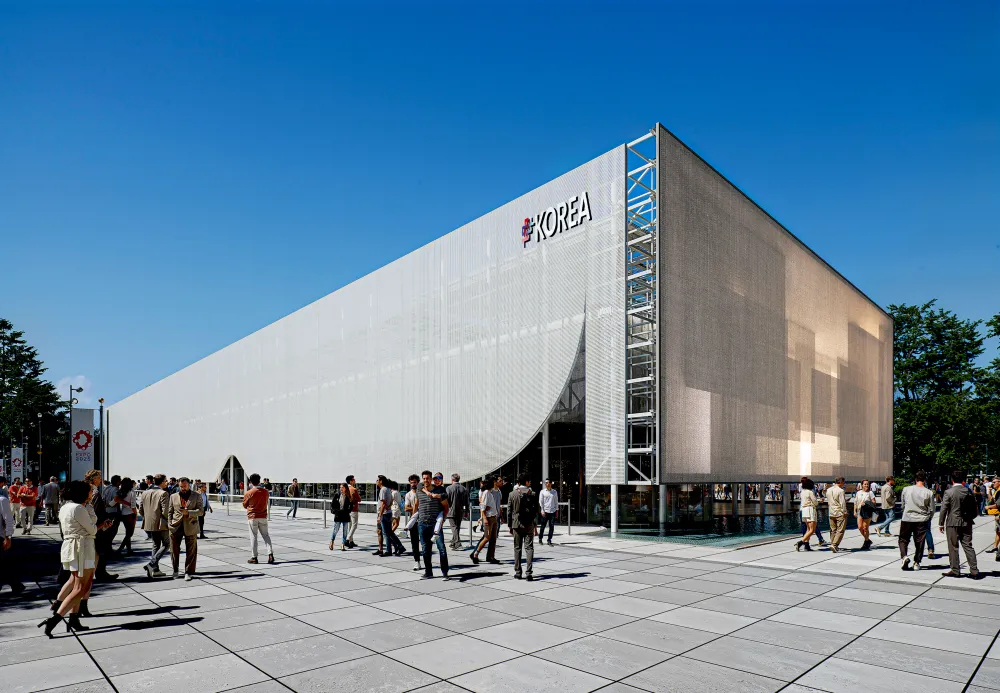
[A view of the Korea Pavilion © Korea Trade-Investment Promotion Agency]
The Korea Pavilion, a Popular Pavilion Drawing Attention for Scale and Content
The Korea Pavilion, talked about for its overwhelming super-large LED — 27 meters wide and 10 meters high — consists of three exhibition halls containing the connection of tradition and modernity, people and technology, and Korea and the world, under the theme "With Hearts." The Korea Pavilion, buoyed by interest in K-culture, is counted as a popular pavilion within the Expo; it contains a visual experience through which one can feel the latest digital-media technology and storytelling that makes one reflect on the relationship and recovery between the environment and humans. Its content includes the regeneration of nature blooming from concrete, a symbol of industrialization; a new eco-environmental system utilizing hydrogen fuel cells; and a participatory exhibition experiencing the communion between humans and the environment using breath sensors. At the Korea Pavilion, one can confirm, in dynamic content, the ESG messages we should know amid cutting-edge technologies such as AI and new and renewable energy. The Korean restaurants that can be experienced only at the Korea Pavilion are a bonus.
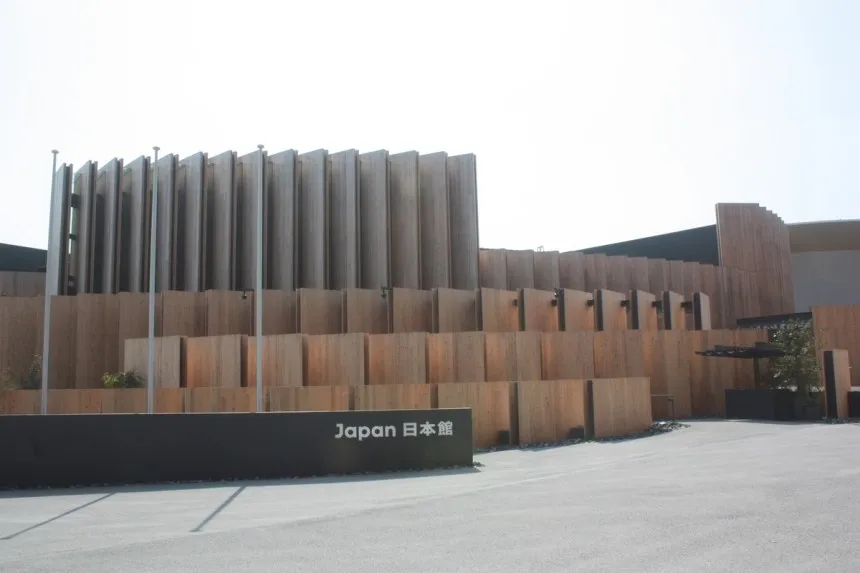
[The Japan Pavilion, built with disassembly and recycling in mind © Yonhap News]
The Japan Pavilion, Containing the Great Cycle of Life
The Japan Pavilion is made of numerous wooden panels, containing the designer's intent, who pondered "the circulation and continuation of life (Between Lives)." The wooden panels form a circle, composing the route so that one can experience the concept of circulation. As the host country that prepared the Expo with ESG in mind, it shows a rough sketch of an environment-related ultra-smart society — the simultaneous resolution of traffic congestion and carbon emissions through real-time data simulation of self-driving electric vehicles, and the optimization of renewable energy through a smart energy grid. At this Expo site, "direct air capture technology" provided by the "Research Institute of Innovative Technology for the Earth (RITE)" is also being demonstrated. One can learn the process of separating carbon from the air like a tree, capturing it, and reducing it into a usable substance.
The Japan corporate pavilion also prepared its exhibition with an emphasis on regeneration and circulation. The Japanese technology company "Panasonic" built its pavilion by actively using recycled iron and copper obtained from home appliances. Panasonic is also providing ideas and technology to realize the regeneration and circulation of the environment and cities, with a vision of recycling urban empty houses — which had emerged as a social problem in Japan — into "urban Mini Farms." This smart farm will show the future of sustainable agriculture, stably producing fresh vegetables in the city center going forward.
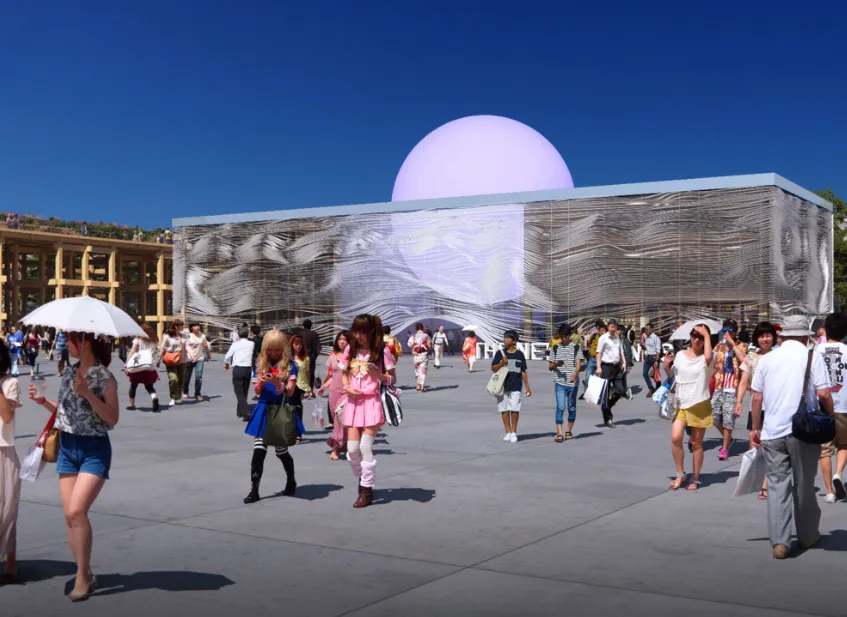
[The Netherlands Pavilion, meaning "illuminating the future through water" © archdaily.com]
The Netherlands: Future Technology Competing with Water
The Netherlands, which always carries a tension related to water in a place lower than sea level, especially presents future technologies concerning water. At this Expo exhibition, it shows smart coastline technology and a water-recycling system, through which one can confirm how it responds nationally to problems such as sea-level rise and water shortage. In addition, visitors can confirm, through digital images, how it protects the safety of cities and provides clean water by building a seawall as a digital twin model. In this way, at the Netherlands Pavilion, one can confirm an extraordinary system that responds to climate change together with water — such as presenting an integrated renewable-energy model combining offshore wind turbines and an energy-storage system.
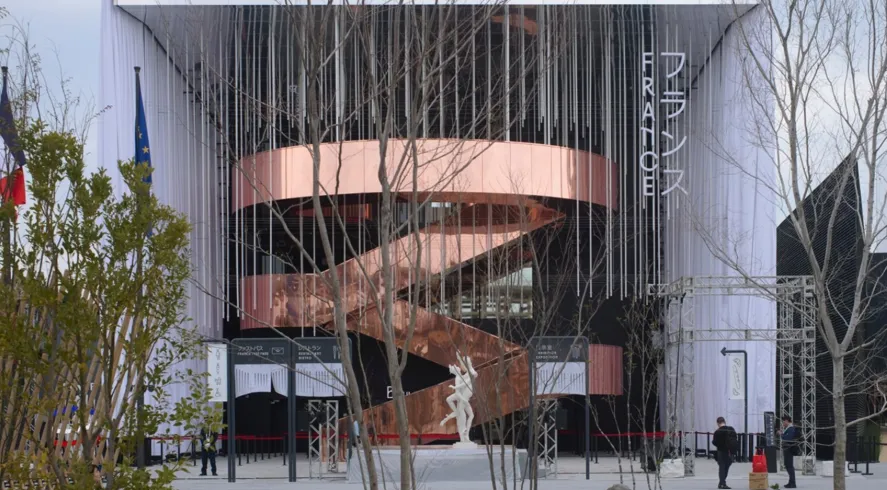
[The France Pavilion, adding aesthetic beauty with a spiral staircase © designboom.com]
France: The Fashion of a Sustainable Future
France participates under the theme "digital-twin-based circular fashion." The fashion-tech startups "Circul'R" and "3DLOOK" show a solution combining fabric recycled from waste clothing with an AI design system. People can experience clothes through AR virtual fitting and, after ordering, watch the process of AI producing clothes with a waste-minimizing pattern. France, a fashion powerhouse, has foreshadowed that, based on the growth of such fashion-techs, it will also present a "2030 France Fashion Waste 50% Reduction Roadmap" at the exposition site, drawing further anticipation.
The Link of Sustainable Circulation and Regeneration
The Japanese government, which hosted the 2025 Osaka-Kansai Expo, stated that it plans to apply the technologies presented at the Expo to the "2025 Osaka Carbon-Neutral City Project." This Expo will be an exposition condensing our future, which we will directly experience before long. The 2025 Osaka-Kansai Expo runs with a long breath until October 13. Let us enjoy the visions of a sustainable future society from around the world during the remaining Expo period.
By Editor L