
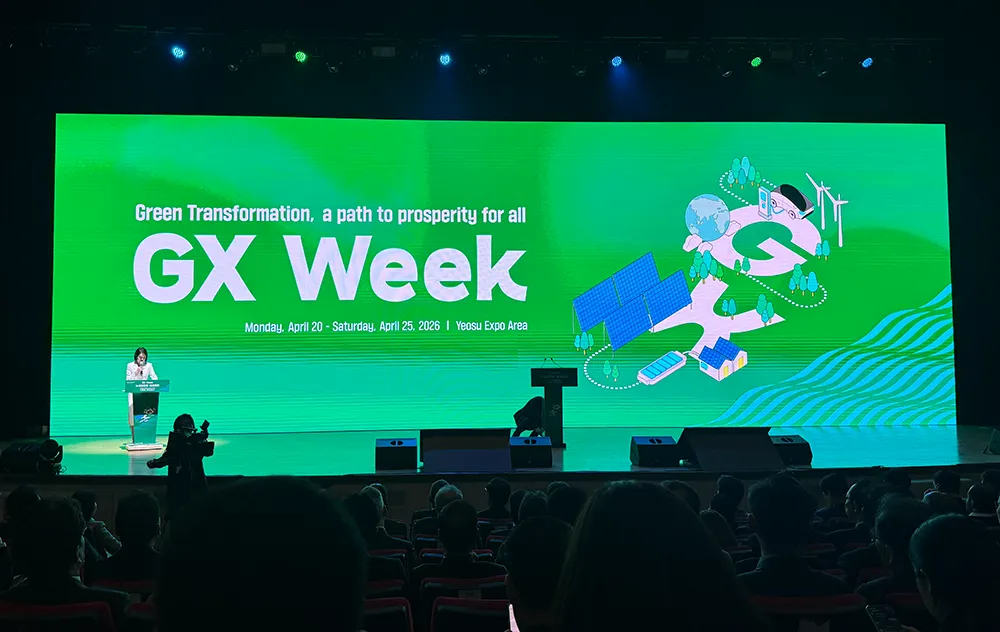
The 3rd United Nations Framework Convention on Climate Change (UNFCCC) Climate Change Week is being held for the first time this year in Yeosu, Jeollanam-do, South Korea. UNFCCC Climate Change Week is an international environmental event that pre-coordinates the official agenda of the annual Conference of the Parties (COP), held each November. At the COP, the 198 countries that have acceded to the UNFCCC gather to discuss climate change response measures and determine greenhouse gas reduction targets.
In conjunction, the government is hosting the ‘Republic of Korea Green Transformation International Week (GX Week)’ during this Climate Change Week. We report from the field on the significance of GX Week, which shares the direction of South Korea’s energy transition policy with the international community.
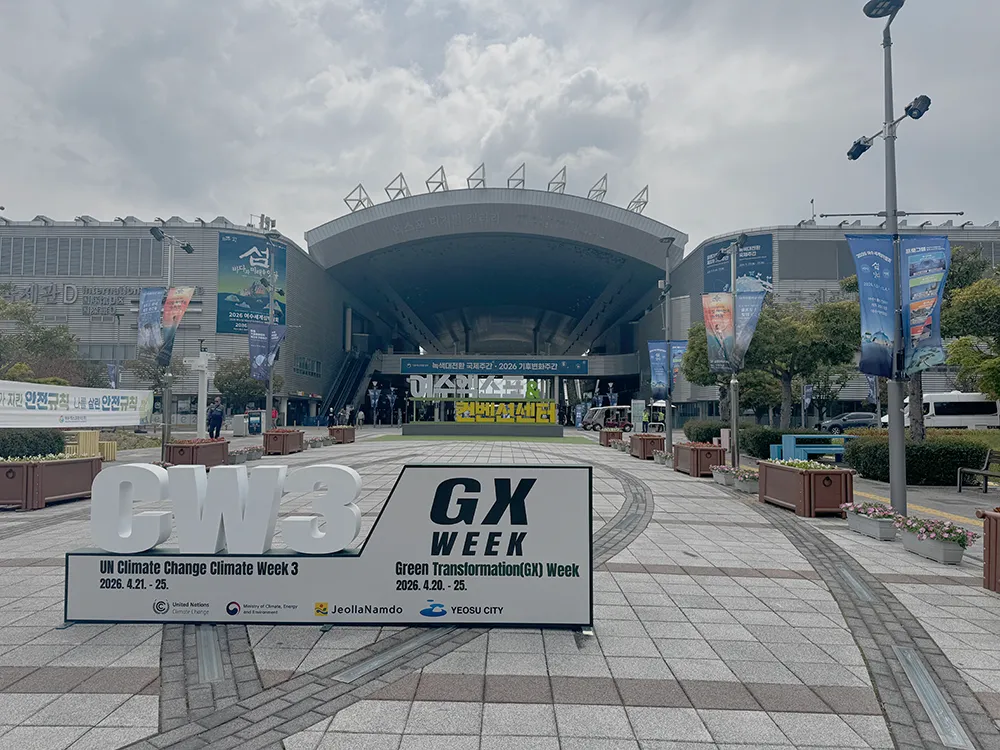
[Yeosu Expo Convention Center, venue for UNFCCC Climate Change Week and GX Week © ESG.ONL]
Yeosu’s Determination Reaches All the Way to Brazil
The road to hosting Climate Change Week in Yeosu was, in fact, preceded by a long preparation period. In September 2025, Yeosu in Jeollanam-do was selected as the host candidate through a nationwide open call by the Ministry of Climate, Energy and Environment. Then in November of the same year, the city of Yeosu went so far as to form a delegation and fly directly to the COP30 venue in Brazil. The delegation held a policy presentation at the COP30 Korea Pavilion, explaining the strategy and response measures for attracting Climate Change Week, as well as Korea’s carbon neutrality vision, while conducting a panel discussion. At the same venue, Jeollanam-do Governor Kim Young-rok personally delivered a letter to UNFCCC Executive Secretary Simon Stiell, succeeding in securing the bid.
What It Means for South Korea to Stand on the International Stage
Since launching the nation’s first Climate Protection Week in 2008, Yeosu issued the ‘Yeosu Declaration’ urging marine ecosystem conservation at the 2012 World Expo. In 2021, it created a forum through the Yeosu Summit of the Urban Environment Convention to discuss carbon neutrality with city leaders from around the world. It was the history of climate action built up over some 20 years that brought Yeosu to this position.
Fittingly, at the GX Week opening ceremony held this morning alongside the start of Climate Change Week, one could savor the significance of Yeosu as the key stage setting the climate agenda for the Asia-Pacific region. The opening ceremony was attended by approximately 800 people, including Minister of Climate, Energy and Environment Kim Sung-hwan, UNFCCC Executive Secretary Simon Stiell, Japanese Vice Minister of Economy, Trade and Industry Takehiko Matsuo, EU Ambassador to Korea Ugo Astuto, ministers and vice ministers of climate and energy ministries from various countries, senior officials from international organizations, academic experts, and citizens. Prime Minister Kim Min-seok and Jeollanam-do Governor Kim Young-rok also added to the significance of the event through their congratulatory remarks and attendance.
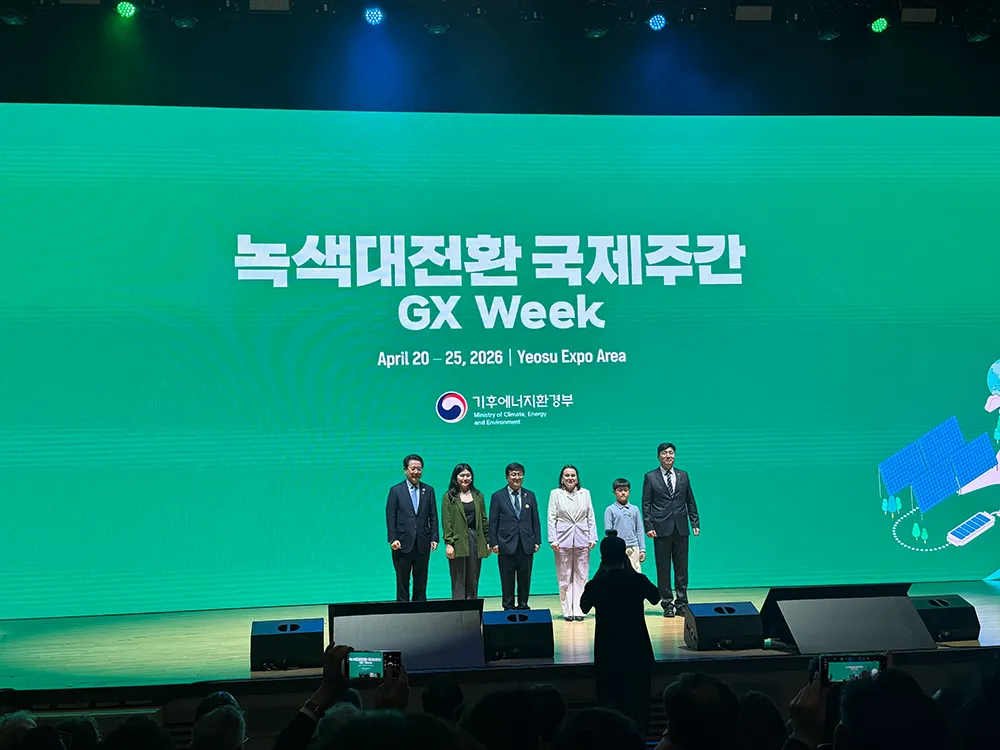
[Participants taking part in the GX Week Declaration © ESG.ONL]
The World’s Resolve Gathered in Yeosu
Speakers participating in the Yeosu GX Week opening ceremony and discussions pointed to the crisis arising from fossil fuel dependence. At the same time, they emphasized that, given the global energy crisis including the surge in super-scale power demand in the AI era, energy transition has become a core task that determines national competitiveness and future survival, going beyond environmental protection.
In their presentations, each country shared the current state and pace of their concrete implementation strategies. The South Korean government is speedily advancing green transformation as a core national strategy, including expanding the renewable energy ratio to 20% by 2030 and spreading solar and wind income nationwide. Jeollanam-do is stepping forward as a leading hub for low-carbon transition through the hydrogen conversion of the Yeosu World Petroleum Complex and the expansion of blue carbon. Japan is accelerating decarbonization with its GX2040 vision, the introduction of an emissions trading system, and a 150 trillion yen investment over 10 years. The EU is legally driving forward a 55% reduction in greenhouse gases and 45% expansion of renewable energy by 2030 under ‘Fit for 55.’
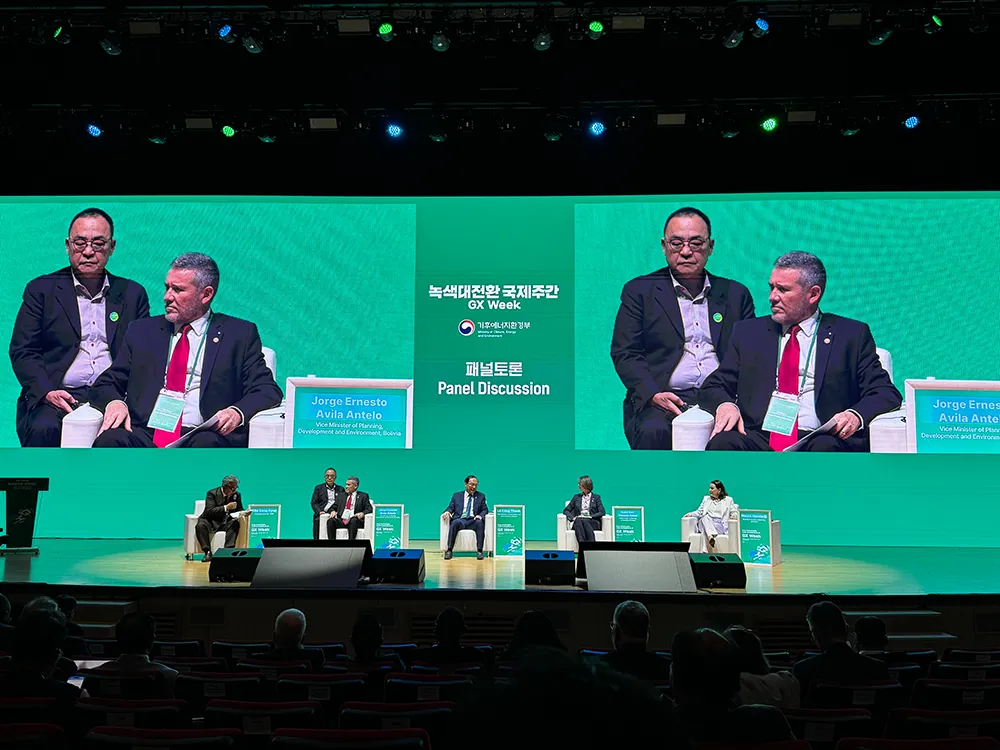
[GX Week opening ceremony discussion © ESG.ONL]
In the second part of the opening ceremony’s panel discussion, senior figures from various countries — including GGGI Director-General Kim Sang-hyup, UNFCCC Deputy Executive Secretary Noura Hamladji, the Norwegian Ambassador to Korea, and vice ministers from Bolivia and Vietnam — engaged in in-depth discussion on the theme of how to simultaneously achieve energy transition and security. With a shared recognition that energy security and climate policy are inseparable and must be pursued simultaneously, substantive implementation strategies were discussed, including resolving geopolitical risks through diversification of renewable energy sources, establishing stable regulatory frameworks such as carbon pricing, and measures to attract private investment. The need for expanded international technology cooperation in offshore wind and hydrogen sectors was also emphasized.
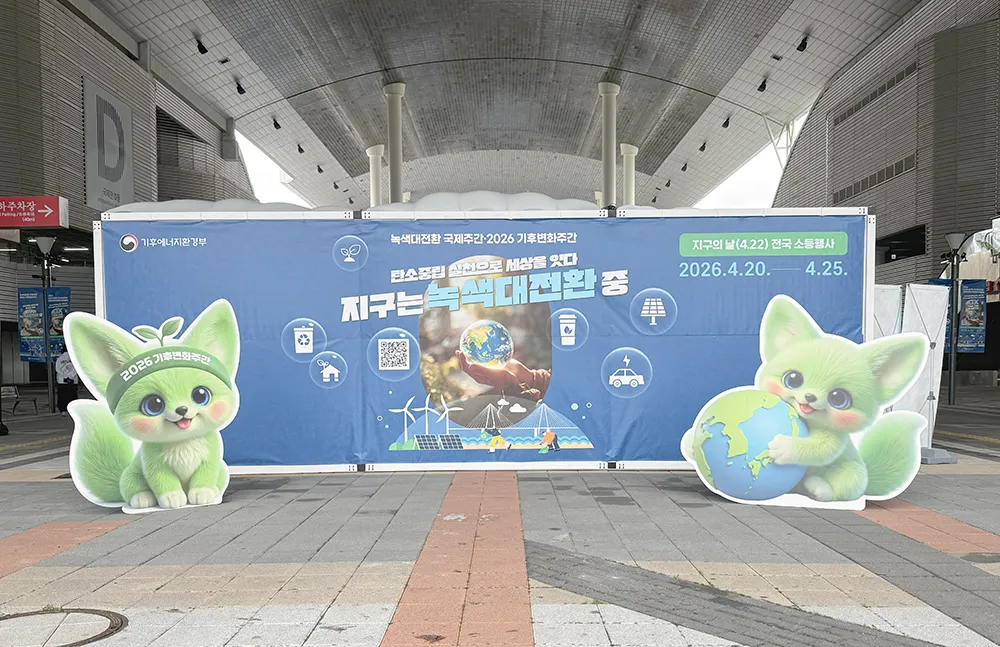
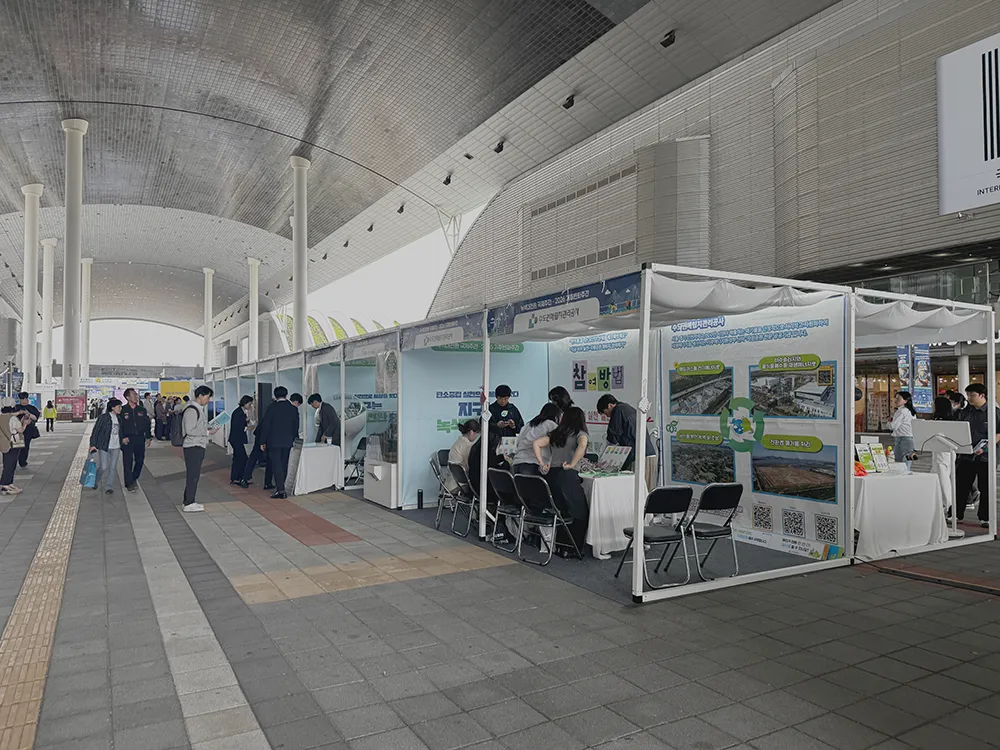
[Outdoor event booths at the Yeosu Expo Convention Center © ESG.ONL]
A Sustainable Everyday Life Encountered at the Exhibition Hall
Outside the Expo Hall where the agenda was presented, exhibitions and hands-on programs conveying the message of green transformation are underway. At the Ministry of Climate, Energy and Environment booth, a quiz was held through which recycled umbrellas and turtle-shaped bottle openers made from discarded fishing nets were given as souvenirs, raising interest in marine waste upcycling. The Sudogwon Landfill Site Management Corporation, which leads the eco-friendly treatment and resource recovery of Seoul metropolitan area waste, directly demonstrates the possibilities of resource circulation in everyday life through a craft activity making pot holders from sock toe offcuts left over from sock manufacturing.
At an exhibition hall lined with government and public institution booths, H&M stood out as a private fashion brand, sharing information on its Stella McCartney collection based on innovative materials to present the direction of sustainable fashion, as well as its supply chain management in which 91% of all materials are procured through recycled or sustainable methods. All the booths at the event venue share a common significance in demonstrating that carbon neutrality is not a grandiose policy goal but is already being practiced across everyday life and throughout industry.
Starting with today’s opening ceremony, Yeosu GX Week continues through the 25th. During this period, a total of 67 sessions will be held sequentially, including the AI Era Energy Strategy Dialogue on the 21st, the Climate Technology Innovation Forum on the 23rd, and the Green Taxonomy and Transition Finance Global Forum on the 24th. Through this event, the government plans to preemptively build international consensus on the ‘Republic of Korea Green Transformation (K-GX) Promotion Strategy’ scheduled for announcement in June, and to concretize the foundation for global climate and energy cooperation. With Yeosu standing at the center of international agenda-setting, attention now turns to what resolutions and outcomes will fill this one week.
by Editor L