
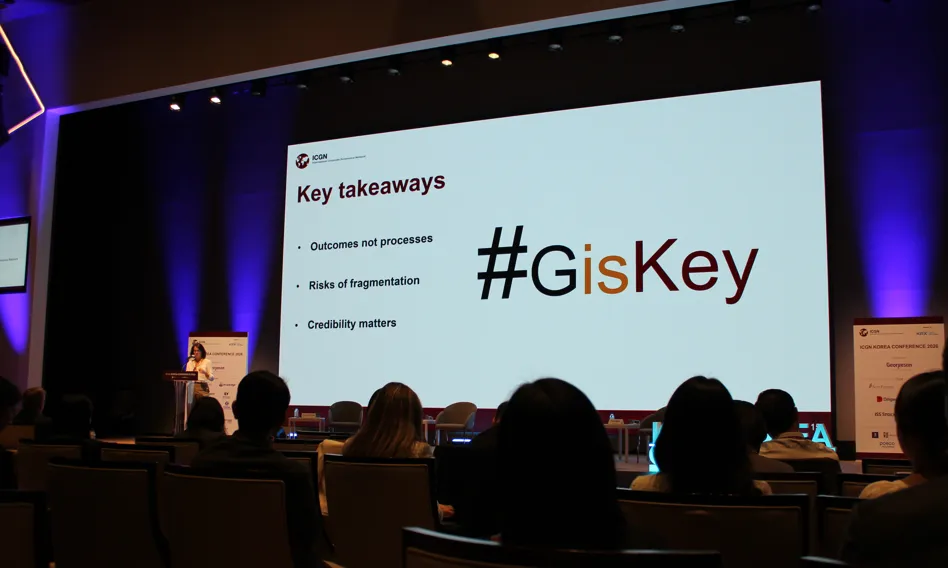
The KOSPI 6,000 era. At a time when the Korean stock market is attracting high interest from the international investor community, the gaze of global investors turned not to financial performance but to the board of directors. On April 14, at the Korea Exchange Conference Hall, speakers from South Korea, Japan, the United Kingdom, the United States, and other countries repeatedly posed a single question: Is corporate governance fulfilling its proper role?
The ‘ICGN Korea Conference 2026,’ co-hosted by the International Corporate Governance Network (ICGN) and the Korea Exchange, was a forum for diagnosing the structural changes in the Korean capital market within a global context. The experts gathered at the conference focused their discussions on the performance of the Value-Up Program, the evolution of the Stewardship Code, and the standards that investors demand of companies.
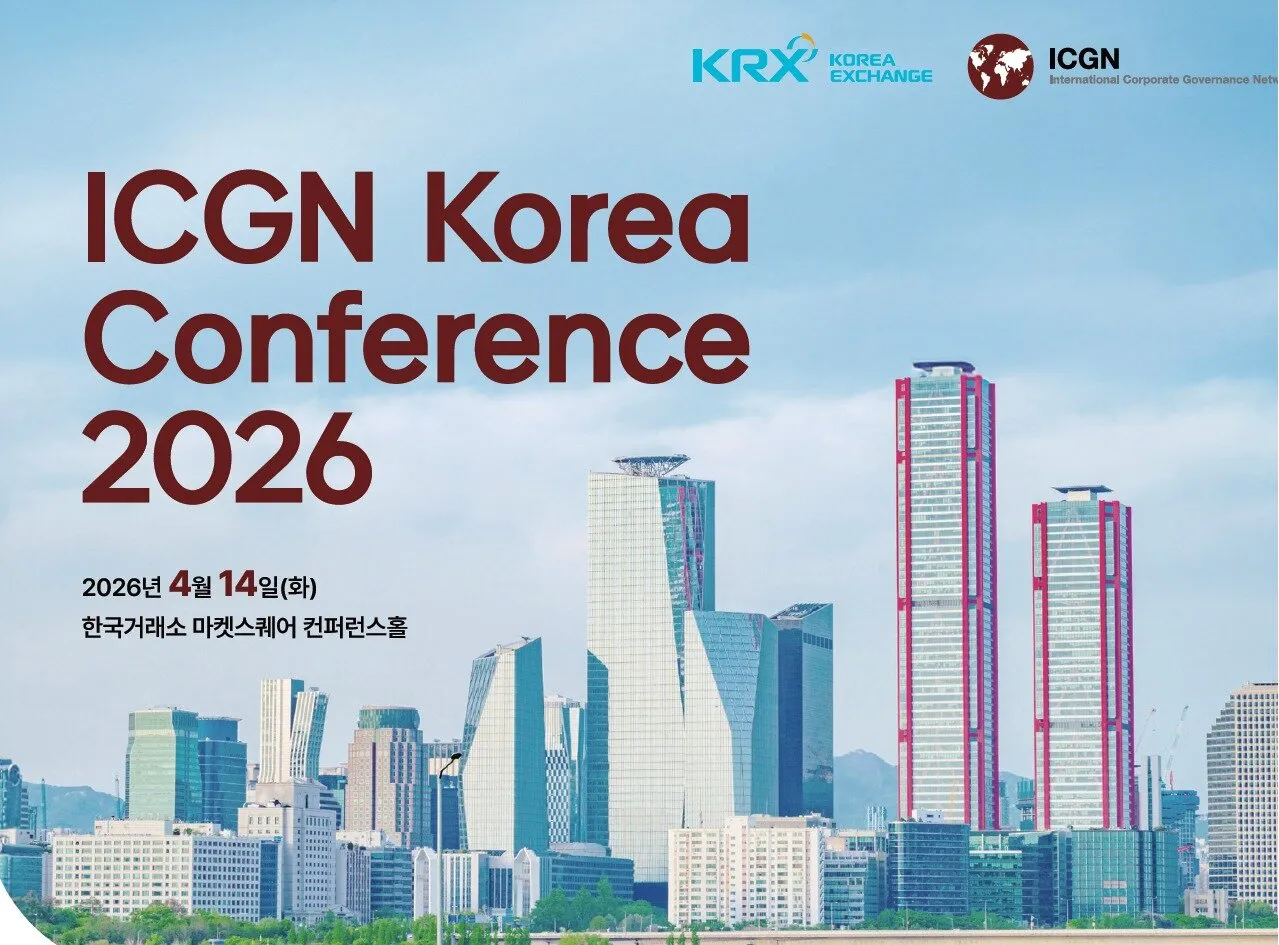
[ICGN Korea Conference 2026 Official Poster © Korea Exchange]
What the Numbers Say About Value-Up Performance
The overall assessment of the rapidly growing Korean securities market was positive. At the center of the assessment was the Value-Up Program, which began in July 2024. The Value-Up Program is a policy that encourages listed companies to voluntarily go through the process of diagnosing their current state, setting targets, formulating plans, implementing them, and communicating, thereby enhancing shareholder value and transparently disclosing those efforts to investors. Aimed at resolving the so-called Korea Discount — the undervaluation of domestic companies — and promoting market growth and shareholder value enhancement, a revision to the Commercial Act was also carried out last February. Amid this trend, the Value-Up Program has taken root in the market, and the results have begun to appear in numbers. This year, the KOSPI surpassed 6,000, the scale of share buybacks and cancellations — an indicator of growing shareholder returns — roughly doubled year-on-year, and the market capitalization share of Korea Value-Up Index disclosing companies, launched in September 2024, reached approximately 72% of the total market.
A change as noteworthy as the numbers is the shift in corporate decision-making criteria. Previously, discussions among board members only occurred after investors exercised opposing voting rights at shareholders’ meetings, but recently, a shift in communication methods has been observed in which board members proactively reach out to ask for investors’ perspectives. It is a signal that corporate governance is shifting its direction from post-facto response to preemptive improvement.
Substantive Changes Unable to Keep Pace with Institutional Speed
However, the conference also highlighted challenges we must overcome. Cases were raised in which companies dispersed director terms or reduced the board’s overall size to effectively neutralize the cumulative voting system, which was designed to allow candidates favored by minority shareholders to enter the board. The corporate practice of establishing vague ‘business purposes’ in the articles of incorporation when disposing of treasury shares also came under criticism, as it was pointed out that this runs directly counter to the intent of the Commercial Act revision to strengthen shareholder returns.
The substantive independence of independent directors also remains an unresolved challenge. Because director appointments are typically made through personal networks, the form may be in place, but genuinely checking management is difficult. The problem is deepened by the fact that even global proxy advisory firms fail to properly capture this gap. The shared conclusion of the conference sessions was that, as institutions change rapidly, the speed of filling in measures that give life to their intent must also keep pace.
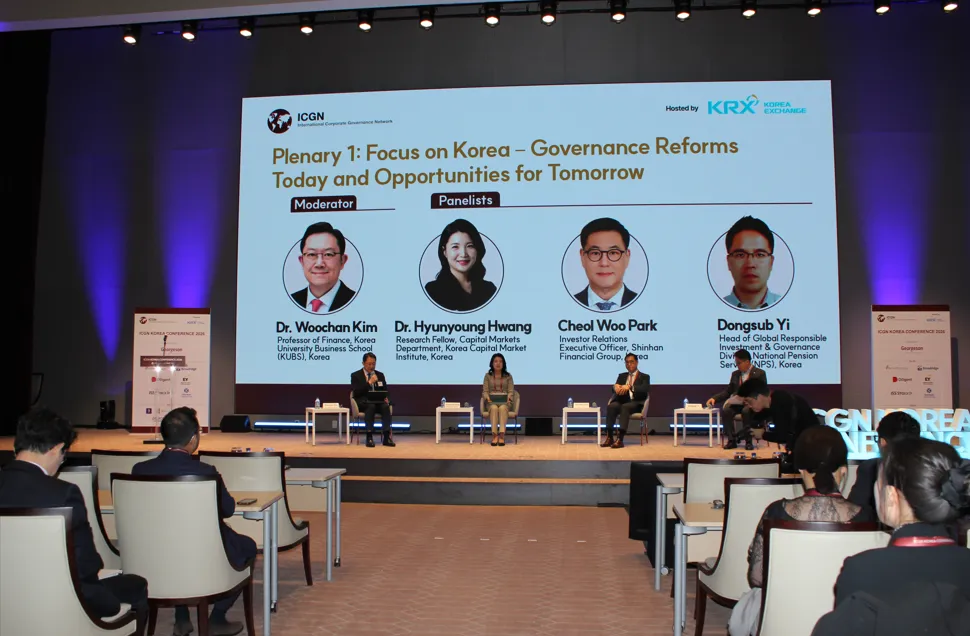
[Panel discussion on ‘Korean Corporate Governance Reform: Today’s Changes and Tomorrow’s Opportunities’ at the ICGN Korea Conference 2026 © ESG.ONL]
Investor Standards Co-Evolving with the Stock Market
As the Korean stock market is showing unprecedented growth, the criteria by which global investors paying attention to our market evaluate companies are also changing. At the core is the Stewardship Code. This private-sector self-regulatory code, which requires institutional investors to go beyond being mere shareholders and responsibly engage in the management of investee companies, had been maintained without significant change. However, last December, the Financial Services Commission, the Korea ESG Standards Institute, and other relevant ministries and agencies announced the ‘Stewardship Code Substantiation Plan,’ setting in motion a major transformation. Specifically, the substantiation plan contains a phased development direction for this year onward, prioritizing inspections starting with asset management firms and pension funds, and strengthening implementation reviews for institutional investors.
This is not a movement unique to South Korea. The United Kingdom operates a structure in which Stewardship Code signatory institutions report on their actual activities each year, while Japan is accelerating reform by releasing draft amendments to its Corporate Governance Code during the conference period. Hong Kong and Singapore are also showing movement toward advanced disclosure.
What Global Investors Are Actually Looking For
While ICGN participating countries are jointly shaping such changes, in the United States, the Securities and Exchange Commission (SEC)’s shift in attitude since the Trump administration took office — moving away from substantive review of shareholder proposals — has become controversial. Previously, when a company sought to exclude a shareholder proposal from the agenda of a shareholders’ meeting, SEC pre-review was required, but from 2025, the SEC has declared that it will not provide substantive judgment on exclusion requests. This effectively expands companies’ discretion to exclude agenda items on their own, raising concerns that shareholder proposals may be neutralized from an ESG perspective. The situation in the European Union is different. The Omnibus Package announced by the European Commission last February raised concerns that it would reduce the scope of sustainability regulations including the Corporate Sustainability Reporting Directive (CSRD) and relax disclosure obligations. Criticism that this is the result of accepting industry backlash over excessive regulation of companies is substantial. The trend of strengthening ESG disclosure and the trend of weakening it are operating simultaneously.
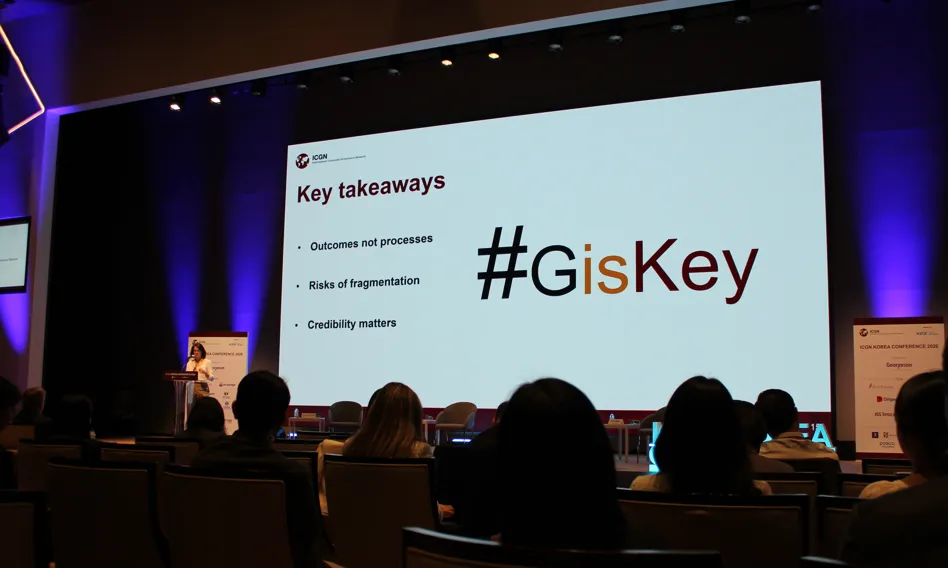
[ICGN CEO Jen Sisson presenting at the ICGN Korea Conference 2026 © ESG.ONL]
Despite this, the standards that investors demand of companies are becoming more concrete. Rather than whether a company operates an ESG committee, what global investors are actually examining is whether the committee’s discussions actually lead to capital allocation decisions, whether ESG objectives are reflected in executive compensation and performance evaluations, and whether the results are reported to the full board. The English-language ESG portal newly established by the Korea Exchange now functions as the first window through which foreign investors assess Korean companies.
Starting this year, all KOSPI-listed companies must submit a corporate governance report, and from May, KOSPI-listed companies with assets of KRW 2 trillion or more must begin comparative disclosure of executive compensation against company performance. Disclosure standards in each country are also increasingly aligning with the global standards set forth by the International Sustainability Standards Board (ISSB). The message delivered by this conference is clear: the Korean capital market is already within the radar of global investors, and the criteria they are looking at are shifting from numbers to structure and actual practice.
by Editor L