
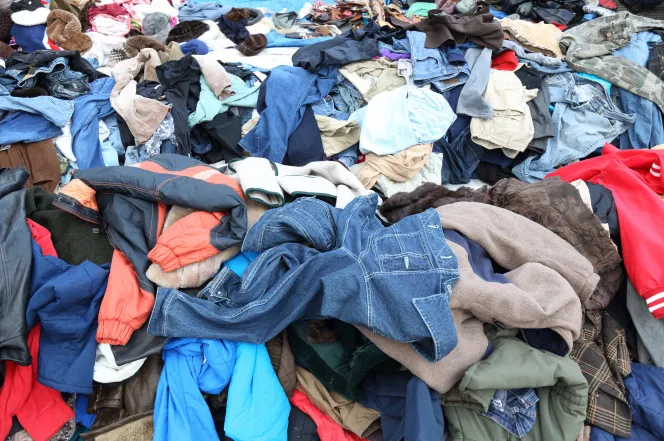
Each year, the market value of unsold inventory that the domestic fashion industry sends to incinerators is estimated at approximately ₩1 trillion. Under the pretext of preserving brand exclusivity, the choice to burn rather than dump at bargain prices had become entrenched as a standard practice. However, such logic is becoming difficult to sustain. Under the EU’s Ecodesign for Sustainable Products Regulation (ESPR), the disposal of unsold clothing, clothing accessories, and footwear by large enterprises within the EU is, in principle, prohibited. The EU is signaling that overproduction and inventory destruction can no longer be treated as merely an internal cost issue for companies.
The ESPR itself is a regulation that took effect in July 2024, and beginning July 19 of this year, the regulation will start applying to products from large enterprises. While the regulation’s direct scope is the EU market, Korean companies that sell products in Europe or are connected to the supply chains of European brands are not exempt from its influence.
The Fashion Industry Will Feel the Regulatory Shift Through ESPR
ESPR is the EU’s core product regulation established for the transition to a circular economy. Its fundamental direction is to impose sustainability requirements across the entire life cycle of products — from the design stage before a product enters the market, through use, repair, reuse, recycling, to disposal. Before ESPR took effect, there was the Ecodesign Directive enacted in 2009. While that directive primarily dealt with energy efficiency standards for energy-related products, ESPR significantly broadens the scope of application. With the exception of certain categories such as food, feed, and pharmaceuticals, nearly all physical products placed on the EU market may become subject to product-specific delegated regulations in the future.
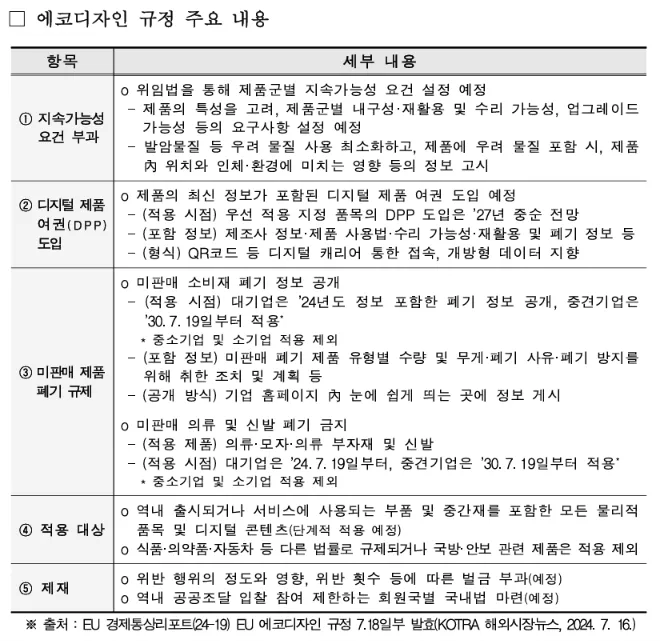
[Key contents of the Ecodesign Regulation © Korea Energy Agency]
While ESPR sets a comprehensive regulatory framework that applies across industries, the specific prohibition on the disposal of unsold textile and footwear products by fashion large enterprises has begun to take effect, making the fashion industry the first to directly experience the regulatory signal.
Three Changes Beginning July 19
The first change that will apply most directly to large fashion enterprises within the EU starting July 19 is the ‘prohibition on the disposal of unsold inventory.’ Of course, there are limited exceptions. Exceptions may be recognized in cases such as safety reasons, products that are severely damaged and unusable, or counterfeit goods that should not be circulated in the market. To apply an exception, companies must retain documentation proving the grounds for the exception for five years. It would be difficult to effectively maintain existing incineration practices through the exception clause.
Second, the disclosure burden regarding the treatment of unsold products is increasing. ESPR requires companies to disclose the quantity, weight, reason for disposal, and treatment method of unsold consumer goods that are discarded. Large enterprises are already within the scope of this disclosure obligation, and from 2027, reporting must be conducted in a more standardized format.
Third, preparations surrounding the Digital Product Passport (DPP) are gaining momentum. DPP is a system that digitally exposes sustainability-related information such as raw materials, composition, repairability, and recycling information of products. Its purpose is to enable consumers, repair shops, recyclers, and regulatory authorities to more easily access product information. Companies are now at the stage where they must begin organizing their supply chain data collection systems to prepare for the phased implementation of DPP requirements.
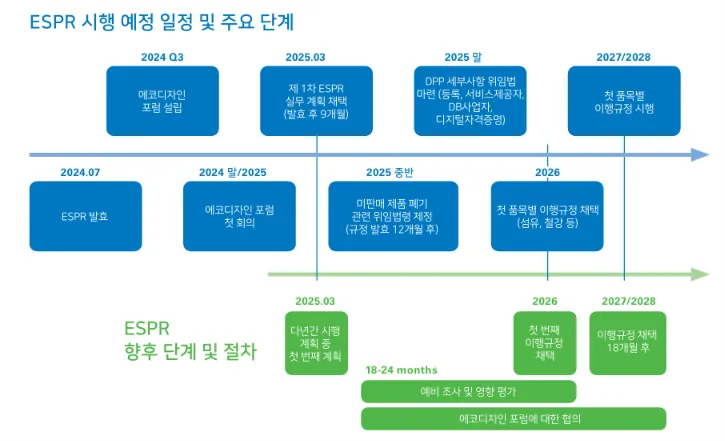
[ESPR Implementation Timeline and Key Phases © TÜV Rheinland Official Website]
Challenges for Korean Fashion Companies in Europe
ESPR targets products sold within the EU. Domestic companies that directly export clothing or footwear to the EU, as well as suppliers that provide fabrics, subsidiary materials, or finished products to European brands, may fall under its direct or indirect influence. The key is not ‘whether you are a Korean company’ but ‘whether your product is placed on the EU market.’
According to Ministry of Climate, Energy and Environment statistics, domestic clothing waste generation exceeds 110,000 tons annually. Clothing incineration or disposal occurring within Korea is not directly subject to ESPR regulation. However, for companies supplying products to the EU market, domestic production, distribution, and inventory handling practices are highly likely to become subject to gradual scrutiny. This is because once DPP is fully implemented, product data will connect the entire life cycle — from raw material sourcing, manufacturing, and distribution to use, repair, and recycling.

[Poster for LF HAZZYS’s first upcycling project, the ‘Rework Collection’ © LF]
In response, the government and industry are also beginning to prepare. The Ministry of Trade, Industry and Energy and related agencies are operating pilot projects and consultative bodies for DPP preparedness, while discussions on inventory management, recycling, and data standardization continue within the textile and fashion industries. Examples linking inventory and circularity are emerging — such as the Rework Collection, an upcycling project launched by LF HAZZYS in 2023, and Kolon FnC’s expansion of its secondhand fashion platform. However, responding to the unsold clothing disposal regulation may be an even more challenging task than DPP preparedness. While DPP is a matter of organizing data, the prohibition on inventory destruction requires transforming production volumes, sales strategies, discount policies, resale channels, and recycling infrastructure — this is closer to an adjustment of the fashion business model itself.
ESPR: An Export Industry Issue Beyond Fashion
The scope of ESPR does not stop at fashion. The European Commission is progressively presenting a timeline for adopting product-specific delegated acts through the ‘2025–2030 Working Plan.’ The adoption of the delegated act for steel is scheduled for 2026, followed by textiles and clothing, aluminum, and tires in 2027, furniture in 2028, and mattresses in 2029.
This is why the ESPR response is not merely about whether unsold clothing can be burned. As delegated acts accumulate, how transparently Korean export companies manage their product data and how they collect and verify environmental information across their supply chains will become a prerequisite for accessing the EU market. The regulatory clock is already ticking.
by Editor L