
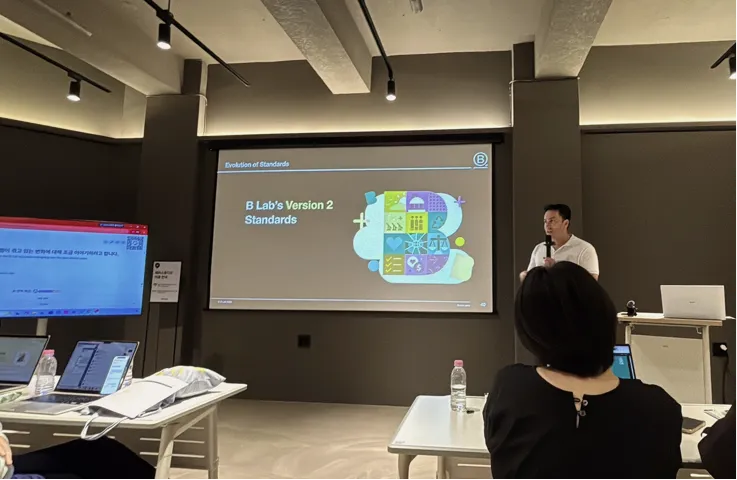
‘B Corp Certification’ is a global certification and corporate movement that recognizes businesses prioritizing social and environmental responsibility beyond profit-seeking. Currently, over 10,900 companies across more than 100 countries and 160 industries have obtained B Corp Certification. In South Korea, around 30 companies, including Toss Bank, DLG Law Firm, and Impact Square, are listed as B Corp Certified companies.
B Lab, the global nonprofit organization that operates B Corp Certification, unveiled its newly revised certification standards in April 2025. The new standards have been applied to new certification applicants since March 2026 — the seventh revision since B Lab’s founding, and widely regarded as the most significant change in 19 years.
B Lab has set ‘System Change,’ centered on continuous improvement and collective effort, as the goal of this standards revision. In this regard, B Lab Korea, B Lab’s Korean partner organization, held a ‘B Corp Certification Information Session’ on June 29 to introduce the new certification standards to domestic corporate representatives. The session covered the revised B Corp Certification evaluation methods, detailed criteria, and their significance.
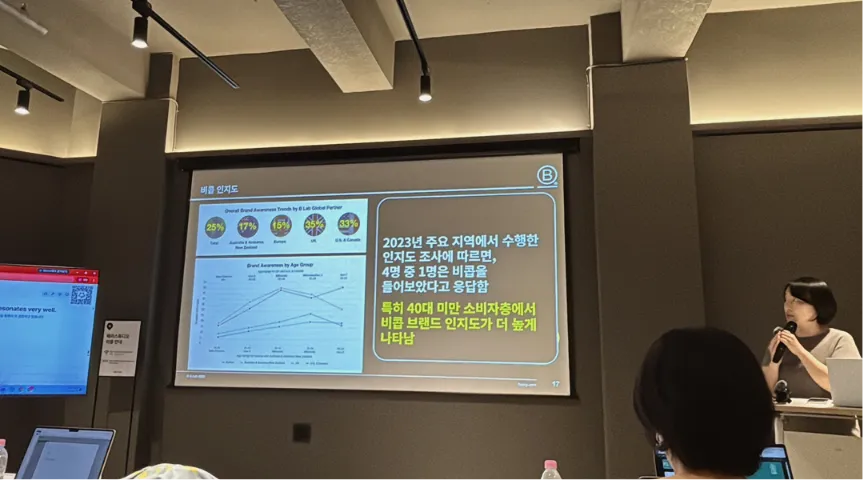
[B Lab Korea Executive Director Jeong Tae-eun explaining B Corp Certification at the session © ESG.ONL]
All Seven Impact Areas Must Be Passed to Be Certified
The core of this certification standard revision is the abolition of the previous composite score summation method. Previously, a company could receive a high overall score by performing exceptionally well in one area, such as environment, which would offset weaker performance in other areas like governance or labor conditions. Under the new standards, such compensation is no longer permitted. Instead, companies must meet detailed sub-performance criteria across seven impact topics: ▲Corporate Purpose & Stakeholder Governance ▲Fair Labor ▲Justice, Equity, Diversity & Inclusion (JEDI) ▲Human Rights ▲Climate Action ▲Environmental Management & Circularity ▲Government Relations & Collective Action. Performance in one area can no longer fill the gaps in another.
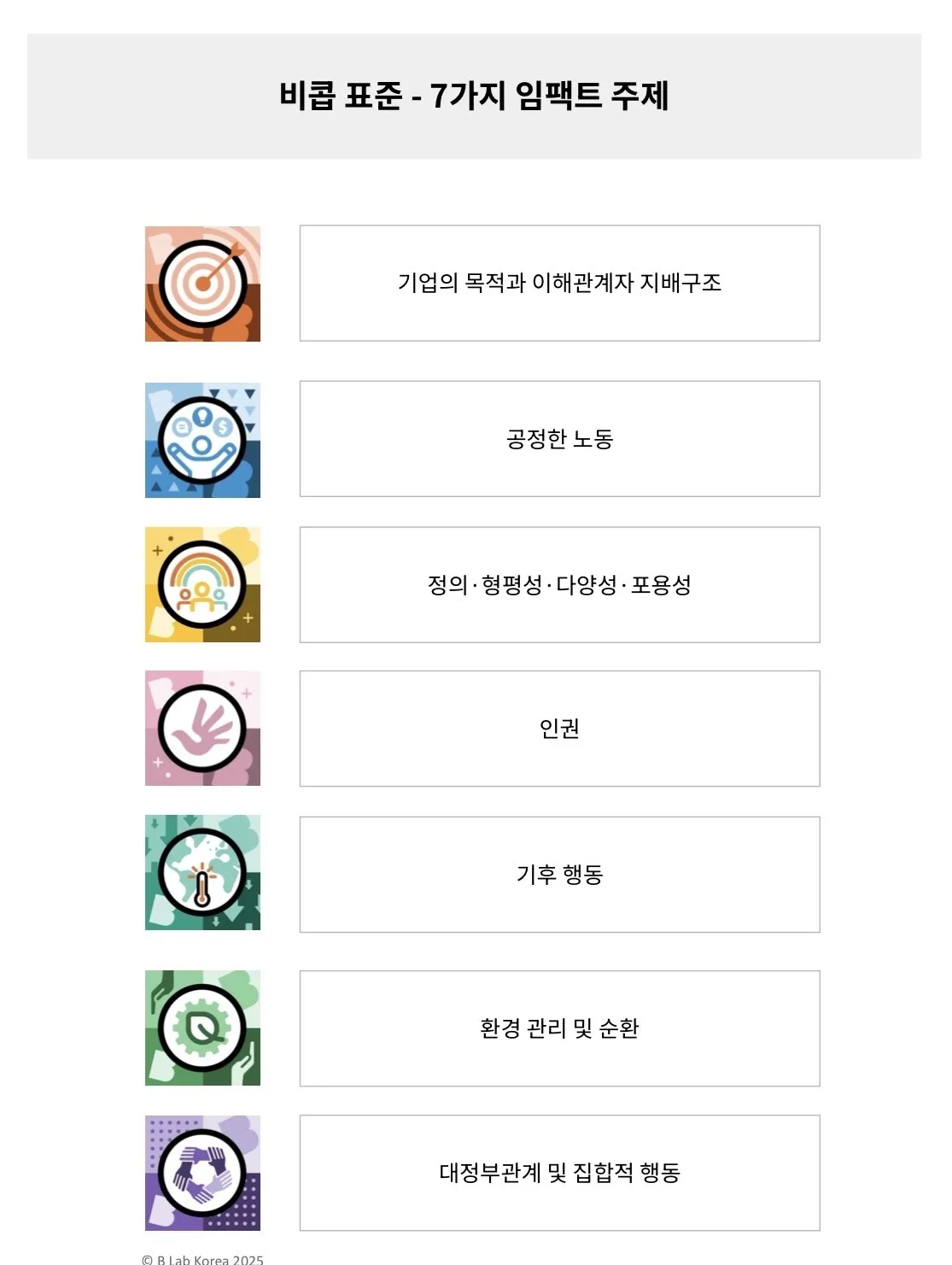
[The Seven Impact Topics of the Newly Revised B Corp Certification Standards © Captured from B Lab Korea Website]
Examining some of the key topics among the seven: ‘Corporate Purpose & Stakeholder Governance’ requires companies to act according to a defined purpose and establish governance that monitors social and environmental performance. ‘Fair Labor’ addresses quality jobs, fair wage practices, and reflecting worker feedback in decision-making. ‘Climate Action’ requires establishing plans that contribute to limiting global warming to 1.5°C, and for large corporations, includes greenhouse gas emissions and Science Based Targets (SBT). ‘Government Relations & Collective Action’ covers corporate efforts to work collectively to promote systemic change.
Beyond Regulatory Compliance, Toward Substantive Action
The backdrop of this revision is the regulatory environment. The new standards were developed in compliance with the EU’s ‘Empowering Consumers for the Green Transition Directive,’ scheduled to take effect in September 2026. This regulation prevents companies from engaging in greenwashing, such as unsubstantiated eco-friendly advertising. Amid the global trend of tightening greenwashing regulations, B Lab has set a direction through the new standards for companies to go beyond regulatory compliance and take substantive action on social and environmental issues. Companies that have received B Corp Certification must continue to demonstrate compliance with the standards and show improvements at each evaluation cycle.
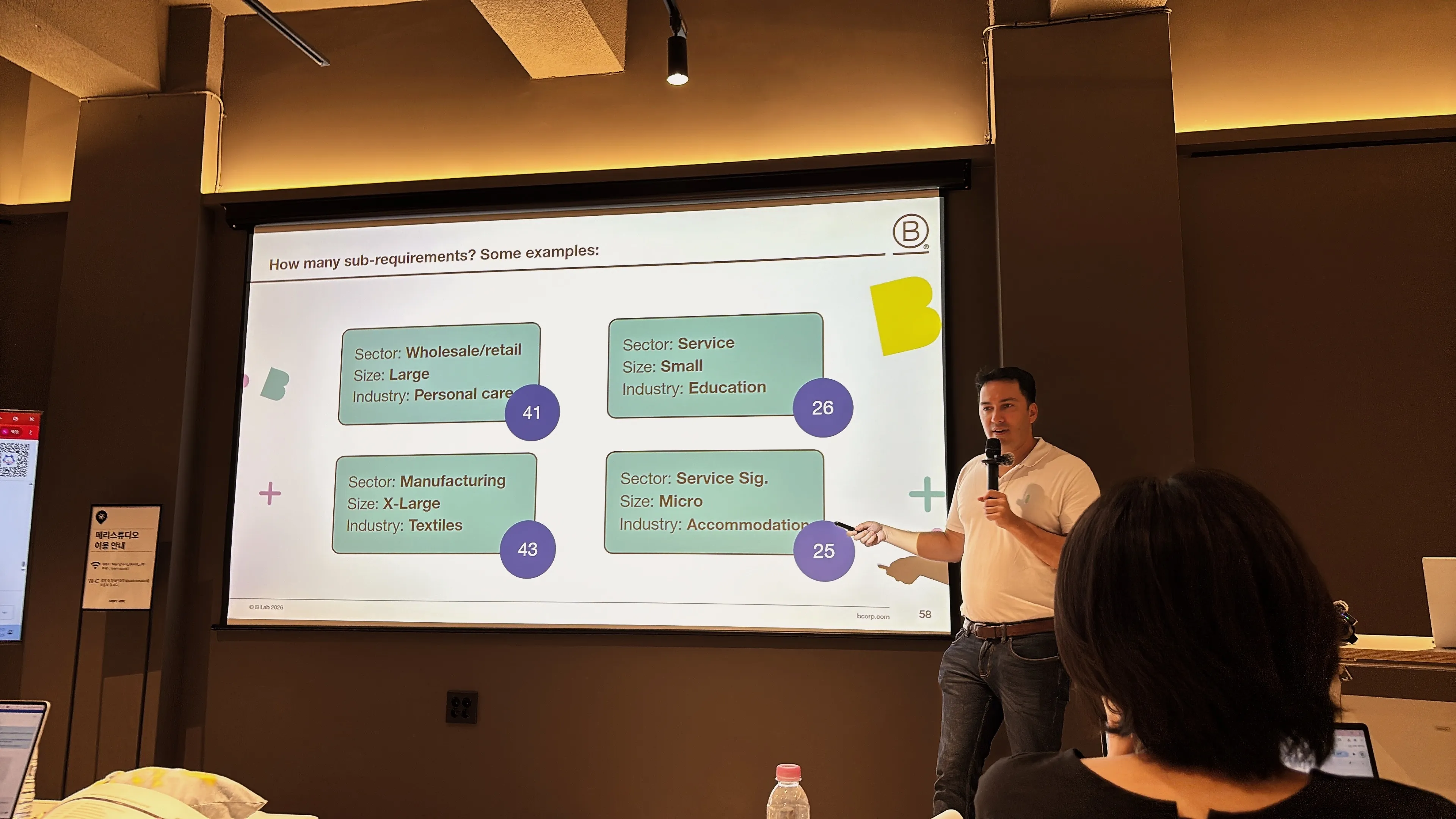
[Billy Hanafee, B Lab Global Certification Operations Strategy Lead, explaining the new B Corp Certification standards © ESG.ONL]
The more stringent performance criteria in the B Corp Certification process may pose a burden on small and medium-sized enterprises (SMEs). For companies with limited personnel and budgets, evaluating and meeting criteria across all seven areas is challenging. Reflecting these difficulties, the revision now varies the number of detailed requirements that companies must fulfill, ranging from a minimum of 20 to a maximum of 124, depending on size and industry sector. The structure applies more requirements to large enterprises and a more basic level of requirements for SMEs first.
If we compare B Corp Certification to a corporate ‘health check-up,’ this revision can be seen as having increased the number of check-up items, while the application of those items can now be adjusted to fit the company’s weight class. Beyond just B Corp Certified companies, any company can freely measure its impact performance through the B Impact Assessment platform. The B Impact Assessment is a tool provided by B Lab for measuring a company’s social and environmental impact, evaluating corporate operations and business models across five areas: governance, workers, community, environment, and customers.
Amid growing investment demand for ESG-managed companies, expectations for corporate B Corp Certification are also rising. In line with this trend, B Lab is refining its certification standards. As certification strengthens, obtaining B Corp Certification can serve as a competitive advantage for overseas business expansion and investment attraction. At the information session, a B Lab Korea representative emphasized the practical competitiveness of B Corp Certification as a management verification tool, noting that “Korean IT startup Eqpoall was able to gain a high level of trust in the North American market by promoting its B Corp Certification status.”
The bar for B Corp Certification has been raised, but the weight of trust in the certification has shifted accordingly. Companies that prove their responsibility across all seven areas and have their implementation consistently verified at each evaluation cycle will serve as the standard demonstrating that B Corp Certification is not a checkpoint but a continuous practice.
by Editor L