
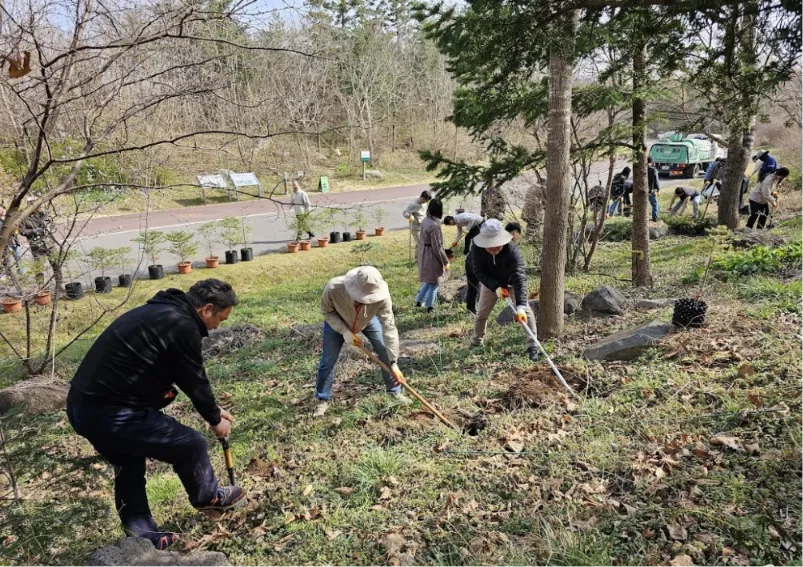
By 2050, forests aged 50 years or older are expected to account for 72% of South Korea’s total forest area. As a result, the greenhouse gas absorption rate of forests is projected to decline significantly. While the spread of renewable energy and electric vehicles is accelerating reductions in carbon emissions, the absorption sinks that must support those reductions are actually weakening. This is one reason why calls have persistently continued for new carbon sinks beyond existing ones such as forests and vegetation in South Korea’s carbon neutrality reduction strategy. In this context, the ground beneath our feet is now garnering attention as a new carbon sink.
Carbon Sinks: Now It’s Soil, Beyond Forests
On May 21, the Ministry of Climate, Energy and Environment held a kick-off meeting at Sangyeonjae Seoul Station for the ‘Soil-Based Environmental Technology Development Project to Contribute to Achieving the Nationally Determined Contribution (NDC)’ and announced plans to pursue related research in earnest. This project aims to develop soil carbon absorption and removal technologies suited to the domestic environment. It is also expected to be utilized as a substantive carbon reduction tool, linked to the ‘National Greenhouse Gas Inventory’ — the administrative process for calculating national greenhouse gas emissions and absorption. With this project, the carbon absorption policy that was previously forest-centered is expected to expand to the soil domain.
According to the Intergovernmental Panel on Climate Change (IPCC), soil is considered a larger carbon reservoir than the atmosphere and vegetation, with soil carbon storage at approximately 1,700 PgC (petagrams of carbon), far exceeding the atmospheric carbon storage of 870 PgC and vegetation carbon storage of 450 PgC. The IPCC’s Working Group III Sixth Assessment Report, published in April 2022, emphasized the importance of carbon absorption by introducing the ‘Top 10 Carbon Removal Technologies,’ which included four soil-based carbon absorption and removal technologies.
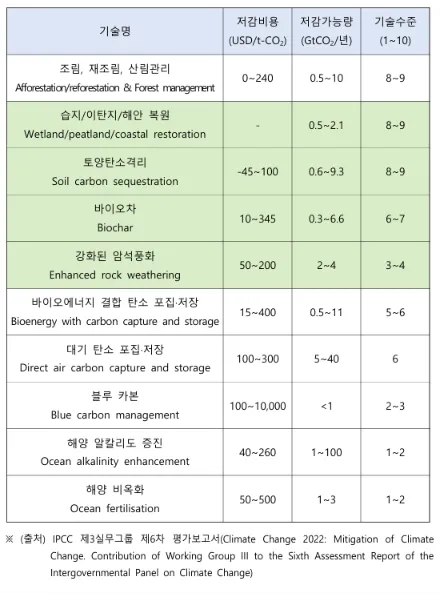
[Top 10 Carbon Removal Technologies © IPCC Working Group III Sixth Assessment Report]
Soil Carbon Absorption and Removal Project: What Is Being Researched?
In the first year of the project, the Ministry of Climate, Energy and Environment is pursuing research on five technologies, including ▲Biochar Utilization Technology ▲Enhanced Rock Weathering Technology ▲Integrated Impact Assessment Model for Soil Carbon Absorption and Removal. Among these, the most noteworthy technology is ‘biochar.’ Biochar is a compound word of ‘biomass’ and ‘charcoal,’ and is a material produced by pyrolyzing wood, agricultural crop residues, organic waste, etc. at high temperatures in the absence of oxygen. During the production process, carbon is converted into a stable structure, and when applied to soil, it can store carbon semi-permanently for over 100 years.
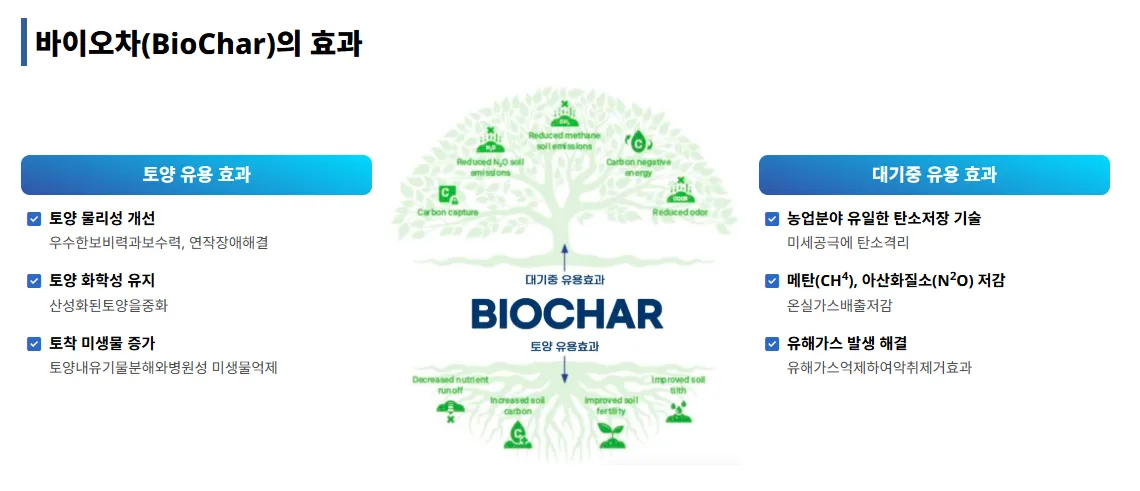
[Effects of Biochar © Korea Biochar Association Official Website]
Second, ‘enhanced rock weathering technology’ involves crushing rocks with high calcium and magnesium content and spreading them on soil, where they absorb atmospheric carbon dioxide in the form of carbonates. The resulting carbonates remain in the soil and oceans, sequestering carbon. Third, in the ‘integrated impact assessment model’ development stage, the effectiveness of soil carbon absorption and removal technologies is scientifically verified, and the environmental positive and negative impacts of the technologies on ecosystems are comprehensively analyzed. The integrated impact assessment model is a key evaluation tool for scientifically verifying greenhouse gas reduction effects. This project is a public-sector technology development initiative, and in the future, institutions or operators designated by the Ministry of Climate, Energy and Environment will be able to use the developed technologies free of charge.
Measurement Standards as Important as Carbon Absorption Technology
Advancing soil carbon absorption technology affects not only national greenhouse gas reduction targets but also corporate ESG strategies. As domestic companies prepare for ESG disclosures based on the status of NDC implementation, securing carbon sinks can contribute to enhancing the credibility of carbon neutrality roadmaps. If a company’s soil carbon absorption performance is officially recognized as a greenhouse gas reduction amount, companies could use farmland or idle land to secure greenhouse gas emission credits. However, for this to happen, an MRV system (Measurement, Reporting, and Verification) that can incorporate soil-based carbon absorption performance into the national greenhouse gas statistical report must first be established. As soil carbon absorption and emission rates vary significantly depending on regional characteristics and climate conditions, establishing reliable measurement standards is just as important as technology development.
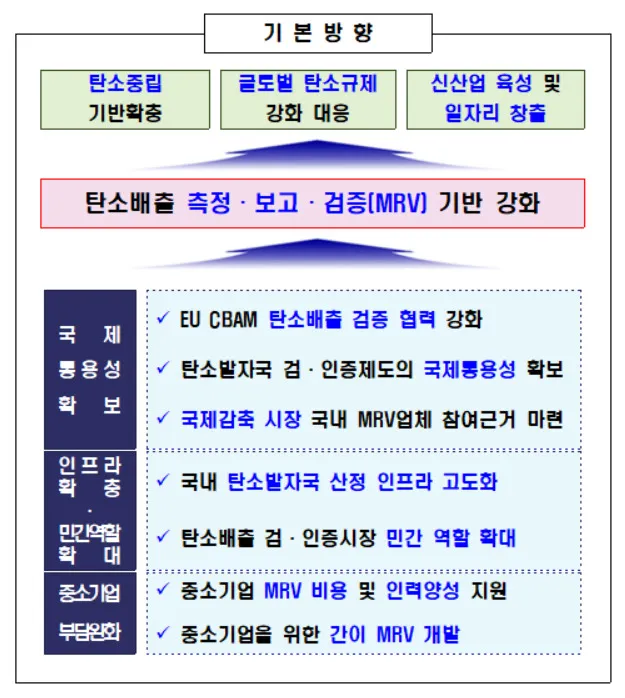
[MRV Strengthening Plan © Ministry of Economy and Finance]
Until now, carbon reduction strategies have primarily been discussed in terms of reducing emissions. However, this project is significant in that it develops the opposite side — carbon absorption technology. Now, as corporate ESG disclosure obligations are being expanded in stages, securing sink-based carbon performance could serve as a means to fill the gaps in NDC achievement that could not be met through emissions reduction alone. For soil to become a genuine strategic resource for carbon neutrality, technology and institutional frameworks must accelerate together.
by Editor L