

In November 2025, the U.S. startup Starcloud, backed by NVIDIA, became the first in the world to successfully train and run a large language model (LLM) in space. It ran Google’s small language model ‘Gemma’ on a satellite equipped with the NVIDIA H100 high-performance GPU to generate responses. And half a year later, on June 12, 2026, SpaceX, the space infrastructure company run by Elon Musk, listed on NASDAQ and broke through a corporate valuation of USD 2 trillion (approximately KRW 3,040 trillion).
Starcloud’s experiment proved that the most power-hungry chip on Earth can also operate in the vacuum of space. SpaceX has also revealed a vision of converting its currently operating Starlink satellite network into a space-based data center network for processing AI workloads. The possibility of harnessing unlimited solar energy for AI data — currently burdening terrestrial power grids — has now opened up.

[SpaceX NASDAQ listing event © Nasdaq Newsroom]
Space: The Next Frontier for Data Centers
In the AI era, data centers require high-efficiency cooling systems because they consume massive amounts of electricity, and they must be able to scale rapidly to keep pace with growing demand. However, meeting these conditions on Earth is becoming increasingly difficult. Global data center electricity consumption is projected to double to 945 TWh (terawatt-hours) by 2030, and the share of power consumed by AI-optimized servers is expected to surge from 21% in 2025 to 44% in 2030. Global data center power consumption already exceeds the total electricity use of some smaller nations, and competition to secure suitable sites is intensifying. Google, which once declared it would use only clean energy, officially acknowledged in its 2025 environmental impact report that achieving its goal of net-zero carbon emissions by 2030 has become extremely difficult due to the massive power demand from generative AI.
The breakthrough that Big Tech has chosen between energy pledges and AI growth is space. Space meets all three conditions that Earth struggles to fulfill: power, cooling, and scalability. In space, solar power generation is possible continuously without the influence of weather or time zones, and the sun emits approximately 400 trillion watts of energy. For cooling, the cryogenic environment of space holds the potential to replace the complex cooling systems on Earth. Unlike Earth, constrained by site regulations and grid saturation, there are no physical limitations in orbital space.
Big Tech Heading to Space, from SpaceX to Google
As space emerges as a solution to the AI power problem, the person most aggressively pursuing this vision is undoubtedly Elon Musk. Musk, who founded SpaceX in 2002, expressed his ambition to build AI data centers in space at the World Davos Forum in January of this year, stating, “Thanks to solar energy and the cryogenic environment, operating AI data centers in space would be very low cost.” To realize this, SpaceX merged with the AI startup xAI in February of this year — xAI also being a company run by Elon Musk. At an investor briefing ahead of SpaceX’s listing, Musk outlined plans to combine xAI’s large language model (LLM) and real-time data processing technology with Starlink’s satellite internet network to build a massive AI data center in orbital space outside Earth.
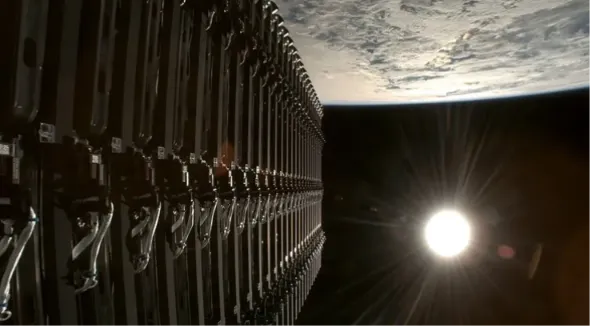
[Starlink satellites built by SpaceX © SpaceX Official Website]
That said, space data centers are not Elon Musk’s stage alone. In November 2025, Google announced ‘Project Suncatcher,’ a plan to build data centers that directly use solar energy in space. The basic concept is to launch solar-powered satellites into low Earth orbit, equipped with Google’s AI-specific Tensor Processing Units (TPUs) and optical communication links. To this end, Google plans to launch two test satellites with partner Planet Labs by early 2027. Google CEO Sundar Pichai said, “Within ten years, space data centers will become routine.”
Thermal Management, Communication Latency, Space Debris… Mountains to Climb
While the vision for space data centers is rapidly taking shape, the technical hurdles to overcome are formidable. Space data centers must address four key challenges before they can become a reality: thermal management, radiation resistance, orbital safety, and launch/assembly. While space is cold, cooling electronic equipment is not as straightforward as it seems. Heat can only be dissipated through radiation in the form of infrared, not convection, requiring large, efficient radiators. Starcloud was unable to run its GPU continuously for 24 hours in its first satellite experiment due to overheating issues. Communication latency also needs consideration. Even in low Earth orbit, data round-trip delays can occur. For this reason, space data centers are more likely to be initially used for training large AI models rather than real-time services. The risk of space debris collisions and the impossibility of immediate repairs in case of failure are also challenges that must be resolved.
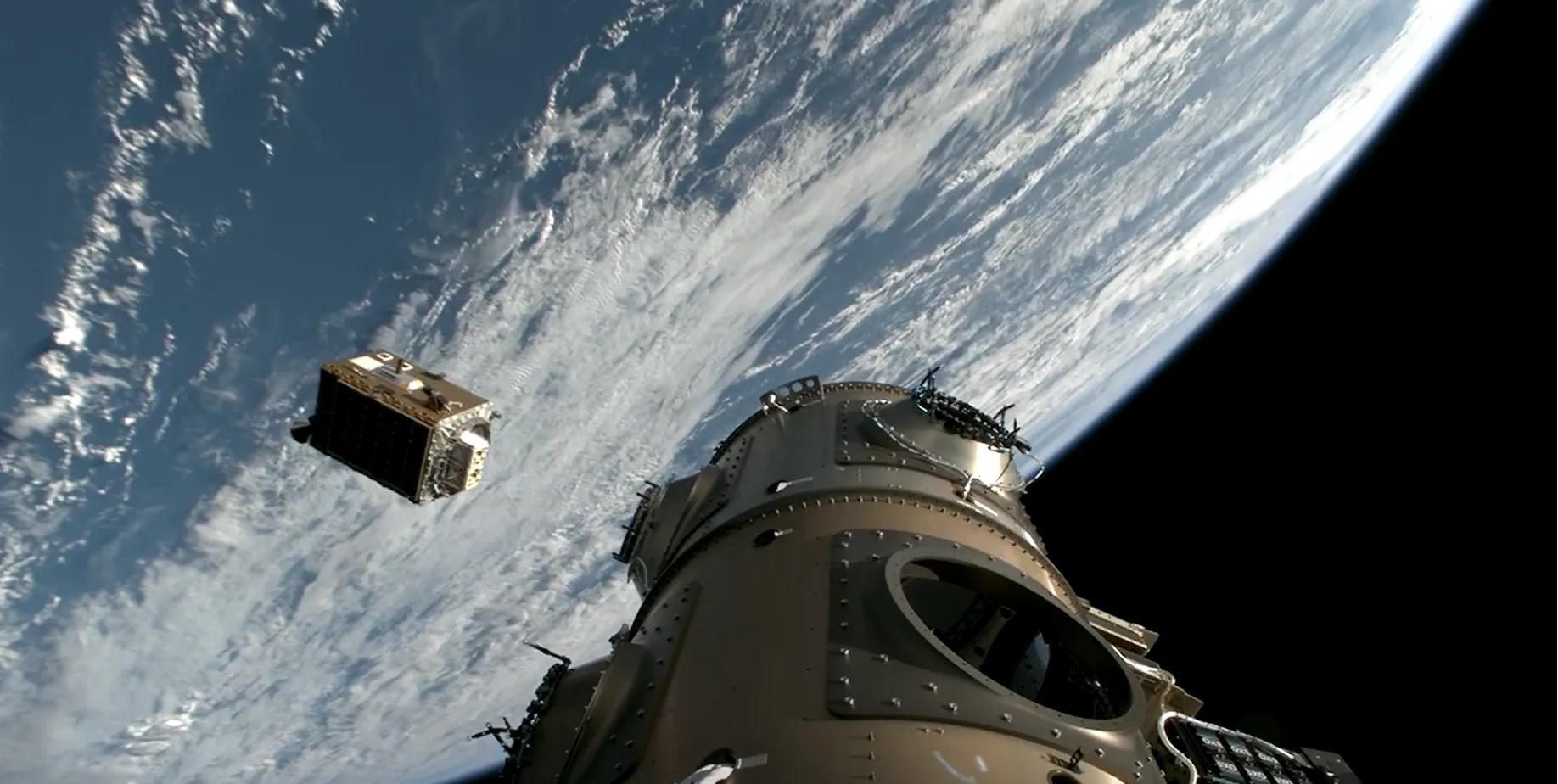
[Starcloud satellite within the space data center © Starcloud Official Website]
Space data centers are not merely a technological innovation — they are directly connected to the ESG E (Environmental) agenda. The surge in Big Tech’s carbon emissions is already a major concern for global investors. If space data centers become commercially viable, they could serve as a structural turning point that reduces the fossil fuel dependence of terrestrial data centers and increases the feasibility of meeting climate pledges. On the other hand, new environmental risks are also emerging, such as the space debris problem from mass satellite launches and interference with astronomical observation. In the era when the address of data centers is shifting to orbital space, it is time to pay attention not only to the direction of the technology but also to its pace and manner.
by Editor L