
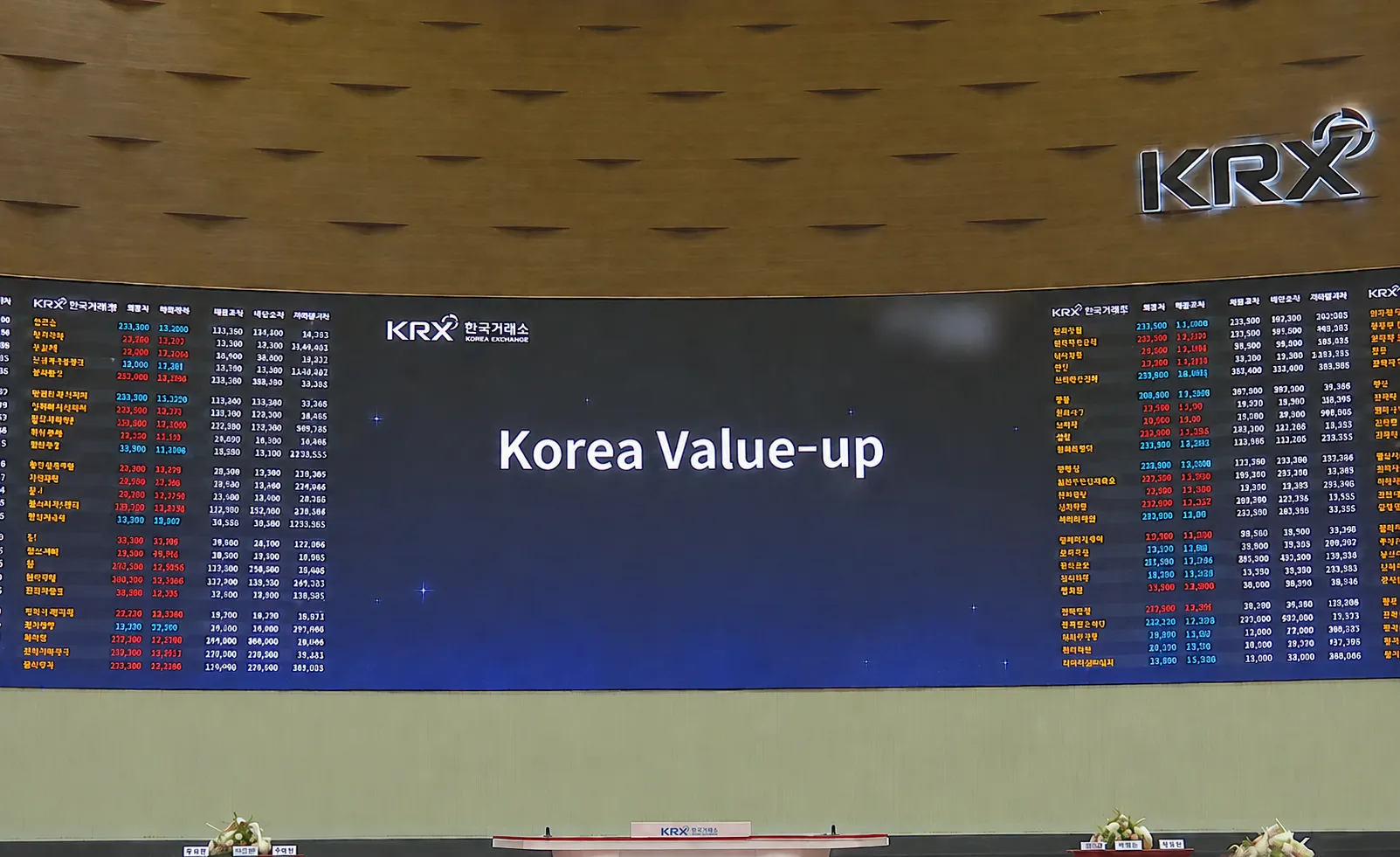
The Korea Exchange (KRX) confirmed the regular rebalancing of the Korea Value-Up Index constituent stocks through the Index Operation Committee on May 21, and the results began to be fully reflected in the market starting June 12. With 20 stocks added and 19 removed in this rebalancing, all 100 constituents have now been filled with companies that have disclosed corporate value enhancement plans roughly two years after the index’s launch. The core of this regular rebalancing lies not in the numerical reshuffling itself, but in the shift in the index’s operational direction.
The Korea Value-Up Index had only 7 disclosing companies among its constituents when first announced in September 2024. The disclosure ratio steadily expanded thereafter — reaching 25% in December 2024 and 61% in June 2025 — and with this adjustment, it has reached 100%.
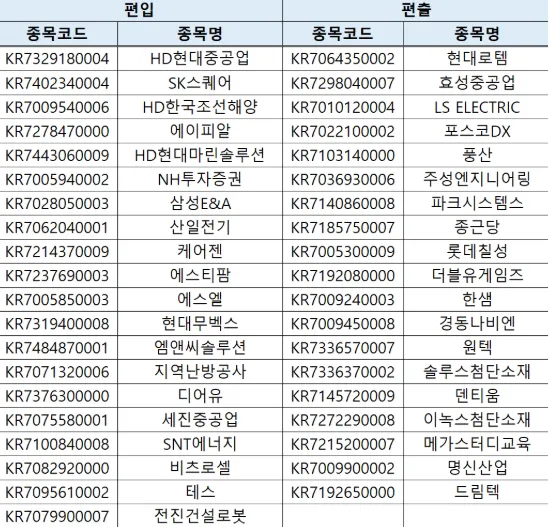
[Korea Value-Up Index additions and removals © Korea Exchange]
Disclosure Compliance Determines the Fate of Stocks
This regular rebalancing is the ‘Phase 3’ measure — the final stage of the phased operational plan outlined by the KRX. In Phase 1, which began in 2024, companies that made early disclosures of their corporate value enhancement plans were granted special inclusion, allowing them to remain in the index for two years, thereby encouraging voluntary participation. Starting with Phase 2 the following year, special inclusion was applied to companies recognized as Value-Up Excellence Companies, and incentives such as relaxed evaluation criteria were provided to disclosing companies. Conversely, penalties were imposed on previously included companies that failed to disclose, such as tightened criteria for market valuation and market capitalization. Phase 3, applied this month, constitutes the index centered on disclosing companies, while non-disclosing companies may be preferentially removed.
Under this direction, industry-specific performance trends and disclosure compliance determined the fortunes of individual stocks in this rebalancing. In the industrial goods sector, major shipbuilding and power infrastructure companies such as HD Hyundai Heavy Industries, HD Korea Shipbuilding & Offshore Engineering, and HD Hyundai Marine Solution were added in significant numbers. In the IT sector, SK Square and Tes were included; in consumer staples, APR; in healthcare, Caregen; and in finance, NH Investment & Securities — a total of 20 stocks newly entered the index. Conversely, major industrial and IT companies such as Hyundai Rotem, Hyosung Heavy Industries, POSCO DX, and Poongsan, which had recently seen rising stock prices, were removed. A clear signal has been sent to the market that even companies with solid performance metrics can hardly remain in the index without disclosure.
Constituent Count from 99 to 100, Market Cap Share Expands to 54.6%
The Korea Value-Up Index constituent count had decreased to 99 last December due to the merger of HD Hyundai Infracore, but was readjusted to 100 through this regular rebalancing. After the rebalancing, the market capitalization share of the index constituents relative to the total KOSPI and KOSDAQ market capitalization reached approximately 54.6%. With the large-scale inclusion of key companies from market-leading sectors such as shipbuilding, defense, and IT, the index’s market representativeness can be assessed as having broadened further.
The changes will also be automatically reflected in the asset composition of exchange-traded funds (ETFs) that track the Korea Value-Up Index as their underlying asset. As of the end of March 2026, the total net assets of 13 Value-Up ETFs stood at ₩2.6 trillion, a 439.4% increase from their initial launch. With this reorganization expected to increase the weight of shipbuilding and infrastructure stocks while reducing that of some consumer goods and healthcare stocks, ETF investors’ portfolio shifts also warrant attention. Since its base date of September 30, 2024, the Korea Value-Up Index has recorded returns exceeding the KOSPI’s increase by 31.8 percentage points, driving capital inflows.
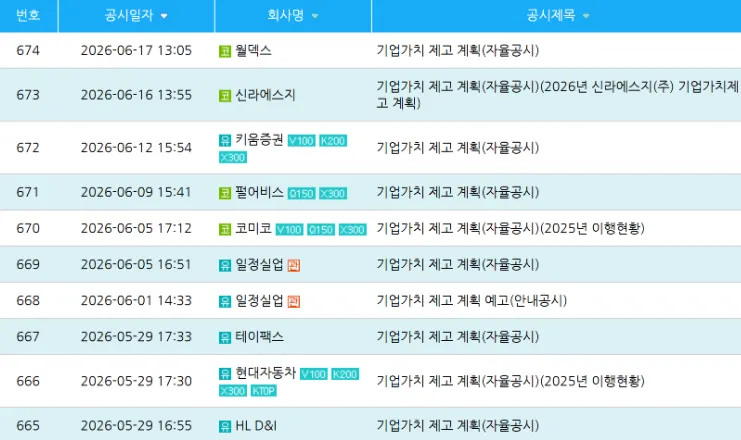
[Korea Value-Up Corporate Disclosure Status © Korea Exchange KIND]
Tax Incentives as a Catalyst for Accelerated Disclosure Participation
Beyond the phased operational plan, another backdrop to this reorganization is the explosive increase in the number of companies participating in disclosure. With the December 2025 revision of the Special Tax Treatment Control Act, separate taxation was introduced for dividend income from stocks of high-dividend companies meeting certain requirements, excluding it from aggregation with other financial income. Following the revision, disclosure became mandatory for high-dividend companies seeking dividend income tax benefits. Individual shareholders with financial income of ₩20 million or less had their dividend income withholding tax rate lowered from 14% to 9%, and companies could deduct 5% of the excess from corporate tax if their total shareholder return increased by 5% or more compared to the average of the preceding three years.
These tax incentives became a decisive driver of corporate participation in disclosure. In March 2026 alone, a total of 409 companies newly disclosed corporate value enhancement plans, of which 405 were high-dividend companies. The cumulative number of listed companies that have disclosed totaled 590, comprising 307 on KOSPI and 283 on KOSDAQ, a sharp increase from 181 at the end of February to 590 in a single month. As the tax benefit requirements for high-dividend companies are linked to the disclosure obligation, value-up disclosure is rapidly establishing itself as essential capital market infrastructure.
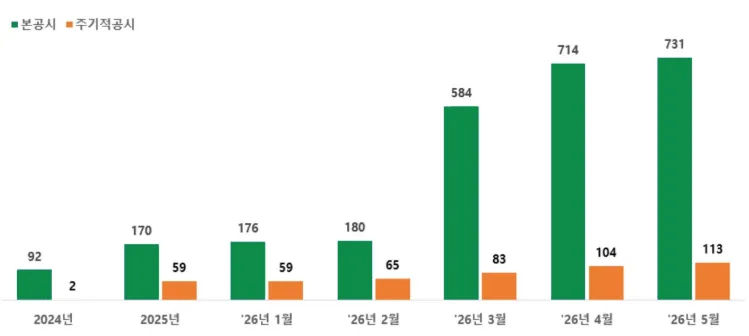
[Cumulative Trend in Number of Companies Filing Main Disclosures © Korea Exchange ‘Monthly Corporate Value Enhancement Status’]
The KRX stated, “We plan to manage the index according to the phased operational plan, aiming to support the spread of a corporate value enhancement culture by constructing the index centered on companies that have disclosed value enhancement plans.” However, while the formal goal of a 100% disclosure system has been achieved, the completion of disclosure does not guarantee the improvement of corporate value. Demands for qualitative criteria such as the substantive depth of disclosure content, the traceability of plan implementation, and whether they are linked to shareholder return performance are emerging as the next challenge. Whether this reorganization prompts additional listed companies to participate in disclosure and how well existing disclosing companies fulfill their promises will be the yardstick for measuring the substantive performance of the Value-Up Program.
by Editor L