

2026 marks the first year in which the carbon cost structure for Korean companies fundamentally changes. The 4th Planning Period (2026–2030) National Emission Allowance Allocation Plan, finalized by the government at a Cabinet meeting on November 11, 2025, includes provisions to phase up the paid allocation ratio for the power generation sector from the current 10.0% to 15.0% in 2026, 20.0% in 2027, 30.0% in 2028, 40.0% in 2029, and 50.0% in 2030. The EU’s Carbon Border Adjustment Mechanism (CBAM) also entered full-scale implementation this year.
During the term of the 9th popularly elected local governments, when the dual pressures of escalating paid emission allowance phases and mandatory CBAM certificate purchases will operate simultaneously, the level of regional renewable energy infrastructure will directly determine the carbon costs of businesses in that region. Companies in regions with high renewable energy accessibility can lower their emission coefficients and reduce the cost burden under both regulations, while companies in regions with insufficient infrastructure may face higher carbon costs even when producing the same products. This is why the ESG competitiveness landscape of businesses in a given region shifts depending on which local government head is elected in the June 3 local election.
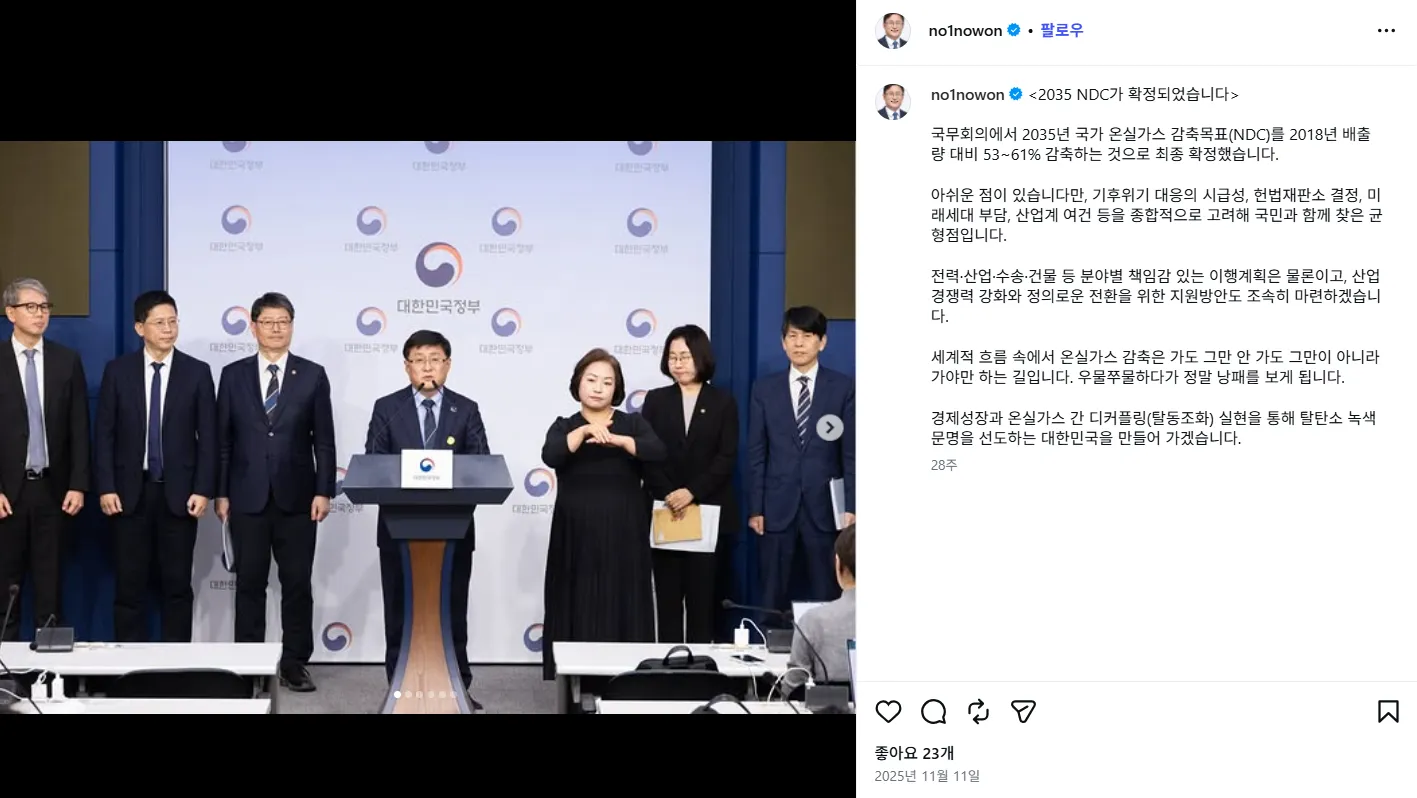
[Nationally Determined Contribution Confirmation © Minister of Climate, Energy and Environment Kim Sung-hwan Instagram]
CBAM Full-Scale Implementation: Challenges for Steel-Concentrated Regions
CBAM is a carbon tariff system formally enacted by the EU in May 2023. Following a transition period through December 2025, it entered full-scale implementation on January 1, 2026. Importers must report the total volume and carbon emissions of products imported in the previous year once annually by May 31 and purchase CBAM certificates equivalent to those emissions. Certificate prices are linked to EU Emissions Trading System (ETS) allowance prices, and failure to submit certificates incurs fines of up to €140 per ton of carbon emissions.
South Korea’s cost burden for CBAM compliance is concentrated in steel. According to 2022 Korea International Trade Association statistics, steel accounts for approximately 90% of South Korea’s exports of CBAM-covered items to the EU. For regions such as Jeonnam, Gyeongbuk, and Chungnam, where major steelmakers including POSCO and Hyundai Steel and related parts and materials companies are densely located, CBAM is a regional economic issue directly tied to export competitiveness. To reduce the CBAM certificate costs applied to companies exporting to the EU, carbon emissions in the production process must be reduced, making renewable energy accessibility in the region a decisive variable.
The Lee Jae-myung administration has designated the creation of RE100 industrial complexes as a national agenda item. The ‘2026 Economic Growth Strategy’ announced by the Ministry of Economy and Finance on January 9, 2026, includes tax support such as 100% income and corporate tax exemption for 10 years for startups in RE100 industrial complexes followed by an additional 50% reduction for 5 years, along with raised local investment promotion subsidy limits and national treasury subsidy ratios, streamlined permitting, and measures to lower renewable energy procurement costs.
Emission Allowance Costs Rising One Step at a Time Throughout the Term
The core of the 4th Emission Allowance Allocation Plan is not a simple ratio adjustment. The partial amendment to the Emissions Trading Act promulgated on October 28, 2025, maintains free allocation for sectors at risk of carbon leakage and special-use sectors such as local governments, public transportation, schools, and medical institutions, but strengthens the Benchmark (BM) coefficient — the baseline value for allowable greenhouse gas emissions per unit of product — to the top 20.0% level by 2030. This means that the baseline for the emission efficiency-based allocation method itself rises each year, creating a structure in which companies bear higher costs even when emitting the same amount of carbon.
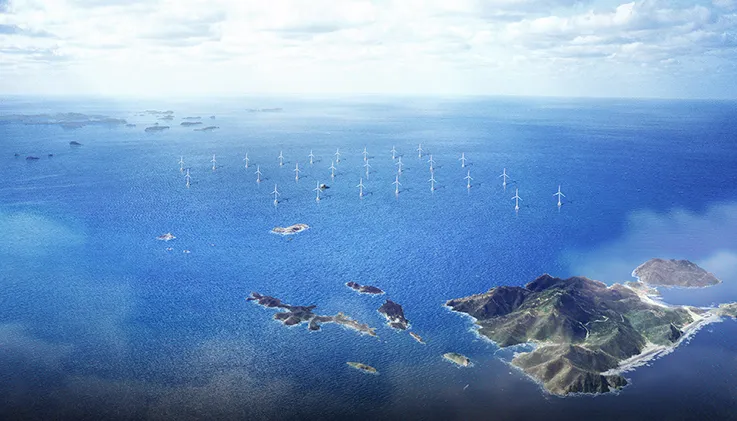
[‘Shinan-Ui Offshore Wind Project,’ the first project of the National Growth Fund and related to RE100 Industrial Complex development © Jeollanam-do Provincial Government]
There are two practical ways for companies to reduce carbon costs: reduce emissions themselves, or switch to renewable energy to lower their emission coefficient. Both methods are difficult to accelerate without infrastructure support from local governments. This is the context for the Ministry of Trade, Industry and Energy’s allocation of ₩1.2703 trillion for renewable energy-related budgets in 2026 — a 42.0% increase from the previous year — including a record ₩648 billion for financial support projects for RE100 industrial complexes, agrivoltaics, and offshore wind expansion. The execution of this budget takes place in the regions, and the speed of execution depends on the administrative capacity of local governments.
The Renewable Energy Infrastructure Gap Determines Regional Corporate Competitiveness
In the competition for RE100 industrial complex site selection, Jeonnam currently leads the pack. It boasts abundant renewable energy potential and relatively advanced solar and offshore wind infrastructure. An October 2025 issue report by the Jeonnam Research Institute, ‘Chronicling the Asset Report of the Energy Transition: Proposals for Building Jeonnam-Style RE100 Industrial Complexes,’ presented a full-cycle support framework encompassing energy supply–grid stabilization–corporate implementation–institutional/incentive support–performance management as the core conditions for RE100 industrial complexes, arguing that “Jeonnam’s renewable energy production capacity must be linked to job creation, improved living conditions, and the attraction of high-tech enterprises to build a virtuous economic cycle.” This is the context in which Democratic Party candidate Kim Young-rok’s core pledge for the integrated Jeonnam-Gwangju Special City includes the designation and creation of 2 million pyeong of RE100 industrial complexes in the Yeongam Samho and Sampo districts.
In contrast, companies in regions with insufficient renewable energy infrastructure have limited means of achieving RE100. As of 2024, South Korea’s renewable energy generation share stands at approximately 9.0%, just one-third of the OECD average (31.0%). While the government is targeting 100 GW of installed capacity by 2030, the actual pace of expansion varies significantly by region. The solar potential of industrial complexes managed by the Korea Industrial Complex Corporation reaches 4.7 GW, but actual installed capacity stands at only 0.8 GW (17.0%). Companies in regions with low renewable energy accessibility face a structure in which they bear higher CBAM costs when exporting to the EU and also pay higher costs in the domestic emission allowance market.

[Sample June 3 Local Election Ballot © National Election Commission]
Issues and Limitations: Legal Gaps and By-Election Variables
The challenge lies in the gap between pledge intent and actual execution. With the RE100 Industrial Complex Special Act yet to pass the National Assembly, it is difficult for local government heads to independently finalize RE100 industrial complex locations and establish power supply systems. Democratic Party lawmaker Kim Jung-ho pointed out during a National Assembly audit that “if the institutional and technological foundations are not in place before 2026, when RE100 industrial complexes are slated to begin full-scale development, achieving the targets will be difficult.”
The results of the 14 National Assembly by-elections held on the same day are also important in this context. With all five RE100 Industrial Complex Special Act bills having been introduced solely by Democratic Party lawmakers, the by-election results directly affect the legislative timeline and momentum for these bills. The establishment of a Measurement, Reporting, and Verification (MRV) system for CBAM certification also falls on companies to handle independently, but the response speed of SMEs and mid-sized enterprises varies depending on how much intermediary support local governments provide. This is the significance of June 3, when the selection of local government heads and the composition of the National Assembly are simultaneously decided.
The four-year term of the 9th popularly elected local governments is a period in which the paid allocation ratio in the power generation sector rises from 10.0% to 50.0%, CBAM certificate obligations become fully operational, and the statutory transition for ESG disclosure converges. Over these four years, during which all three systems are simultaneously strengthened, the ESG competitiveness of regional businesses becomes even more directly linked to the renewable energy infrastructure of the region and the carbon neutrality administrative capacity of the local government head. Companies in regions capable of sufficiently supplying renewable energy can remain in global supply chains by implementing RE100, while companies in regions that cannot will fall behind in competition as carbon costs accumulate. The local government head we choose on June 3 determines not only four years of regional carbon policy but also the ESG cost structure of businesses operating in that region. The direction of the transition is clear, but the pace and center of gravity are still pointing elsewhere.
by Editor L