
Along with mosquitoes, there is one insect that will soon visit us and has appeared more frequently in the media in recent years than perhaps any other: the red-backed hairy fly, better known as the lovebug. This insect, which flies with male and female joined tail-to-tail in mating pairs, was first discovered in Korea in 2015, but it has been at the center of full-scale controversy only since 2022. That year, lovebugs densely blanketed the streets of western Seoul districts such as Eunpyeong-gu and Mapo-gu as well as Goyang in Gyeonggi Province, startling residents. And now, larvae are being discovered as far north as Dongducheon and Yeoncheon at the northernmost edge of Gyeonggi.
Public opinion largely regards lovebugs as repulsive due to their distinctive appearance and overwhelming numbers, yet at the same time, they are a part of our ecosystem and are in fact beneficial insects. How can we coexist with lovebugs this summer and in the summers ahead? Let us examine the causes of their mass outbreak uncovered over the past five years of controversy, the debates surrounding them, and approaches for living alongside them.
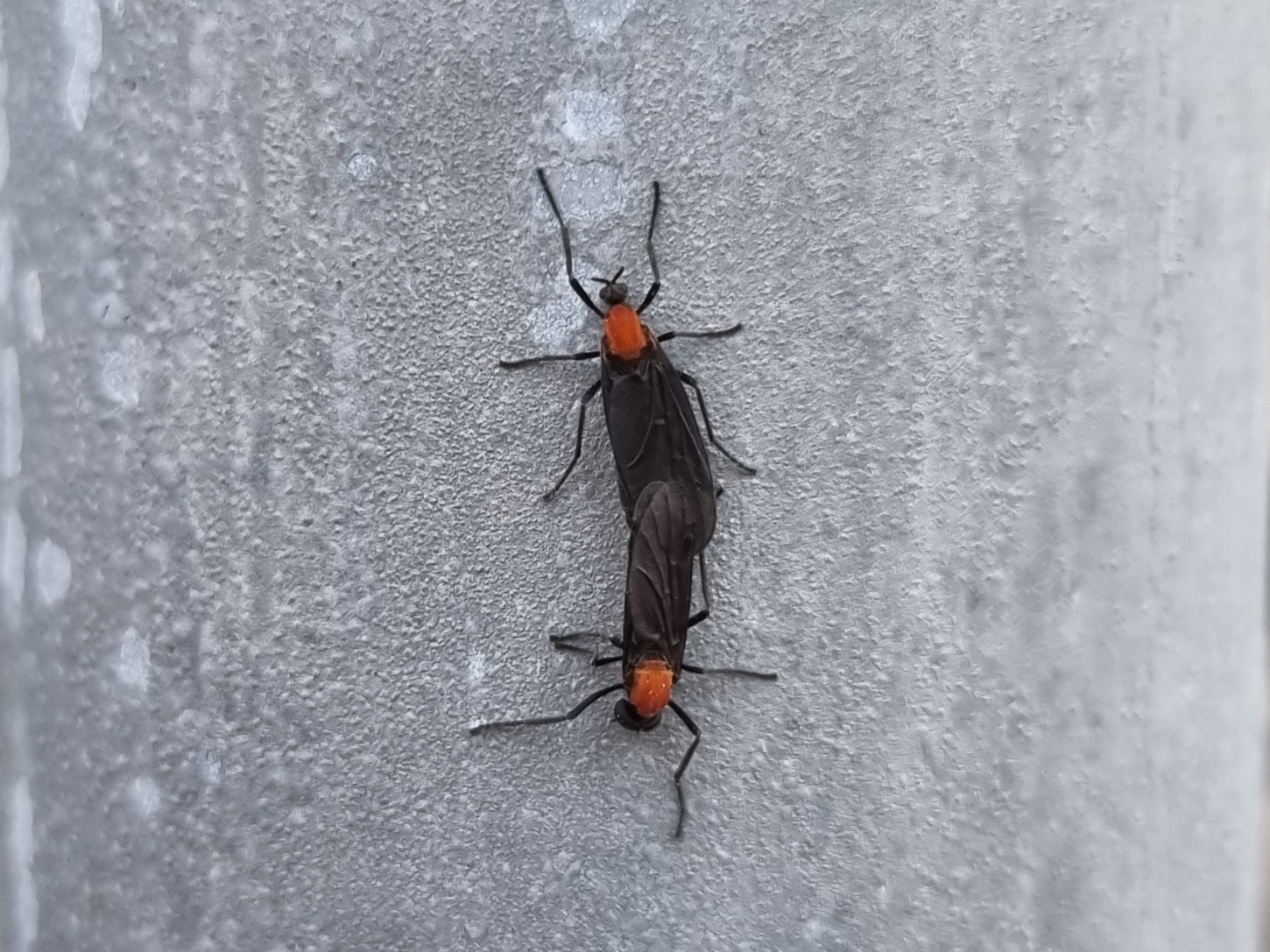
[Lovebug (Plecia nearctica) © National Institute of Biological Resources]
Why Have Lovebugs Become So Numerous?
Lovebugs are originally insects found abundantly in warm regions such as southeastern China and Okinawa, Japan. Climate change is cited as the main reason for the surge in their population in South Korea, especially in Seoul and Gyeonggi Province, since 2022. As our winters have grown warmer, the survival rate of overwintering larvae has soared, and abnormally high temperatures have accelerated larval growth, triggering mass emergence of adults. At the same time, the habitats of their natural predators — birds, frogs, and spiders — have been destroyed. In these circumstances, Korean cities have become an ideal environment for lovebugs. Urban heat island effects have made city centers even hotter, and artificial lighting attracts them.
The lovebug’s own characteristics have also played a part. They mistake the smell of automobile exhaust for the smell of decaying leaf litter that their larvae feed on, and their preference for bright colors leads them to cling to urban buildings and walls. Moreover, according to recent research by a Seoul National University team, lovebugs even possess genes for pesticide resistance and heat stress adaptation, making them well-suited to urban life.
There is also a paradoxical hypothesis that human pest control itself triggered the lovebug outbreak. Professor Shin Seung-kwan of Seoul National University’s School of Biological Sciences pointed out that the pest control measures implemented during a mass outbreak of stick insects in Eunpyeong-gu from 2020 to 2021 may have been the cause. In the process of controlling the stick insects, other predatory insects were killed alongside them, and as a result, lovebugs — despite being relatively slow insects — were able to survive in large numbers without being eaten.
Beneficial Insect vs. Pest: The Controversy Surrounding Lovebugs
Looking at lovebugs themselves, they are clearly beneficial insects. They decompose organic matter such as fallen leaves and decaying wood to enrich the soil, and as adults, they feed on dew and flower nectar, aiding plant pollination like honeybees. They do not carry pathogens or bite. Regardless of these facts, people’s perception of lovebugs remains negative because they swarm in the thousands, cling to clothing and window screens, and give off an unpleasant odor when their carcasses decompose. Dead lovebugs splattered on cars can turn acidic and corrode vehicle paint, and they cling to storefronts and entrances, disrupting business. According to a survey by the Seoul Institute, 86% of respondents considered lovebugs to be pests, and related complaint calls were said to be paralyzing administrative work. In response, the Seoul Metropolitan Government classified lovebugs not as traditional pests but as ‘epidemic discomfort-causing insects.’
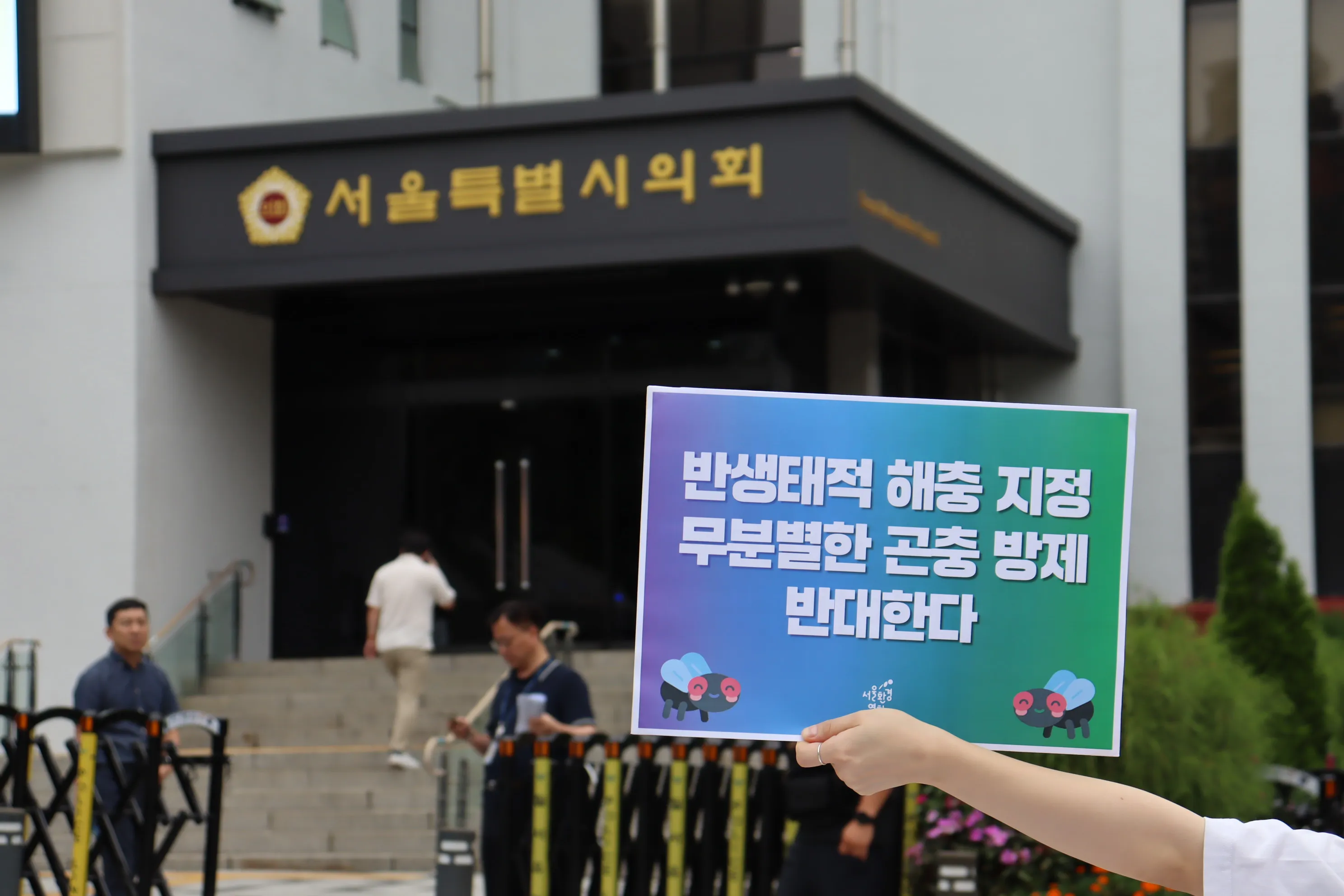
[Environmental groups opposing the Seoul City ordinance on mass insect management and control support © Seoul Federation for Environmental Movement]
Environmental groups have pointed out that such classification could lead to the logic that ‘any insect that causes discomfort can be controlled, even if it does not harm people,’ potentially resulting in indiscriminate insect destruction. Since it is virtually impossible to control only lovebugs without affecting other species, some argue that enduring a week of summer with lovebugs is environmentally and economically preferable. As indiscriminate pesticide spraying disrupts ecosystems and even affects humans, population management rather than eradication is called for.
2026: The Year New Lovebug Control Methods Begin
The National Institute of Forest Science predicted that the main outbreak period for lovebugs in the Seoul metropolitan area in 2026 would be from June 15 to 29, with peak activity on June 24. In preparation, the National Assembly passed the ‘Partial Amendment to the Wildlife Protection and Management Act’ on May 7, and on May 21, the Ministry of Climate, Energy and Environment announced the implementation of the ‘2026 Lovebug Mass Outbreak Response Plan.’ While adult control measures such as spraying drones, portable insect vacuums, and expanded light-attractant traps are notable, the largest change lies elsewhere: moving beyond the existing approach of eradicating adults toward population control starting at the larval stage. The microbial agent used for larval removal (Bacillus thuringiensis israelensis, or BTI) had previously been widely used for mosquito larvae. The National Institute of Biological Resources reported that in indoor verification tests targeting larvae of a related species, 98% were killed within 48 hours, and that BTI acts only on fly-order larvae without affecting other plants or animals.
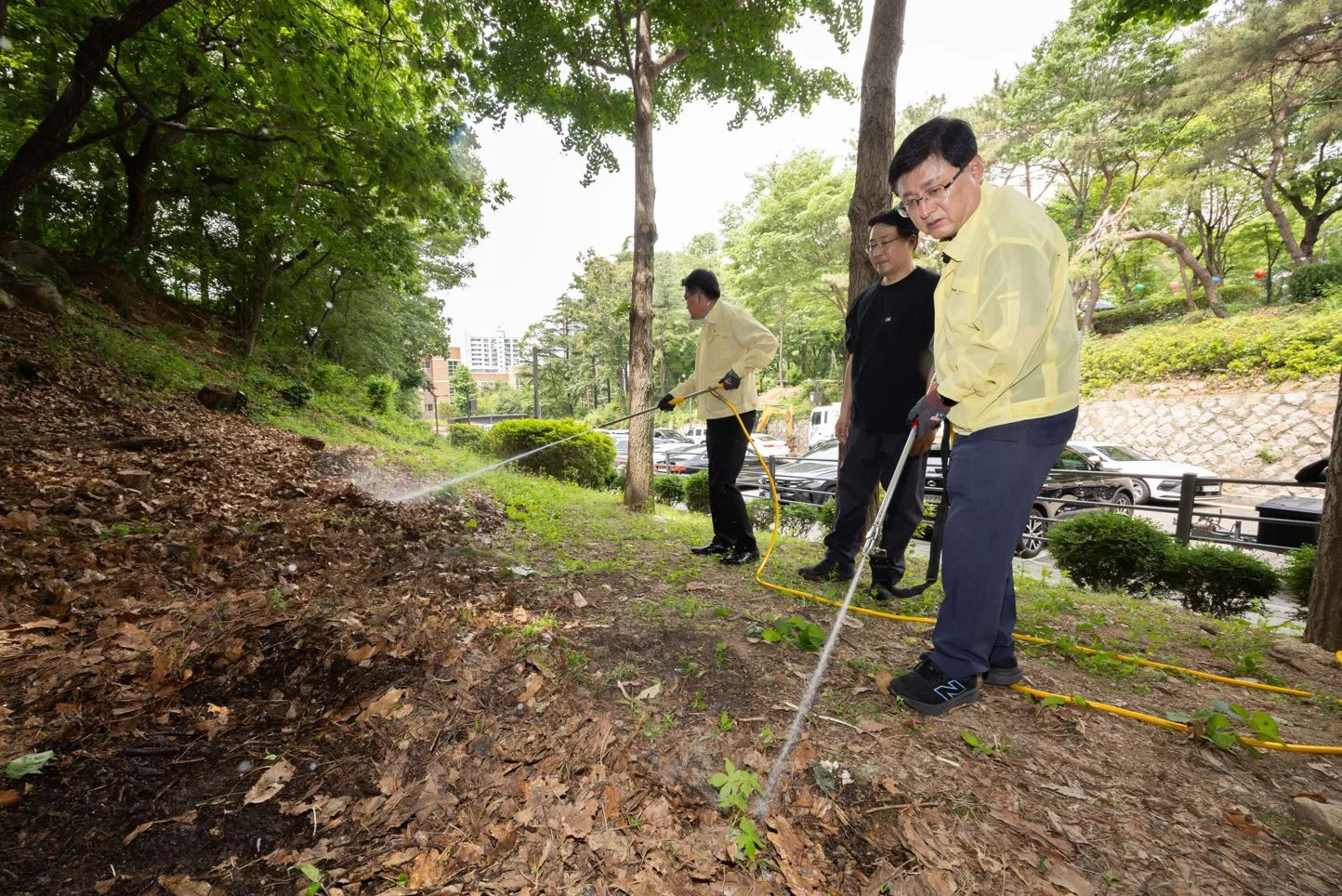
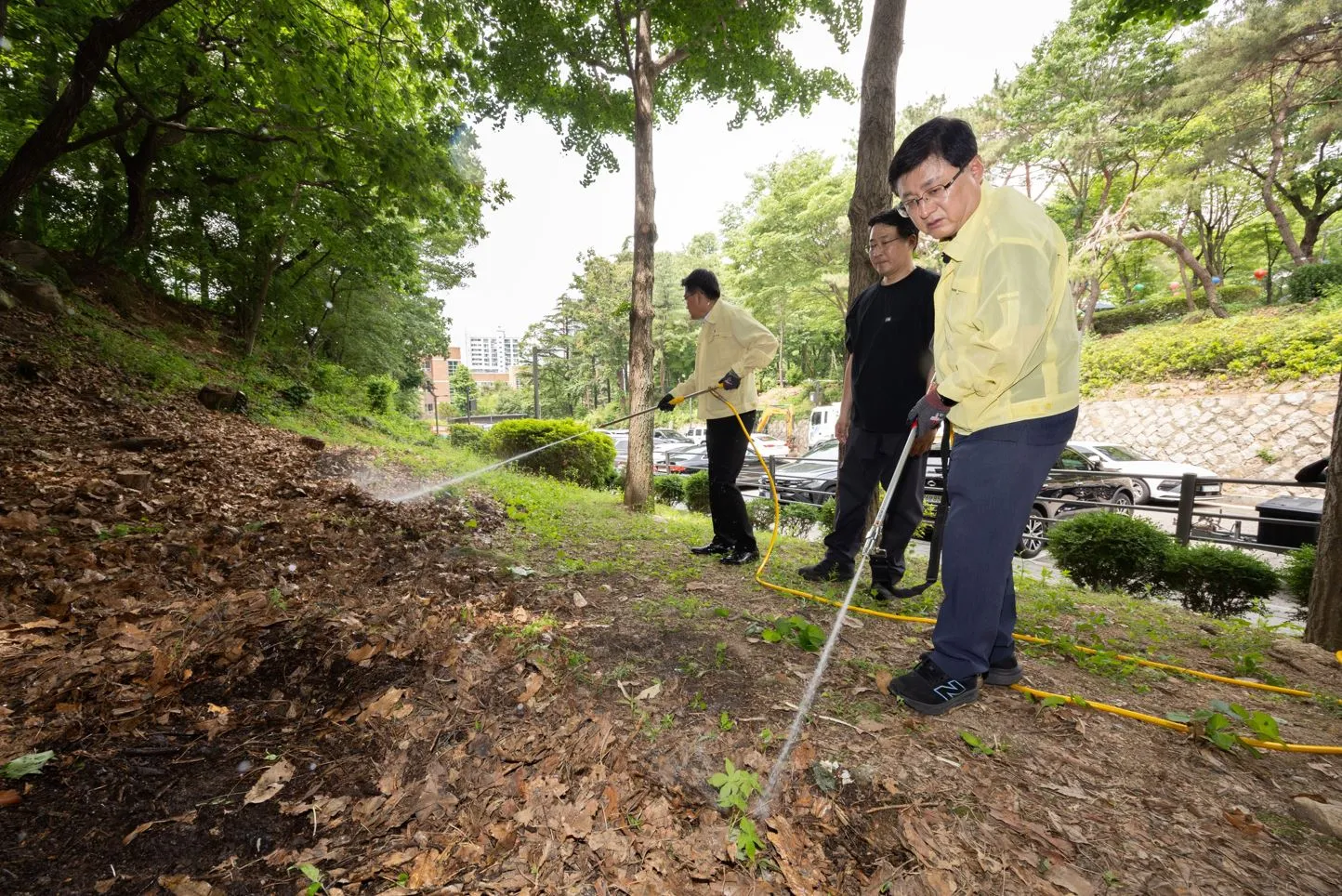
[Minister of Climate, Energy and Environment Kim Sung-hwan visiting the microbial agent spraying site at Bulamsan Mountain © Ministry of Climate, Energy and Environment]
Field experiments are already underway. At Gyeyangsan Mountain in Incheon, where complaints surged last year, 2 kg of control agent was mixed with 1 ton of water and sprayed primarily on moist soil where larvae thrive. At Baengnyeonsan in Eunpyeong-gu, 10 kg of a formulation made by coating corn kernels with BTI was mixed with 1 ton of water and sprayed, with additional kernels scattered. Related experiments are also in progress at Suraksan and Bulamsan in Nowon-gu. Meanwhile, the Korea Forest Service is testing entomopathogenic fungal control agents and plant extract control agents in forests, which showed 90% and 60% insecticidal efficacy respectively in indoor verification tests.
However, environmental groups contend that the academic consensus on these control methods is not that they are ‘safe’ but that ‘condition-dependent effects have been observed, so monitoring is required,’ and argue for a more cautious approach.
Many agree that indiscriminate chemical pesticide control destroys ecosystems. This is why considerable research and debate continue over whether truly eco-friendly control is possible and what efforts toward ecosystem coexistence should look like. According to a Seoul Institute report, if the climate crisis continues, lovebug habitats are projected to spread across the entire Korean Peninsula by 2070. With lovebugs that are sometimes seen as creepy and unpleasant, we may perhaps have no choice but to continue forming our ecosystem together and coexisting. Now is the time for deeper reflection and more experimentation.
by Editor L