
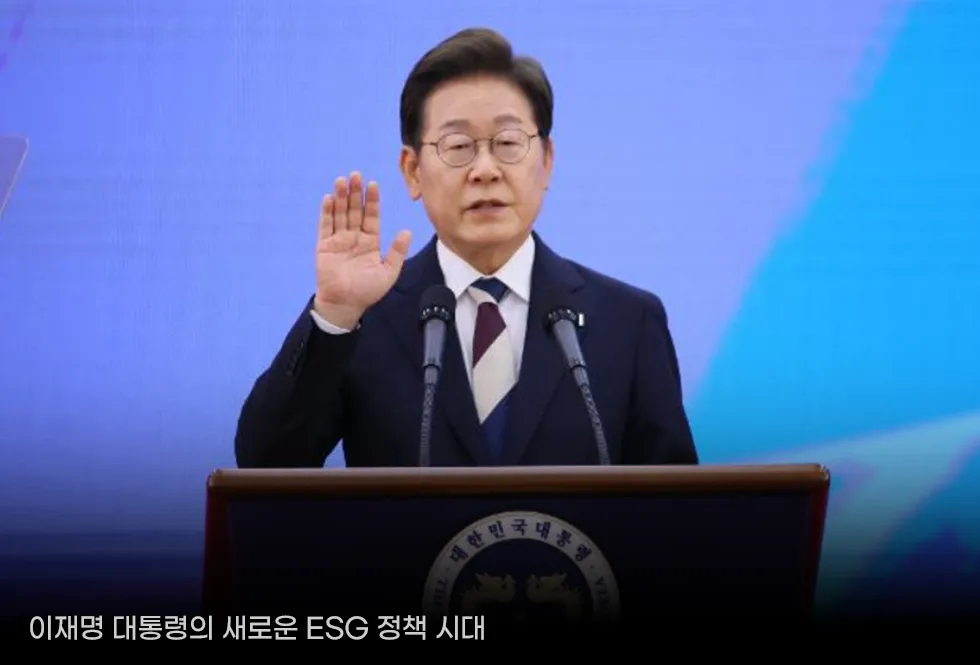
At last, a nEw president has been inaugurated. The 21st presidential election — which drew citizens' interest to the point of recording the highest turnout of 79.8% in 28 years — concluded with the victory of President Lee Jae-myung, who won 17.28 million votes, the most ever. The political and economic turmoil that all citizens had to experience due to the former president's martial law and impeachment is finding some stability amid the new president's inauguration.
The same goes for ESG-related policy. It is worth noting that President Lee Jae-myung's inaugural address, which emphasized a message of integration and recovery, contains content related to ESG policy, unlike previous presidents' inaugural addresses. President Lee emphasized that his would be a pragmatic market-oriented government, backing corporate growth while, on the other hand, protecting citizens' lives and safety, workers' rights, and the weak, and preventing market threats from unfair trade. In addition, along with aspirations for national growth and development, concrete implementation plans for responding to the climate crisis — such as transitioning to a renewable-energy-centered society, replacing energy imports, and responding to RE100 — were also contained in the inaugural address. On the occasion of President Lee Jae-myung's "People's Sovereignty Government," where more active ESG-related policy discussion is expected to follow than before, we would like to organize the ESG policy direction promised in his campaign pledges and inaugural address.
[ⓒESG.ONL]
Climate-Crisis Response as an Economic-Growth Strategy

[ⓒESG.ONL]
In his inaugural address, President Lee Jae-myung defined the present as "a time to revive people's livelihoods, restore growth, and create a happy tomorrow for all," expressing the will to keep pace with the global trend of responding to the climate crisis. Specifically, President Lee had stated as a campaign pledge that he would push to establish a "Ministry of Climate and Energy" to realize carbon neutrality. This is intended to create an entity that will integrally manage climate and energy policy, which had been dispersed across the existing Ministry of Environment, Ministry of Trade, Industry and Energy, and Ministry of Economy and Finance. If a Ministry of Climate and Energy is created, it is expected to carry out the inaugural address's declaration of transitioning the industrial structure to an eco-friendly focus and integrally managing national energy policy with a renewable-energy focus. Also included in the inaugural address were the introduction of a dedicated PPA planned-siting system for expanding renewable energy — which progressed somewhat slowly under the previous government — and infrastructure expansion such as an energy highway connecting West Coast offshore-wind complexes with the metropolitan area. In addition, President Lee's pledges include the complete abolition of coal-fired power generation by 2040, the overhaul of the greenhouse-gas reduction roadmap, RE100 achievement for industrial complexes, and the reform of the greenhouse-gas emissions-trading system, so an active overhaul and application of carbon-neutrality policy is anticipated.
President Lee's inaugural address contains both the content of "creating a country that grows and develops vigorously again" and a climate-crisis response strategy, giving rise to the expectation that he will pursue overcoming the economic crisis and the climate crisis — the pressing tasks of our society — from a perspective of integration. We should pay attention to the presentation of a growth model that catches two rabbits — economic growth and climate-crisis response — beyond the frame that renewable energy and eco-friendly policies are progressive policies.
Inclusion of the Socially Disadvantaged and Realizing a Fair Society Through Strengthening Labor Rights
President Lee Jae-myung also stated, on the premise that "growth is possible only when citizens' basic living conditions are guaranteed," that he would expand support for the socially disadvantaged and marginalized groups and raise the quality of workers' working environments through labor-market reform. As he led the labor-rights policy discourse of the presidential-election arena by emphasizing policies such as abolishing the comprehensive wage system, making a workers' representative committee permanent, and re-pushing the Yellow Envelope Act, a strengthening of the substantive protection of labor rights is expected going forward.
Along with this, policies aimed at realizing a fair society are also expected to take shape. The enactment of a "Framework Act on Guaranteeing Workplace Rights" for platform workers and special-type employees, who have found it hard to receive labor-law protection; the phased expansion of the Labor Standards Act to small businesses with fewer than five employees; policies for work-family balance and for eliminating gender discrimination in the workplace; and the premise of the principle of equal pay for equal work were already foreshadowed as campaign pledges. President Lee revealed the will to create a society where all citizens can enjoy equal opportunity through strengthening social responsibility and inclusiveness. Through this, he appears to aim at strengthening the foundation of a sustainable society by improving the structure of the labor market and expanding the social safety net.
Governance Innovation for Improving Trust and Transparency
As can be seen from President Lee Jae-myung's inaugural address, which premised both social protection for the weak and a warning about threats to market order from unfair trade, the pursuit of policy in a direction that raises the trust and transparency of economic actors — including private and public — and emphasizes social responsibility is anticipated. Through his pledges, President Lee foreshadowed swift governance-innovation policy such as making ESG information disclosure mandatory, strengthening sustainability management reports, and amending the Commercial Act.
Such policies also appear to drive the effect of raising the trust of domestic and foreign investors. Inducing listed companies to cancel treasury stock, separately electing audit-committee members, and standardizing ESG investment criteria for public funds such as the National Pension Service are also cited as major tasks. Governance-reform measures such as strengthening minority-shareholder rights and mandating the appointment of independent directors and audit-committee members are policies for resolving the stock market's "Korea Discount" (the undervaluation phenomenon of the domestic stock market) and creating a transparent, fair management environment that meets global standards.
National Integration and Sustainability: Will a New Horizon of ESG Open?
Sustainability is a central agenda for many countries and organizations. For this, ESG is emphasized. Looking at President Lee Jae-myung's policy pledges and inaugural address, one can see that we too are not outside this. President Lee, who during the presidential-election period fully agreed to the "7 major ESG policy tasks" presented by the Korea Sustainability Investing Forum (enacting a Framework Act on ESG, making sustainability disclosure mandatory, amending the Stewardship Code, reflecting climate-risk assessment by financial institutions, transitioning public finance to net zero, establishing a Green Finance Corporation, and a dedicated PPA planned-siting system for renewable energy), presented a blueprint for the next five years containing policies encompassing the major axes of ESG — climate-crisis response, protection of the socially disadvantaged, and strengthening transparent governance. Therefore, ESG is highly likely to function as a rudder for the national integration and restoration of trust that will secure our society's sustainability.
With the inauguration of President Lee Jae-myung, ESG policy too has entered a new era. Hoping that the five years of the People's Sovereignty Government can be a great-transition momentum for a country with a sustainable future in which all citizens live well together, let us become citizens who take ceaseless interest in the drafting and pursuit of ESG policy for this.
by Editor L