
"Even if you do your best, someone can die."
Yoo Seung-gyu (32), CEO of "Notscary Company," began the interview with a frightening statement. Recently too, he went through the sorrowful last moments of a friend who had experienced reclusion. The reason CEO Yoo can understand the deep feelings of the reclusive is that he himself experienced five years of reclusive life directly in his twenties. After coming to recognize, based on his own experience, that the isolated-and-reclusive-youth problem is not a private-realm problem for the individual to solve but a social problem, his time began to move again.
This past February, I visited "Notscary Company," which is located in the "Social Economy Integration Support Center" in Gangbuk-gu, and met CEO Yoo Seung-gyu. A feature of this company is a "culture of sharing hardship through conversation." Even if one opens up about personal difficulties at the company, one is not criticized, because there is the CEO's wish that "I want to prevent people from getting sick because they can't speak." Notscary Company also operates a communal-living-type share house — a 10-minute walk from the office, in a family home — to help the self-reliance of isolated and reclusive youth.
Self-Reliance Programs and Collaboration Experience as the Driving Force of Change
CEO Yoo Seung-gyu was able to take the first step of meaningful change after getting to know a certain organization. The Japanese nonprofit "K2 International (hereafter K2)," which aims to be "a place where you can stay even while feeling bad," sought to help long-term recovery instead of rashly intervening in the lives of isolated and reclusive youth. In "a place where you can stay just as you are," fear faced in social life decreased thanks to a warm atmosphere that fully understands your state, and a social family is also formed. CEO Yoo also worked as a K2 employee, but K2 eventually closed due to long-term deficits. The sense of loss when a dense community disappeared was very great.
"Honestly, I too needed a place to stand."
CEO Yoo confided that reclusion rather became a unique credential. After leaving K2, he founded "Notscary Company" with four colleagues. Their teamwork was good. Luckily, the work positions each was responsible for also matched well and complemented one another. And, in the spirit of crawling along the bottom, they took shape one by one and came to have the current business form. Thus, reaching out one by one to reclusive youth, they have pioneered new ground for them to stand on anew in the world.
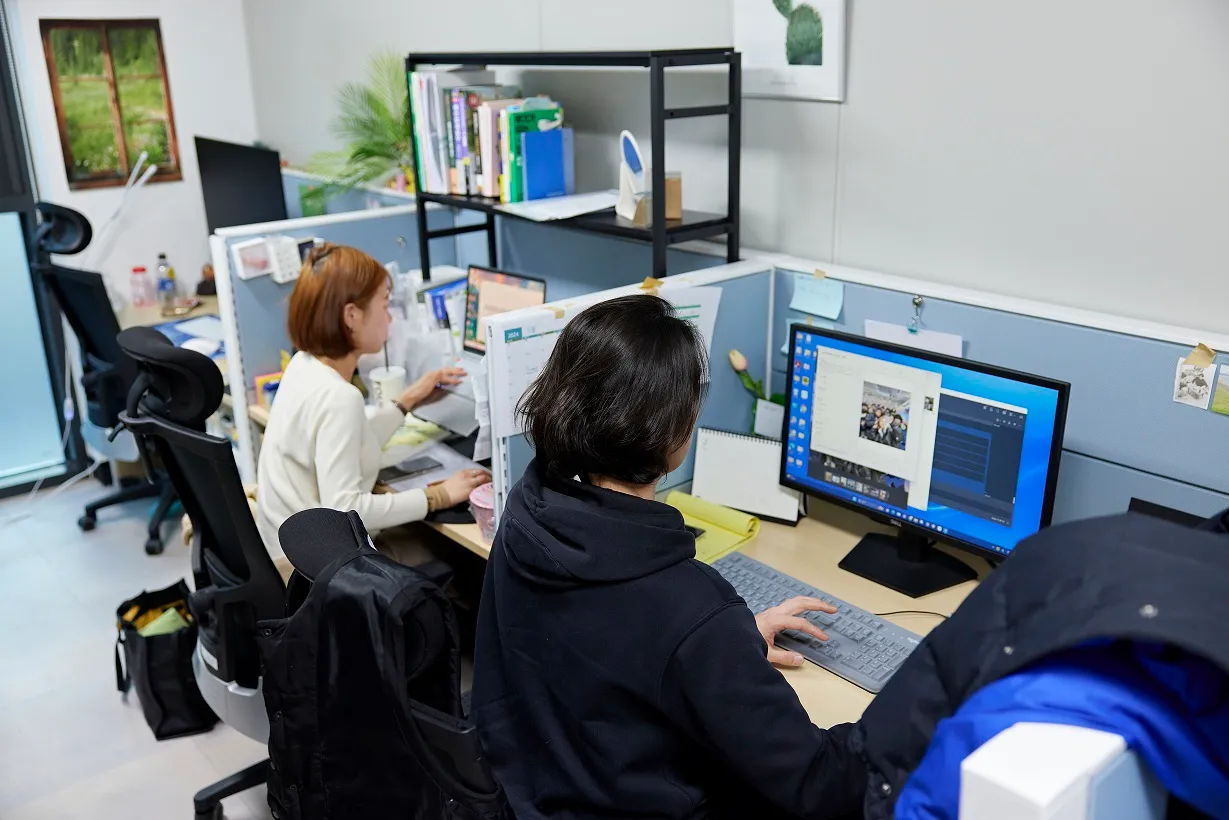
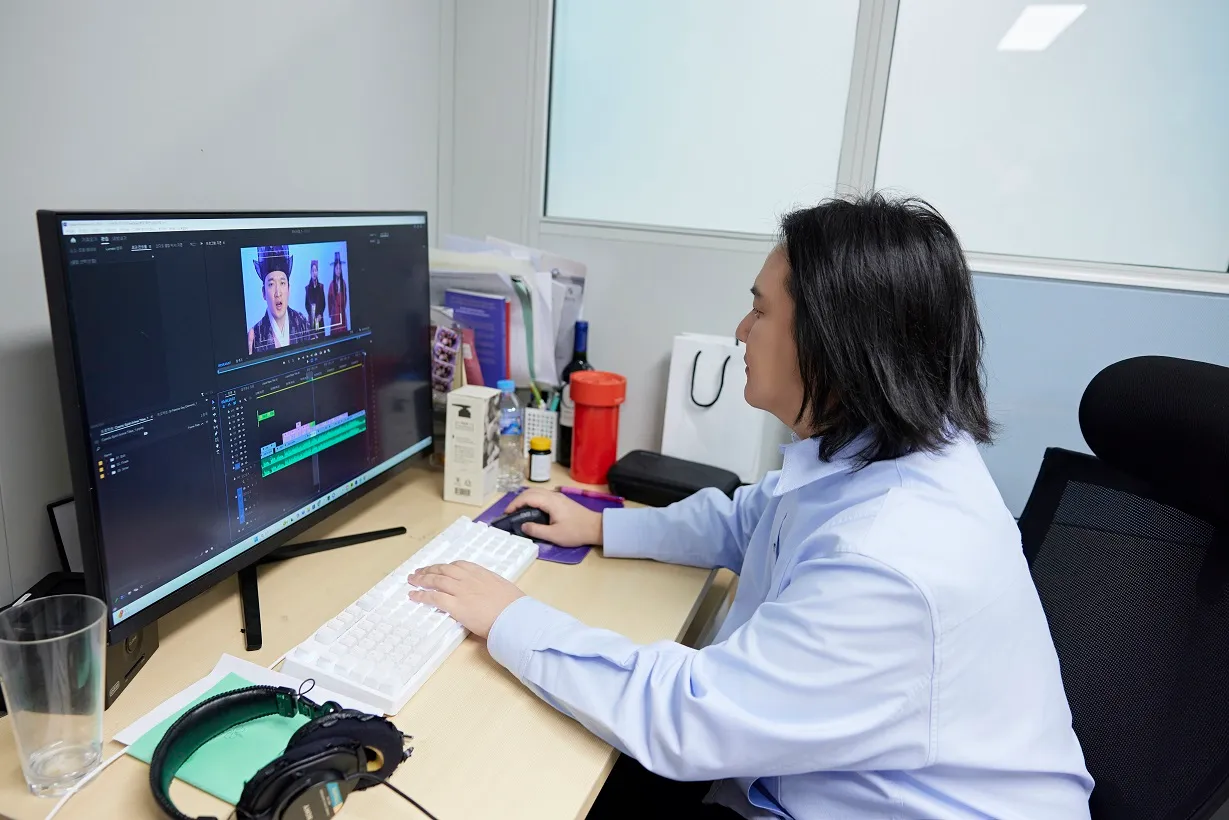
["Notscary Company" employees and CEO Yoo Seung-gyu at work © ESG.ONL]
The Evolution of Goals and a Sense of Social Responsibility
Notscary Company is known for its "parent coaching (Hiki Signal)" for parents with reclusive children, and its "Eundun Gosu (reclusion master)" program service for isolated and reclusive youth.
"From the start, our goal was not to go under."
After K2's closure, seeing a friend he had previously helped through counseling become isolated again, CEO Yoo felt a great sense of responsibility. The case of a friend who had overcome aphasia entering reclusion again was especially heartbreaking. When facing the death of a friend he had worked with, doubt about the work would sometimes rush over him, beyond sorrow. But the desperate reason he must not give up this work is that it must not become "an act of causing yet more harm to someone."
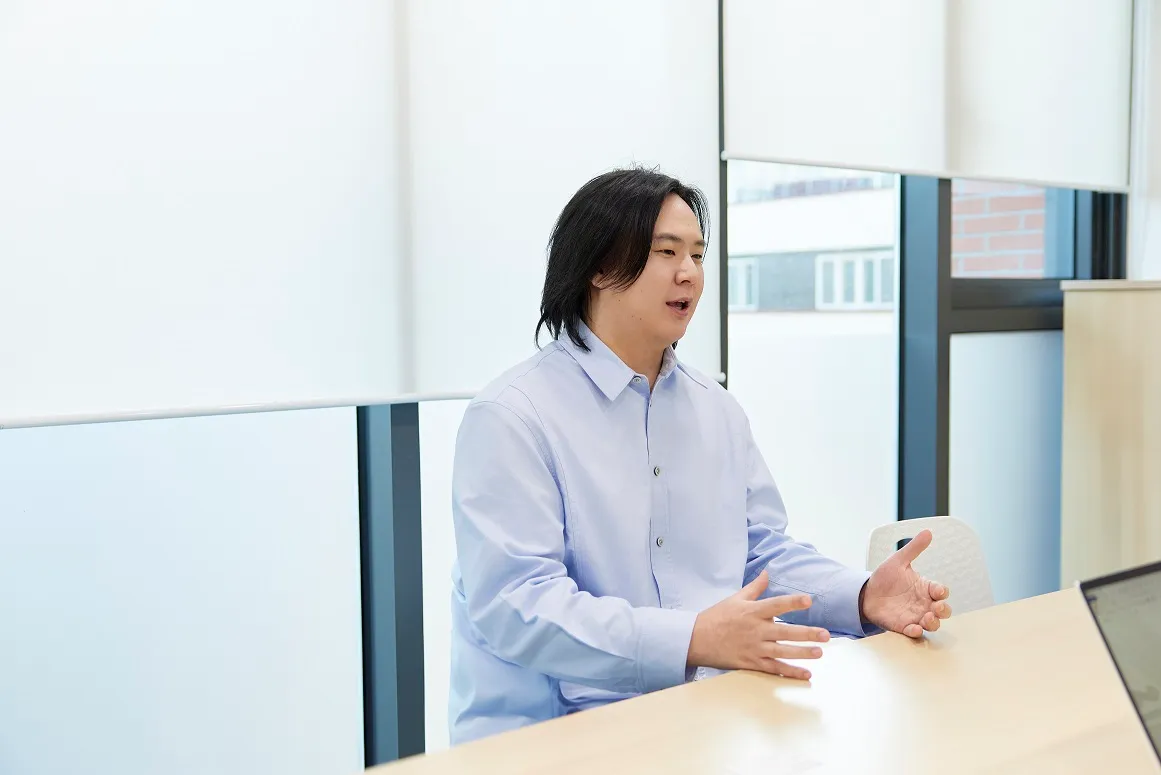
[CEO Yoo Seung-gyu talking about solutions to the isolated-youth problem © ESG.ONL]
540,000 Isolated Youth: What Is the Problem?
According to data released by the "Korea Institute for Health and Social Affairs," the isolated-and-reclusive-youth population aged 19–34 is 540,000. But experts estimate the actual number is far higher. After COVID-19, the social safety net collapsed, and the number of young people who, wounded in an infinite-competition society, fear coming out of the house increased. There is an analysis that this problem emerges especially in Japan and Korea worldwide because of a background of a similar cultural sphere. A major cause is a social atmosphere that values saving face and forces self-consciousness.
The family collapse arising from isolated and reclusive youth is one especially serious social problem. The reason the isolated-and-reclusive-youth problem is not only a youth problem is that, including families, the population suffering from this problem increases twofold, threefold. In Japan, cases are reported of parents with children who have lived in reclusion for decades losing their ability to support them and developing dementia. How will society embrace young people who have become hard to socialize, and those who become middle-aged as they are? The worry over the isolated-and-reclusive-youth problem deepens as much as the concern over young people's marriage or birth rates.
Reclusive-and-Isolated-Youth Support Projects Together with Public Institutions
CEO Yoo says he is grateful that the first public projects related to reclusion-and-isolation support are being entrusted to "Notscary Company." Notscary Company jointly carried out the establishment of the "outreach-counseling methodology" of the "Seoul Youth Gijigae Center," a project for isolated and reclusive youth supported by the Seoul city government. Currently, collaboration with the government and public institutions seems set to continue — for instance, producing a "guidebook for share-house workers" for the "Youth Future Centers" of four metropolitan cities together with the Ministry of Health and Welfare.
He revealed that he feels most understood especially when collaborating with the Seoul Youth Gijigae Center. Reasonable performance indicators and budget allocation could be discussed and coordinated together from the early stages of promotion. When working with public institutions, there are cases where the reality of the field and the response prepared do not match. Therefore, as with the experience in Japan, he proposes that it is necessary for private organizations to play a hub role connecting the public and reality. This is because the causes of reclusion are too varied, and it is a reality that a small number of institutions find it hard to solve all problems.
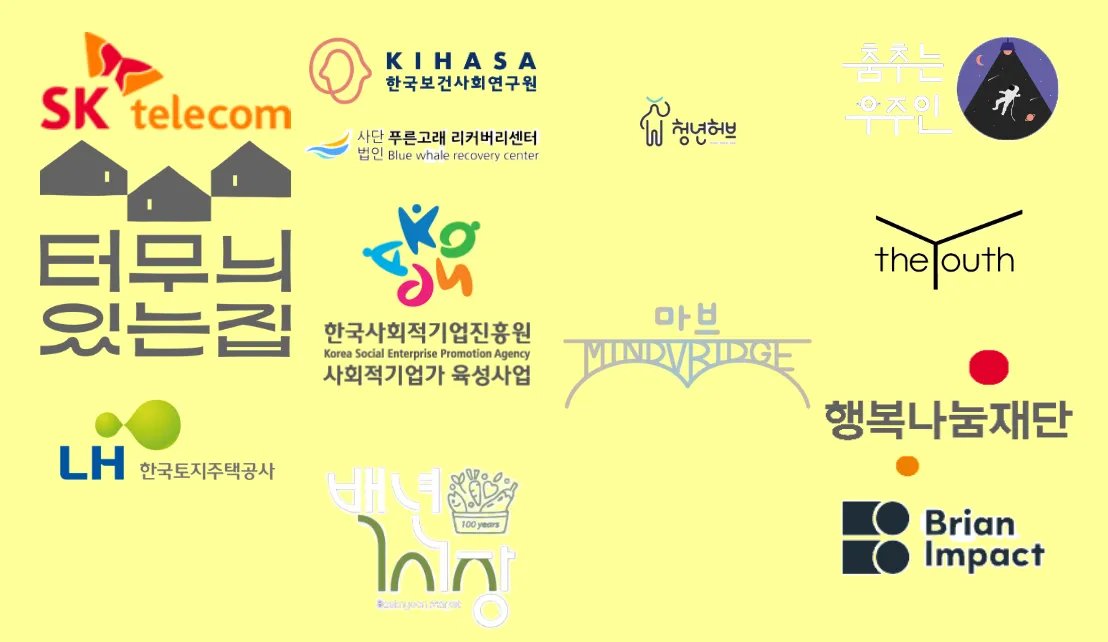
[Companies that work together with "Notscary Company" © Notscary]
As Much as Our Society's Interest, Opportunities for Awareness Improvement Open Too
The "Youth Foundation," which has worked with "Notscary Company" for a long time, has a high understanding of the isolated-and-reclusive-youth problem. A success case like CEO Yoo's — overcoming isolated and reclusive life and even starting a business — is greatly meaningful to the Youth Foundation too. He said that the Youth Foundation's support, which continues consistently based on trust, is a great help in carrying out this work. Notscary Company, selected as a fellow at the "Brian Impact" foundation, which supports the social-innovation ecosystem, also receives support of 3 million won per month for four years from Kakao. It is valuable that the human exchange created through Brian Impact foundation's support became a stepping stone opening opportunities to collaborate with companies.
For example, the SK Happiness Sharing Foundation generously gave 50 million won to "Notscary Company"'s content business. Through this, Notscary Company created an occasion to secure content, such as overseas reporting, to increase insight into the isolated-and-reclusive-youth problem. Inquiries also increased from people who saw Notscary Company's YouTube channel where the content was posted. Through such publicly released content, one can aim for improvement in awareness of isolated and reclusive youth. CEO Yoo, who is thus building up the value of collaboration with various organizations in our society, emphasized that for successful collaboration with companies, the understanding of both the communication officer and the company's decision-maker is desperately needed.
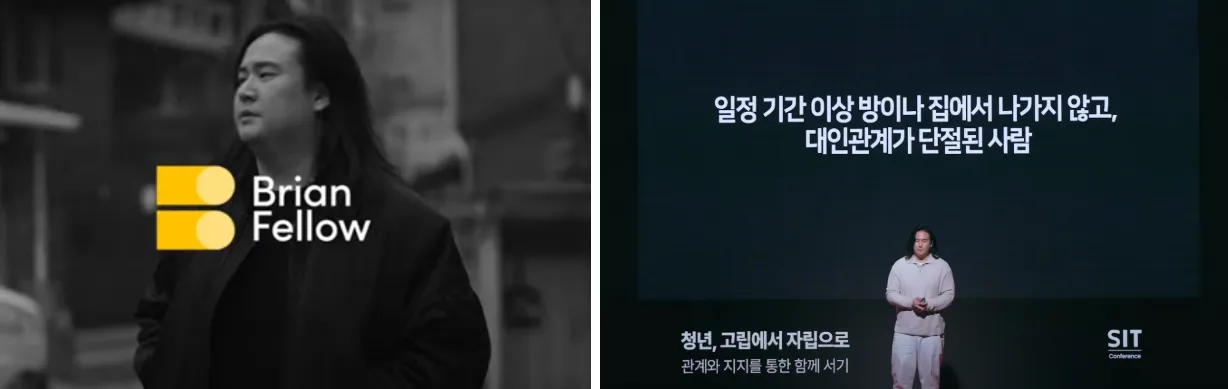
[Kakao "Brian Fellow" and the SK Happiness Sharing Foundation conference on YouTube © Notscary]
The Ideal Social-Connection Model: "Things You Can Do Even in a Withdrawn State"
In Japan, there is a café where isolated and reclusive youth can commune with society just through a hand they extend through a small hole while wearing bear-paw-shaped gloves, handing over coffee. This case, benchmarked in Korea under the name "Bear-Paw Cafe" too, provided an occasion for isolated and reclusive youth to wake from hibernation. CEO Yoo appealed for people to understand that "even in a withdrawn state, one can do something." Shueisha, a large Japanese publisher famous for its many hit works, presents an impressive social-return model. This company recognizes reclusion as a credential and employs manga-mania isolated and reclusive youth at bookstores to work as counselors recommending life-changing manga. CEO Yoo emphasized that, as with such cases, Korea too needs a model that recognizes the strengths of isolated and reclusive youth while helping their return to society.
For example, what if isolated and reclusive youth, together with a game company, created within the game screen a window through which isolated and reclusive youth can receive mental counseling anytime? Among isolated and reclusive youth, those who play games are said to have a relatively better prognosis than those who do nothing. This is because they at least feel elements of healing and solidarity within the game and communicate with the world. With car companies, one could also support obtaining a driver's license. CEO Yoo, who presented such ideas, said, "It's impossible to throw a person who has been reclusive for ten years directly into a competitive society and make them adapt," saying a customized approach for isolated and reclusive youth is needed. Just by having programs for youth in difficulty proactively cheer young people's new start and let them know our society supports them can give great strength to isolated and reclusive youth.
The Health of Youth and the Stability of the Organization That Notscary Company Dreams Of
CEO Yoo sets as Notscary Company's goals firming up organizational stability within the next five years and creating its own revenue model in the seventh year. He plans to continue laying the foundation for the organization's activities by making the Eundun Gosu workforce elite, establishing know-how through guidebooks, and promoting donation fundraising and video content. In the long term, he also dreams of a co-living house business focused on young people's mental health. Furthermore, a plan to create a matchmaking company of the isolated-and-reclusive-youth version is also under way. Because we all know that the greatest driving force of growth in life is, in the end, love.
On the other hand, CEO Yoo's realistic worries about running the company are also great. There is a share house facing the end of its lease, so the residing members may have to vacate. In this case, someone could become isolated again. So CEO Yoo, who sees the housing stability of isolated and reclusive youth as an important task, is desperately looking for a sponsoring company.
A Sustainable Social Safety Net Made Together
In an age of 540,000 isolated and reclusive youth, the effort to lead them out of the house is by no means only for the young people who are the parties concerned. It is a matter of protecting their families and our society as a whole. Notscary Company CEO Yoo Seung-gyu will further bring the isolated-and-reclusive-youth problem into public discussion and, with the private and public sectors, individuals and society solving this problem together, create a sustainable social safety net made by all members together.
By Editor L