
October 4 is "World Animal Day," which encourages action for animal-rights protection and animal welfare. In Korea, its meaning has grown greater as, starting this year, the same day has been established as the statutory commemorative day "Animal Protection Day." The topics we might say to pay attention to on Animal Day cover a very wide range — protecting endangered species, welfare for living together with companion animals, protecting the rights of service animals and laboratory animals, and so on. This year's "World Animal Day" dealt with the protection of endangered species and a sustainable Earth shared with animals as its main themes, while the domestic "Animal Protection Day" event dealt with the protection and welfare improvement of animals around us, showing a direction that is similar yet different.
On October 4, in celebration of the day, let us look at the establishment processes of "World Animal Day" and Korea's "Animal Protection Day." Dividing them into the two broad frames that are the two days' themes — "protecting endangered animals" and "improving animal welfare" — we have organized the current state of animal-protection activities and the activities of domestic local governments and companies commemorating "World Animal Day."
[World Animal Day poster © WorldAnimalDay]
How "World Animal Day" Came to Be Established as "Animal Protection Day" in Korea
World Animal Day was designated at an international animal-protection congress in 1931, on the proposal of the German writer and activist "Heinrich Zimmermann." Zimmermann was a person devoted to animal protection — publishing the biweekly magazine "Man and Dog (Mensch und Hund)" to make the general public aware of the concept of animal welfare and carrying out a movement to ban animal cruelty. The reason it was set as October 4 is that it is the feast day of "Francis of Assisi," a 13th-century Roman Catholic saint who spent his life for animals and nature. Since 2003, World Animal Day has been run by the UK animal-welfare organization "Naturewatch Foundation." Naturewatch Foundation put forward "Save animals, Save the planet" as this year's theme; this theme was selected to make people aware that the way we treat animals and the environment directly affect each other — from the loss of biodiversity and habitat destruction to industrial agriculture and pollution.

[Animal Protection Day poster © Ministry of Agriculture, Food and Rural Affairs]
In Korea, various local governments, public institutions, and companies have carried out their own related events commemorating World Animal Day. Although the Seoul city government designated October 4, 2024, as "Seoul Animal Protection Day," this year is the first time it has been established and commemorated as a statutory commemorative day. The Lee Jae-myung government selected "a society where people and animals are happy together" as a national policy task and designated and proclaimed October 4 as the statutory commemorative day Animal Protection Day. Regarding the day's designation, bills were proposed to the National Assembly several times even in the 2010s but did not come to fruition; it is the result of finally passing after the full revision of the Animal Protection Act in 2023.
Efforts to Protect Disappearing Animals
According to 2024 statistics from the World Wide Fund for Nature (WWF), over the 50 years since 1970, the size of wildlife populations worldwide has decreased by an average of 73%. Amid worldwide efforts for the conservation of endangered species, Korea established the "Comprehensive Plan for the Conservation of Endangered Wild Species 2018–2027" and is aiming to restore 25 endangered species by 2027. Because problems such as damage to the food-chain structure due to habitat destruction and overhunting had previously been pointed out, it is focusing not on simply raising and releasing endangered animals but on restoring habitats and creating a healthy food chain. As a result, this past June, footage was released of a fox — a Class-I endangered species — hunting a water deer, and a Eurasian eagle-owl and a marten — Class-II endangered species — hunting a hedgehog and a hare. From a human standpoint, one's heart may go out to the small animals, but the realization of such a food chain is proof of the result that endangered species returned to the wild are adapting well and recovering into a stable ecosystem.

[A fox carrying off a water deer © National Park TV]
Around World Animal Day, many campaigns are carried out in the private sector to call for interest in endangered species; last year, Cheil Worldwide and the World Wide Fund for Nature drew attention with "AniStay," a unique donation campaign using a travel platform to commemorate World Animal Day. When you search for domestic accommodations, lodgings whose "owners" are endangered animals living nearby are shown, and on the detail page you can check information about the endangered animals and their habitats. Donation is made through the action of pressing the "sponsor by booking" button, and the entire donation is used for the World Wide Fund for Nature's protection of domestic endangered species and habitat-conservation activities. This campaign drew much interest by effectively and wittily capturing that endangered species, which feel somewhat distant, exist closer than one might think. Besides this, education and campaigns related to endangered species are carried out each year at domestic private and public zoos and aquariums.
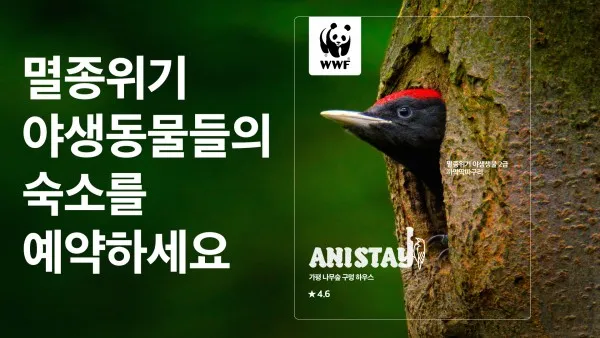
[The AniStay campaign © World Wide Fund for Nature]
Efforts for Animal Welfare, Where Animals Are Happy
Since the Universal Declaration of Animal Rights was announced at the UN in 1978, the perception that "all animals must be respected as beings that feel pain" has begun to spread. The EU defined animals as "sentient beings" and, on this basis, created welfare standards and enacted laws for farm animals, laboratory animals, and companion animals alike. On September 27 this year, at the Animal Protection Day event, Korea for the first time declared an "Animal Welfare Charter" recognizing "animals as living beings, not possessions." It also gave concrete shape to content addressing animal welfare — welfare tailored to the animal life cycle, protection in disaster situations, scientific animal-welfare indicators, building an evaluation system, and public-private cooperation. Though it has no legal force, it is greatly significant in that it presents a direction for animal policy and promises standards of practice for the government and the private sector. Furthermore, our government is moving to change the "Animal Protection Act" into the "Animal Welfare Act."

[The signing ceremony of a business agreement to support retired national service dogs, held last year © Ministry of Agriculture, Food and Rural Affairs]
What drew attention in the process of spreading awareness of animal welfare was the "national service-animal adoption business agreement ceremony." National service animals serve in public duties for more than two-thirds of their lives. Yet 8 out of 10 service animals, after retirement, live confined in kennels due to failed adoption. All six agencies where service animals work — police, fire services, and others — pooled their intentions in this business agreement for improving service animals' welfare and operated adoption-promotion booths. Last year, the Ministry of Agriculture, Food and Rural Affairs signed an agreement with several private institutions so that those who adopt a retired service animal can receive large discounts on treatment costs, feed costs, and funeral costs. A program in which a retired service animal and a prospective adopter go on a trip together before adoption to decide whether to adopt also drew attention. A recently held policy forum for invigorating adoption also drew the interest of the media and citizens, and related legislation has proceeded, so improvement in service animals' welfare is anticipated.
There are so very many agendas we should pay attention to on World Animal Day. The population raising companion animals is steadily increasing, interest in animal rights has grown, and the movement to prevent species extinction accelerated by the climate crisis is also large. In order to live together, we hope it becomes a commemorative day on which we can think about the animals around us or far from us, and let us continue to pay attention to the movements of various domestic local governments, institutions, and the private sector, which will grow even richer going forward.
by Editor L