
An Energy Storage System (ESS) refers to a device or technological system that stores electrical energy in various forms and supplies it when needed. ESS is a critical infrastructure for addressing the intermittency issues of renewable energy such as solar and wind power and enhancing grid stability.
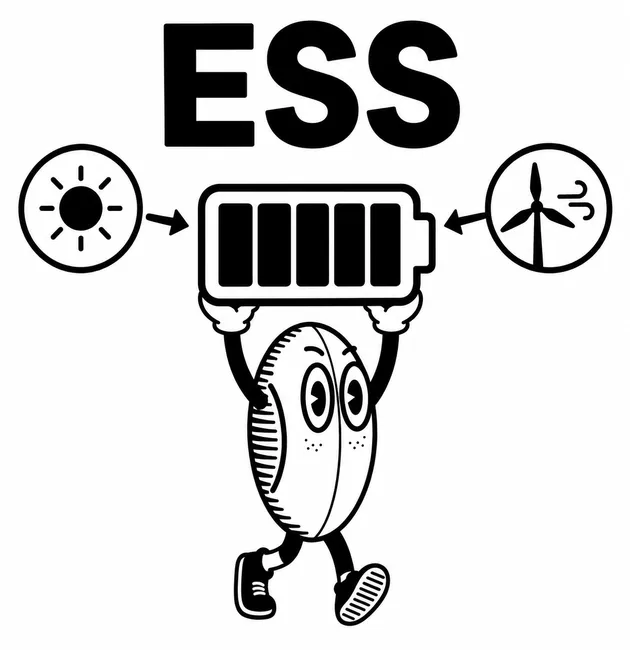
[Energy Storage System (ESS) © ESG.ONL/ESG Today]
ESS, whose importance is rapidly growing in the transition to carbon neutrality, is classified by storage method into ‘electrochemical storage,’ ‘mechanical storage,’ and ‘thermal storage.’ Electrochemical storage converts electrical energy into chemical energy and then converts it back to electrical energy during discharge. Mechanical storage uses physical force, potential energy, or kinetic energy to store electrical energy, while thermal storage converts electrical energy into thermal energy such as cold or heat and stores it for use in heating and cooling when needed.
The key driver behind the growing attention on ESS is the expansion of renewable energy. Since solar and wind power generation is irregular depending on weather and time, ESS is essential for storing surplus power and supplying it during peak demand. According to the International Energy Agency (IEA), global renewable energy generation capacity is expected to more than double by 2030, and ESS demand is rapidly increasing accordingly. In the ESS market, companies such as China’s CATL and BYD, along with South Korea’s Samsung SDI, are currently leading the market. In July 2024, Samsung SDI signed a contract worth approximately ₩1 trillion to supply 6.3 GWh of ESS batteries to U.S. clean energy company NextEra Energy.
ESS is projected to grow 17-fold by 2050 and is closely tied to ESG investment as essential infrastructure for achieving carbon neutrality goals. The combination of renewable energy and ESS is regarded as a key means of reducing fossil fuel dependence and cutting greenhouse gas emissions.
by Editor O