
The Intergovernmental Panel on Climate Change (IPCC) is an international body jointly established in 1988 by the World Meteorological Organization (WMO) and the United Nations Environment Programme (UNEP). Its primary role is to synthesize the latest research on the scientific basis of climate change, its environmental and socio-economic impacts, and response strategies, and to provide this to policymakers worldwide. The IPCC does not conduct its own research; instead, hundreds of scientists and policy experts from around the world review and analyze existing studies and publish their findings in reports.
The IPCC is composed of three working groups: Working Group I (WG I), which addresses the physical science basis of climate change; Working Group II (WG II), which analyzes climate change impacts, adaptation, and vulnerability; and Working Group III (WG III), which studies greenhouse gas mitigation options. It also operates the Task Force on National Greenhouse Gas Inventories (TFI), which develops methodologies for calculating and reporting national greenhouse gas emissions.
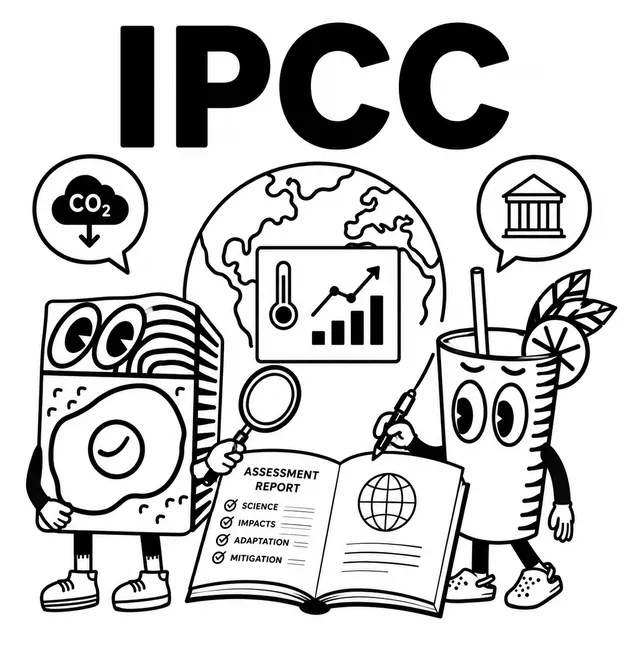
[Intergovernmental Panel on Climate Change(IPCC) © ESG.ONL/ESG Today]
The IPCC publishes comprehensive Assessment Reports on a 6–7 year cycle. Since the first report in 1990, it has released a total of six reports through the Sixth Assessment Report (AR6) in 2023.
IPCC Assessment Reports serve as the scientific foundation for international climate agreements. The First Assessment Report in 1990 became the starting point for negotiations on the United Nations Framework Convention on Climate Change (UNFCCC), and subsequently provided key evidence for the adoption of the Kyoto Protocol and the Paris Agreement. In 2007, the IPCC jointly received the Nobel Peace Prize with former U.S. Vice President Al Gore for its efforts to raise awareness of the dangers of climate change and present response measures. In the Sixth Assessment Report released in 2023, the IPCC pointed out that to limit the global average temperature rise to within 1.5°C, greenhouse gas emissions must peak before 2025, decline by 43% by 2030, and reach net zero by 2050.
While the IPCC functions as a key platform connecting climate science and policy, it also has limitations. It has been criticized that the political positions of national governments can be reflected in the report adoption process, potentially weakening scientific conclusions. There are also concerns that the long publication cycle for Assessment Reports makes it difficult to rapidly reflect the changing climate reality. Nevertheless, the IPCC remains the most authoritative scientific consensus body on climate change, and its findings are widely used in ESG disclosure standards and corporate climate risk assessments.
by Editor O