

The tvN drama A Military Cook Becomes a Legend, currently airing to great popularity, concludes today on the 16th. In the drama, the military cook creates the best meals that soldiers eagerly await, even under harsh conditions. What if our unit’s cook really was that good? Viewers with military service experience have likely had such thoughts at least once while watching — imagining a cook who can create the menu soldiers wait for even with limited ingredients, with lines naturally forming in front of the mess hall.
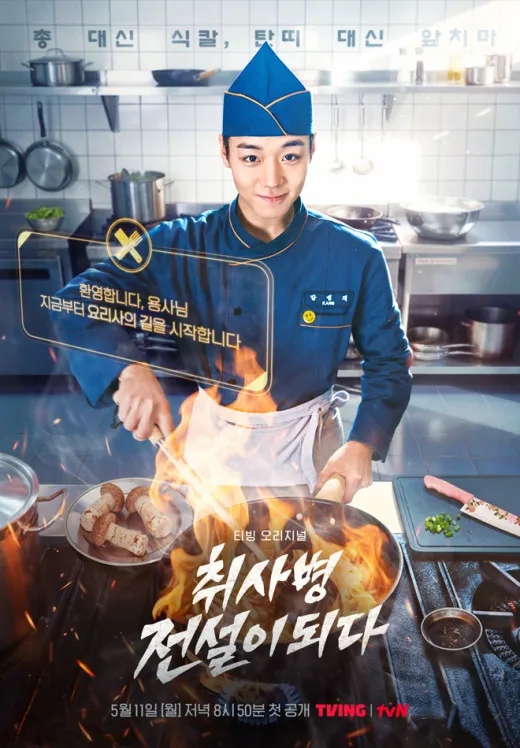
[tvN drama ‘A Military Cook Becomes a Legend’ © CJ E&M]
Mealtime in the military carries a peculiar significance. On some days, it is the most anticipated moment of the day; on others, it is simply a time to fill one’s stomach and quickly return to the barracks. Even within the same unit, the mess hall atmosphere changes dramatically depending on the menu. Some items disappear with remarkable speed, while certain side dishes remain until the very end. Some days, trays are left spotless; on other days, diners head to the return station with one or two side dishes barely touched. So just how much food is being left uneaten in the military right now? And why is it being left behind?
Who Is Responsible for the Leftover Trays?
There are certainly cases where soldiers leave side dishes because they do not like them, but it is also not uncommon for unwanted items to appear on their trays in the first place. On some days, meals must be rushed due to training or work schedules; on others, delayed serving times mean the food has deteriorated from its initial state. Additionally, while military mess halls prepare food considering the number of personnel, training schedules, and leave counts, errors in estimation are inevitable. Because running short of food poses a bigger problem, a certain margin is invariably prepared — and as a result, some food ends up untouched, never even reaching the serving line.
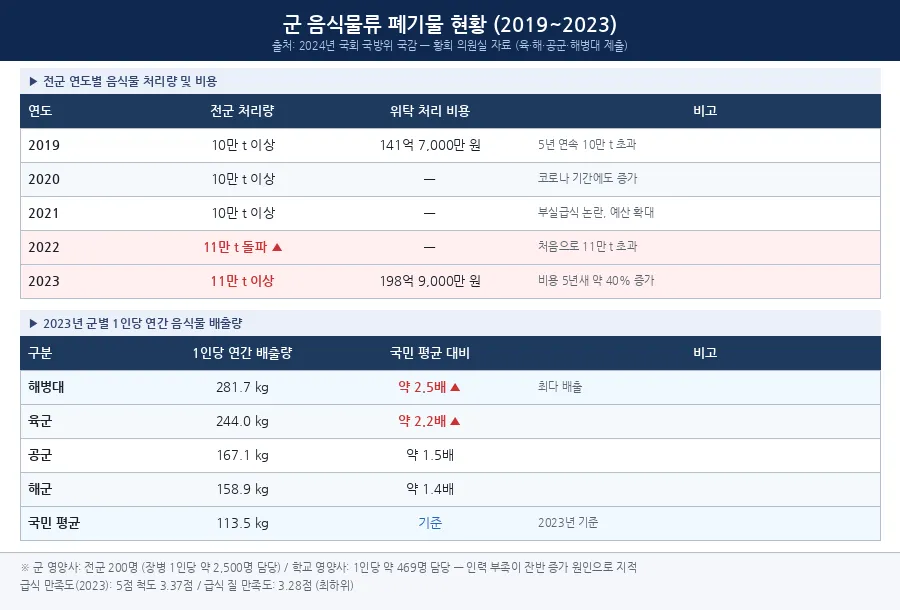
[Military Food Waste Status © 2024 National Assembly National Defense Committee Audit, Office of Rep. Hwang Hee, Data Reorganized]
In fact, according to data from the National Assembly National Defense Committee, food waste generated by the military exceeds 100,000 tons annually. Even more interesting is that a considerable portion of food waste originates not from leftovers that soldiers failed to finish, but from food prepared but never served. More food is being discarded before it even reaches the tray than is left uneaten on it.
Changes Born from the Poor Meal Controversy
The decisive moment that brought military meals to public attention was the 2021 ‘COVID-19 Quarantined Soldier Poor Meal Controversy.’ The meal photos released at the time shocked not only those without military experience but also veterans. Among discharged soldiers, reactions included “The menu composition is worse than in my day” and “Why do these problems keep recurring?”
The truth is, dissatisfaction with military meals is nothing new. However, while such issues were once regarded as something to be endured in the unique military environment, the perspective has now shifted toward viewing them as matters of soldier welfare. As standards for living conditions and welfare have risen across society, military meals have begun to be evaluated by the same benchmarks.
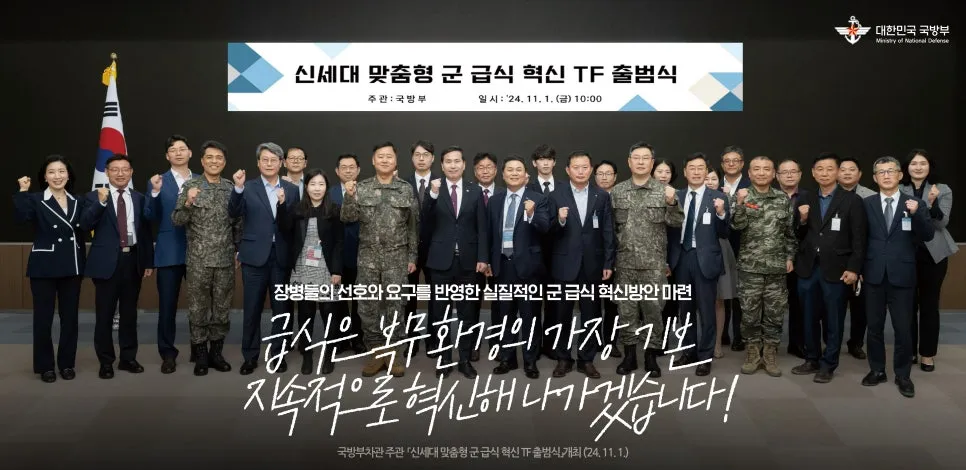
[Launch Ceremony of the New Generation-Customized Military Meal Innovation TF © Republic of Korea Ministry of National Defense Blog ‘Donggodongnak’]
Following the controversy, the Ministry of National Defense embarked on improving the meal system. Menus reflecting soldier preferences were expanded, and projects for upgrading cooking facilities and enhancing meal quality were pursued. The per-soldier meal budget has also been steadily increased. Where the goal was once ‘a meal to stave off hunger,’ it has now become ‘a meal that soldiers actually enjoy eating.’ This change is not merely about soldier satisfaction. The more food goes uneaten, the more ingredients and budget are wasted. In the end, a well-eaten meal is also the meal that leaves the least behind.
A Story That Doesn’t End at the Tray Return
Food waste is often regarded as little more than leftover food. But what disappears when food is thrown away is not just the food itself. The water, fertilizer, agricultural fuel, transport energy, and the electricity and gas used for cooking — all are discarded along with the food. Food waste is thus not merely a garbage problem but a resource problem.
Leftover food is collected and may be repurposed as animal feed, compost, or biogas feedstock. Yet no matter how well it is recycled, nothing is as efficient as not being wasted in the first place. The treatment process itself requires additional cost and energy. This is why recent meal policies are moving beyond simply increasing the number of menu items to focusing on preference surveys and leftover management. The priority has shifted from cooking more to cooking exactly what is needed, and ensuring that what is prepared is actually consumed.
In the drama, the legendary military cook moves people’s hearts. But what real-life mess halls need is not one legendary individual, but a meal system that makes such a person unnecessary. When recalling military life, remembering ‘a meal well eaten’ before ‘a tray left behind’ — perhaps that is the most practical goal that today’s military meals should aspire to.
by Editor N