

Excel broadcasting is a form of internet broadcasting in which the amount of sponsorship determines performers’ rankings and actions. The name comes from the fact that the sponsorship amounts received by multiple performers and their rankings are displayed in real time like a table in Microsoft Excel. When viewers sponsor a particular performer, that performer responds by dancing or carrying out an agreed-upon action. Some broadcasts also impose penalties on performers with low rankings or remove them from the broadcast.
In October 2026, major domestic Excel broadcasting channels on YouTube were deleted one after another. Beyond revealing outfits and dances, the impact of sponsorship competition on performers’ choices and actions is an issue that warrants particular scrutiny. Can a performer who has received money refuse an unwanted demand? How far can a viewer who has paid money demand that another person act? As these broadcasts are spread through short-form videos and exposed to teenagers, concerns are also growing about how sponsorship competition in Excel broadcasting may affect the way people treat others.
Can Performers Refuse a Reaction?
In internet broadcasting, sponsorship is a way for viewers to support their favorite internet broadcasters (hereinafter “BJs”) and fund their activities. “Reactions,” in which BJs express gratitude to sponsors, are also a familiar part of broadcasting culture. Excel broadcasting combines this reaction culture with a competitive system among performers.

If viewer sponsorship continues without interruption, how long must the performer continue reacting? Suppose a performer agrees to react by performing a particular dance and receives the same sponsorship continuously for two hours. Can the performer stop dancing midway and take a break? Or must they dance endlessly for as long as sponsorship continues?
Performances and broadcasts are also activities that provide audiences with enjoyment in exchange for payment. For Excel broadcasting performers, reactions are part of their work to earn income. However, receiving payment does not mean they must accept every demand without limits. In particular, it is important to consider that in Excel broadcasting, the number and duration of reactions can increase in real time depending on viewer sponsorship. The way broadcasts are operated also makes it difficult for performers to refuse reactions. If operators treat performers differently based on sponsorship results or impose penalties for low rankings, performers may feel pressured to choose competition over rest. Even without explicit coercion, if the disadvantages of refusal are significant, performers’ freedom of choice may be constrained.
Sponsorship competition can affect not only performers but also how viewers treat other people. In Excel broadcasting, when viewers send money, performers respond immediately, and the result is displayed on the broadcast screen. Sponsors can directly see in real time how their payment changes a performer’s actions. Repeated experiences of this kind may teach viewers that they can demand the behavior they want from others in proportion to the amount they pay. The issue is whether the person receiving the request can choose how to act according to their own wishes. When performers are asked to do actions they find difficult to endure, and their performance of them is consumed as entertainment, the person’s discomfort itself can become content that generates revenue.
How Far Should Broadcast Operators and Platforms Be Held Responsible?
Broadcast operators and agencies are the parties that directly determine performers’ actions and the rules of sponsorship competition. They recruit performers, plan broadcasts, and establish the reaction and ranking competition systems tied to sponsorship. When they enter into contracts with performers, they also become involved in the conditions of their activities and the distribution of revenue. Accordingly, establishing operating standards that respect performers’ wishes must begin at the stage of planning the broadcast. It is also the operator’s role to ensure that humiliating penalties are not imposed simply because a performer has a low sponsorship ranking and that performers’ discomfort is not used as a tool of competition.
If broadcast operators’ responsibility focuses on performers’ activity conditions and broadcast rules, platforms’ responsibility extends to content distribution and sponsorship payment systems. Platforms decide which broadcasts to allow and provide the functions and payment methods viewers can use for sponsorship. Even if they do not directly create the reaction rules for individual broadcasts, they can manage risks by sanctioning problematic content or restricting sponsorship functions.
In practice, platforms differ in how they respond to Excel broadcasting. In October 2025, Naver CHZZK revised its content guidelines to include Excel broadcasting among inappropriate content and strengthened related regulations. On YouTube, videos and livestream content from major domestic Excel broadcasting channels were also deleted one after another in October 2026. By contrast, the live broadcasting platform SOOP has maintained an approach of assessing violations in individual content rather than uniformly banning the Excel broadcasting format itself.
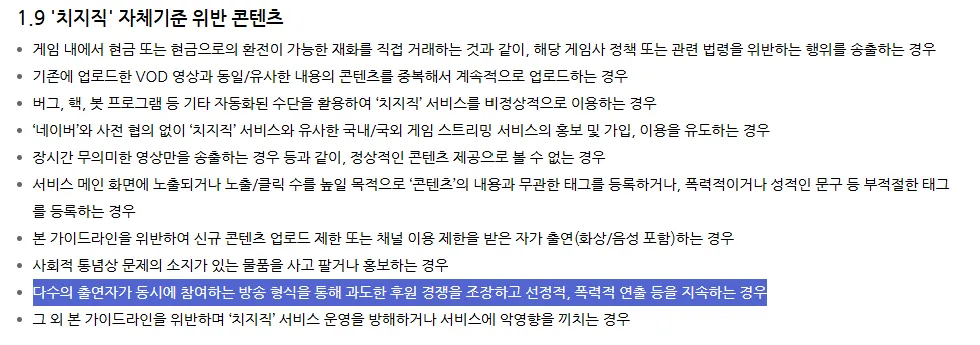
This does not mean that platforms should ban all sponsorship-based broadcasts. The fact that multiple performers compete for sponsorship rankings does not necessarily mean that human rights issues arise in every broadcast. However, clear standards are needed for broadcasts that disregard performers’ wishes to refuse or link sexual or humiliating acts to sponsorship. The principle that viewers cannot demand unlimited behavior from others simply because they have paid money should also apply to broadcast operations.
The controversy over Excel broadcasting ultimately concerns how companies treat people in the process of generating revenue. If sponsors prioritize their own demands over performers’ wishes because they have paid money, and broadcast operators use this relationship to generate revenue, sponsorship is no longer merely an expression of support. The standards that broadcast operators and platforms must establish should not focus on how much sponsorship can be received, but on the extent to which people’s wishes and dignity are respected in the process of receiving it.
by Editor N