
[Japan's GPIF runs against the global investment trend by expanding ESG investment ©ESG.ONL/ESG Today]
The world's largest pension fund, the "Government Pension Investment Fund (GPIF)" of Japan, has expanded its ESG investment. The reason this news is surprising is that it is a move running against the current global trend. Amid political pressure centered on the U.S., fatigue with regulation, and doubts about returns, global asset managers' investment in ESG funds had been declining. According to the investment-research firm "Morningstar," the funds that flowed into ESG funds in the U.S. in 2023 came to just 3 billion dollars, down 78% from the previous year. It was in a situation where major U.S. asset managers, including BlackRock, were pulling out of climate-related investment citing pressure from state governments, or changing the names of their ESG funds, that the GPIF increased its ESG investment.
GPIF's Investment Management, Contrary to the Global Flow—Where Did It Begin?
This GPIF ESG-investment expansion can be seen as originating from a fundamental difference in investment philosophy. The GPIF emphasizes the roles of a "Universal Owner" and a "Cross-Generational Investor," maintaining the position that sustainable corporate growth is essential to maintaining market stability and improving long-term portfolio performance. Through its FY2024 business report released on July 4, the GPIF stated that, as of the end of March, it held about 18.2 trillion yen (about 126 billion dollars) in assets included in ESG indices. This corresponds to 14.7% of the GPIF's total equity investment, an increase of 400 billion yen from the previous year's 17.8 trillion yen. What is even more notable is that the ESG-integration investment ratio increased on both the domestic-equity and foreign-equity sides. In domestic-equity management, the ESG-integration investment ratio is about 16%, and foreign equity shows a ratio of about 14%. This shows that the GPIF consistently considers ESG factors when making investment decisions.
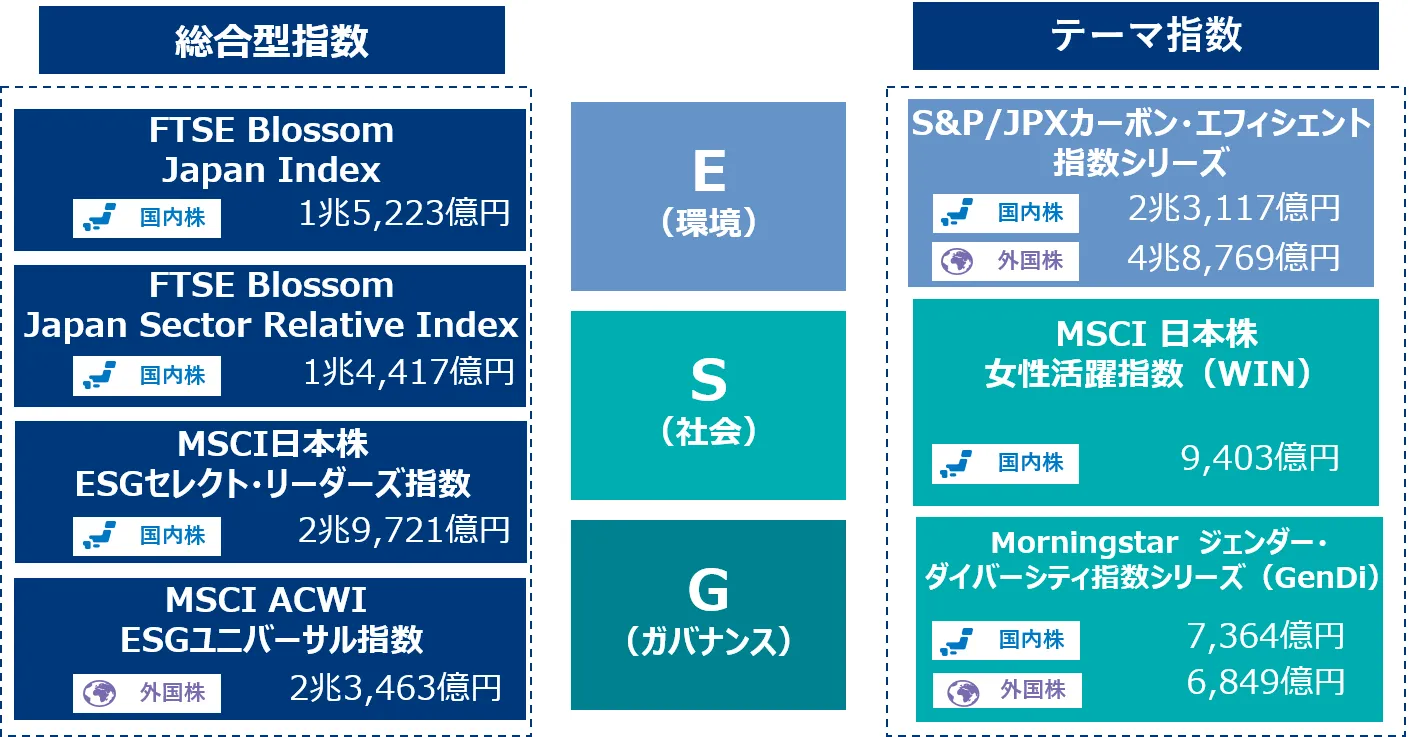
[The ESG-related indices the GPIF used for investment ©GPIF]
ESG, a Strategic Choice for Pursuing Long-Term Returns, Beyond a Mere Trend
This GPIF ESG-investment expansion cannot be seen merely as a result of following the ESG trend. Moreover, the GPIF has drawn a line that it will not invest for impact alone. The GPIF is simply judging that reducing the negative impacts stemming from environmental and social problems is key to companies' long-term market stability and securing returns. It is interpreted as viewing climate change, social inequality, governance problems, and the like as crises that can affect the entire market over the long term, and reflecting them as investment considerations. The GPIF's investment-strategy approach, not buried in short-term results, is expected to be an important reference case for other large pension funds as well. In particular, in a situation where global risks related to climate change and social inequality are intensifying, the GPIF's strategy of systematically reflecting these problems in investment decisions can be assessed as an effective methodology that pursues both risk management and profitability at once.
Reaffirming the Value of ESG Investment from a Long-Term Perspective
Korea's "National Pension Service" currently allocates about 3% of its total managed assets to ESG-related investment. This is a considerable difference from the GPIF's 14.7%. Can the GPIF's investment be a reference approach for the National Pension Service in finding a balance between profitability and social responsibility? The GPIF uses a full range of ESG-investment techniques, from index investment considering ESG factors to active stewardship activities to impact investment. The National Pension Service, too, can be seen as directly and indirectly conducting an approach similar to the GPIF's, in that it has introduced a Stewardship Code and is pursuing investment that induces ESG improvement in the companies it invests in. And this can be a way of presenting a direction for ESG management to our companies.
Going forward, if the GPIF's ESG-investment results induce a move to expand ESG investment among other countries—especially Asian pension funds including Korea—let us watch whether it can bring change to the ESG-investment flow of the North American and European asset-management industries.
by Editor N