
ThEre is an opinion that the Korean government's climate policy is insufficient for crisis response. Amid this, the release date of the domestic climate-disclosure draft was announced as the 30th of this month. Unlike the industry's expectation that it would be released this week, the full text of the draft will be viewable on the 30th, delayed by a week. In the draft, among the ESG areas, climate (E; Environment) disclosure—for which international consensus has formed—is set to be introduced first, and since it is estimated highly likely to include "Scope 3 disclosure," which was even omitted from the U.S. climate-disclosure final draft, voices of concern are growing in some quarters.
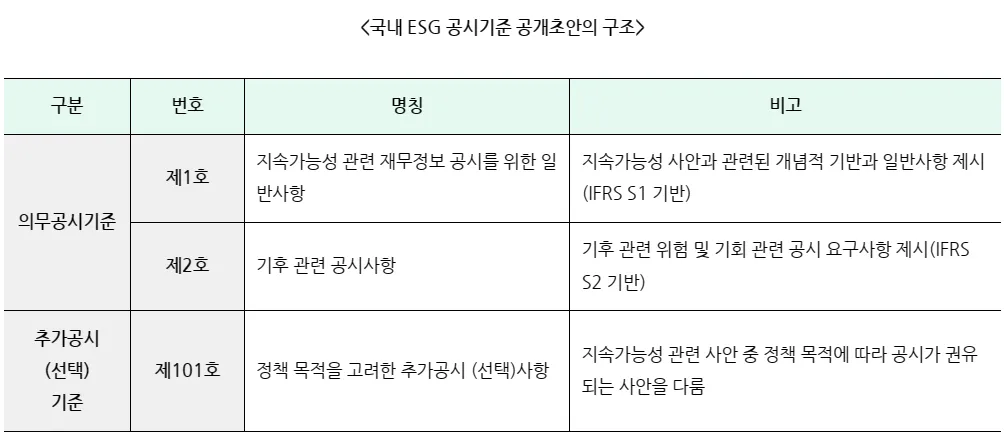
[The basic structure of the climate-disclosure draft ©Financial Services Commission]
At the fourth meeting of the ESG Finance Promotion Group, held on the 23rd, the basic structure and key content of the draft—allowing an advance look at the draft to be released next week—were shared. The structure is basically divided into mandatory-disclosure standards and selectable additional-disclosure standards, with the gist being "governance for climate-risk management" and that "a company must disclose its response strategy and management process related to climate risk." Among these, the phrase "a company must disclose the impact of climate-risk factors affecting corporate value on the value chain" is specified, giving rise to the opinion that the draft will include Scope 3.
Scope 3, beyond a company's direct and indirect greenhouse-gas emissions, designates even the value chain as a target for emission reduction. In the U.S., which announced its climate-disclosure adoption draft this past March, the intent to actively respond to the climate crisis was good, but the opinion that it realistically burdens corporate management clashed, and a tense controversy arose. In the end, Scope 3—which had been included in the 2022 draft—was excluded from the final draft. Domestically as well, one could approach the greenhouse-gas-reduction target quickly, but because companies' cost burden grows, attention is focused on whether Scope 3 will be included in the draft to be released.
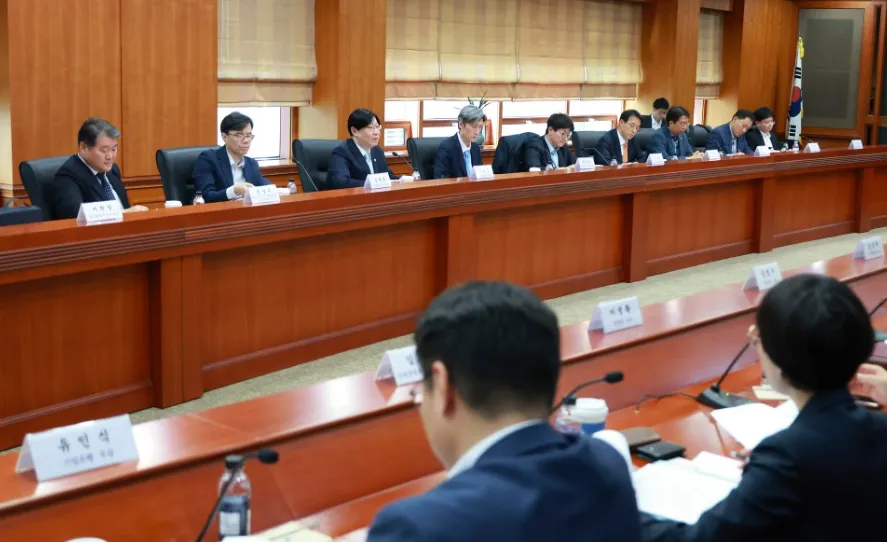
[The fourth meeting of the ESG Finance Promotion Group, where heated debate was exchanged ©Financial Services Commission]
Another point of contention is expected to be the "timing of mandating." The earlier the introduction timing, the more effectively one could mitigate the climate crisis and respond to international standards, but there is also an opposing opinion that the burden on companies unprepared for climate disclosure grows. Such a clash can also be confirmed in the case of domestic ESG disclosure, which was originally to be mandated from 2025 but was delayed to 2026 for the reason of easing corporate burden. It was expected that the mandating timing would be released simultaneously with the announcement of the disclosure-standards draft, but the mandating timing was reportedly not included in the agenda of the fourth ESG Finance Promotion Group meeting, which discussed the climate-disclosure draft.
The Korean climate-disclosure draft will be prepared by the "Korea Sustainability Standards Board (KSSB)" within the Korea Accounting Institute, which belongs to the Financial Services Commission. Because the Accounting Institute establishes accounting standards for companies' financial reporting, it takes on the role of presenting the government's sustainability guidelines. The Sustainability Standards Board has been reviewing appropriate climate-disclosure guidelines to apply to domestic companies ever since it was newly established in 2022 to effectively respond to the mandating of climate disclosure in advanced countries such as the EU and the U.S.

[The Korea Accounting Institute reviewing points of contention with the Hong Kong Institute of Certified Public Accountants ©Korea Accounting Institute]
In particular, as this draft is the first domestic climate disclosure to be released, bilateral talks were held with major sustainability-disclosure-standard-setting bodies on the 17th and 18th to review international compatibility. With the Australian Accounting Standards Board (AASB), the Sustainability Standards Board of Japan (SSBJ), the Hong Kong Institute of Certified Public Accountants (HKICPA), and the International Public Sector Accounting Standards Board (IPSASB), they checked and discussed recent exposure-draft trends and the points that became contentious in each country.
In early April, the U.S. Securities and Exchange Commission (SEC)—which had put forward climate-disclosure-mandating regulation—decided to temporarily suspend the mandating regulation for listed companies as various lawsuits contesting the system's legality continued. Following this, according to Bloomberg, Europe's private banks are also reportedly appealing to the European Central Bank (ECB) to "not take the lead in responding to the climate crisis," worried that the competitiveness gap between U.S. Wall Street and European banks will widen. As lukewarm moves regarding the mandating of climate-crisis disclosure and the inclusion of financial elements continue in Europe and the U.S.—which released climate disclosures ahead of others—the direction of Korea's draft announcement is also hard to conclude.
by Editor N