

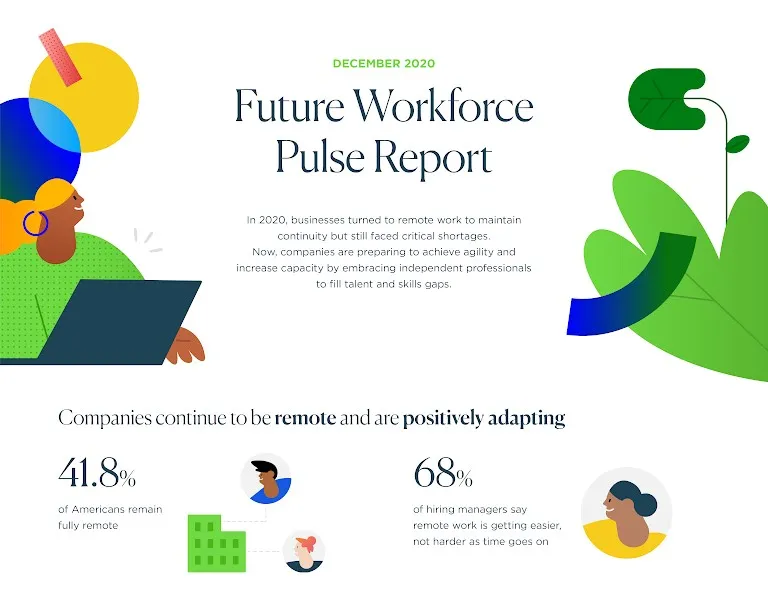
The pandemic that swept across the globe accustomed office workers to remote work—performing their jobs from locations other than the office. However, as more companies like Amazon, Meta, and IBM have brought all employees back to the office following the end of the pandemic, debate has intensified over whether remote work benefits a company's long-term ESG strategy. According to Forbes, as of 2023, 12.7% of full-time employees work remotely, while 28.2% utilize a hybrid model that combines both office and remote work. Analysis from video conferencing technology company Owl Labs also indicates that 16% of companies globally operate entirely remotely without a physical office. Freelance platform Upwork has even predicted that if the current trend actively encouraging remote work continues, approximately 32.6 million Americans—22% of the entire U.S. workforce—will choose remote work by 2025.
[Future of Remote Work Report 2020 ⓒUpwork]
Fewer Commutes, Smaller Carbon Footprint
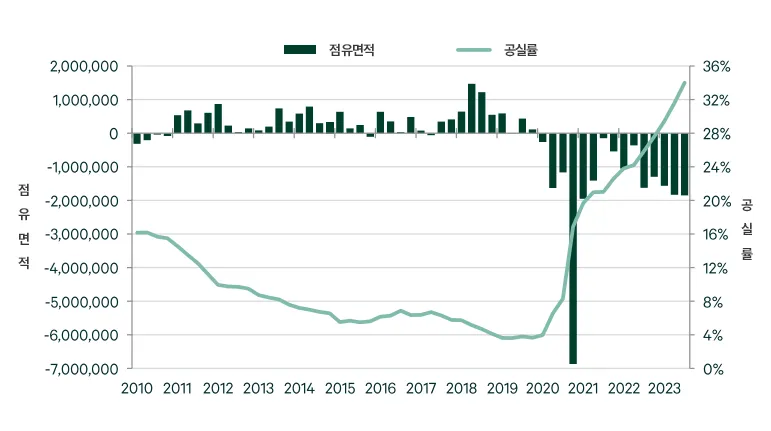
During the pandemic period when remote work was actively encouraged, positive assessments emerged that it supported corporate ESG strategies. From an environmental perspective, remote work can reduce a company's carbon footprint by cutting down on time spent commuting via car or public transportation, as well as reducing the fixed office space required. According to Spain's Institute of Environmental Science and Technology, remote work can reduce nitrogen dioxide—a major air pollutant emitted by transportation—by approximately 10%. Between 2020 and 2022, numerous San Francisco-based IT companies reportedly transitioned to remote work or downsized their operations and relocated offices. As a result, San Francisco's office vacancy rate surged to 34% in the third quarter of last year.
[San Francisco Office Vacancy Rate Graph ⓒCBRE Research]
There are also benefits from social and governance perspectives. 35% of remote workers reported improved productivity, while 71% indicated that remote work helps maintain work-life balance. Moreover, the ability to work without being physically gathered in one location broadens recruitment diversity and can increase organizational inclusivity and flexibility. Hiring employees from various regions also expands the talent pool and increases the potential to provide more jobs. Tom Wilson, CEO of U.S. insurance company Allstate, stated that after adopting remote work, Allstate saw a 30% increase in hiring diversity. The U.S. Department of Labor also noted that compared to February 2020 when the pandemic began, the number of employed workers with disabilities nationwide increased by approximately 28%, reaching about 1.8 million, as commuting became unnecessary.
Hidden Carbon Emissions from Remote Work
On the other hand, there is criticism that many ESG values have been lost with the introduction of remote work. This is because individual employees cannot consider their own environmental impact, making it impossible for companies to manage pollution levels in an integrated manner. Harvard Business Review raised the possibility that while commuting to a fixed office allows measurement and management of carbon emissions based on consistent travel distances, remote work makes it difficult to manage the pollution levels generated by individuals moving between workspaces or producing waste, potentially resulting in higher overall environmental pollution. Opinions also point to risks in the social and governance dimensions. With communication taking place remotely, there has been an increase in isolated employees feeling a lack of belonging and experiencing loneliness. Burnout resulting from conducting work solely through video conferences and messaging apps has also been cited as a downside of remote work. Additionally, alongside analysis linking a 238% increase in cyberattacks during the pandemic to remote work, management has expressed concerns about security risks arising when information is exchanged outside internal networks.
Companies Pursuing Hybrid Work to Reduce Direct and Indirect Carbon Emissions
Owl Labs' "2023 State of Hybrid Work Report" analyzed that 54% of companies still require fully on-site work. As more companies adopt hybrid work or mandate in-office attendance, discussions on how closely work models and ESG strategies interact are expected to become even more active. The EU's recently expanded Sustainable Finance Disclosure Regulation (SFDR) now includes both direct and indirect emission sources in carbon footprint calculations for companies. Going forward, companies based in or operating within the EU market will need to calculate both direct and indirect carbon emissions according to their work models and focus on reducing their total carbon footprint. The CEO and CTO of UK office management software company Kadence, together with a Vice President at real estate firm CBRE, published the "Hybrid Manifesto for Sustainability." Through this manifesto, they expressed their ambition to find ways to achieve ESG strategy without being tied to a single fixed office, by combining both remote work and commuting. Just like the goals of the companies joining this manifesto, businesses of the future are expected to focus more on creating work environments that can simultaneously achieve improved work efficiency and the pursuit of ESG values, rather than maintaining traditional work systems.
by Editor N