
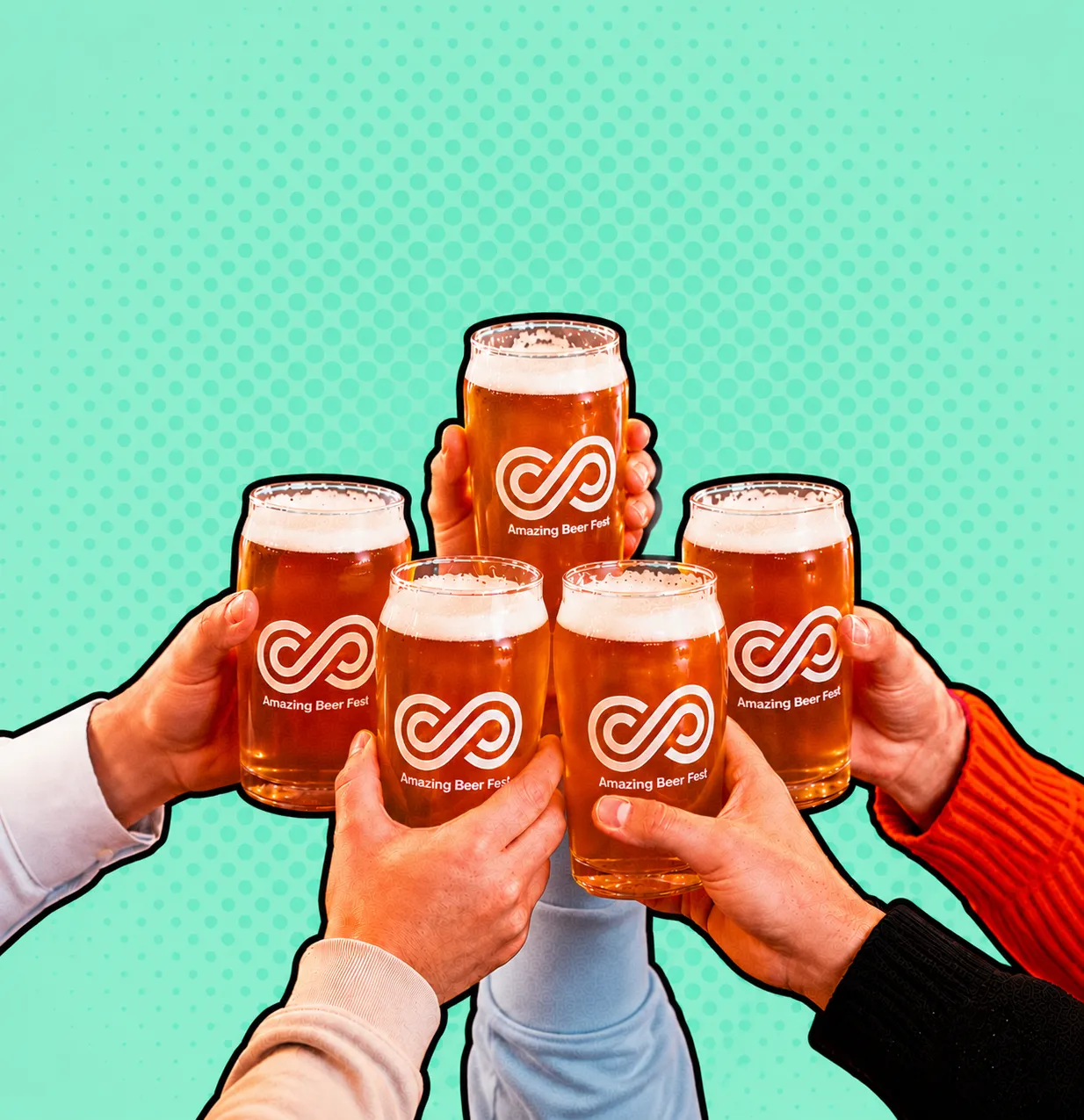
A few years ago, as small local breweries entered convenience store distribution channels, ‘craft beer’ began filling convenience store shelves. Collaboration products triggered sell-out frenzies, and it seemed the craft beer industry was ushering in a new wave of change in the domestic alcohol market. Then this past April, Amazing Brewing Company, which had anchored Seoul’s Seongsu-dong for a decade, filed for rehabilitation proceedings with the Seoul Bankruptcy Court.
The rehabilitation filing of Amazing Brewing Company — which had been the first domestic craft brewery to attract Silicon Valley capital and had completed two large-scale breweries in Icheon, Gyeonggi Province — came as a significant shock to consumers. While the industry cites excessive facility investment as a primary cause, reading this event merely as one company’s strategic failure is somewhat superficial. The case of Amazing Brewing Company can be seen as a symbolic event signaling that alcohol consumption culture is fundamentally changing.
From Craft Beer to Global Brands: A Broad Downturn Across the Alcohol Market
The worsening conditions in the alcohol industry are not limited to Amazing Brewing Company. Last year, the domestic alcohol market shrank by over 5%, and the number of restaurants and bars decreased by approximately 10%. In the aftermath, Sevenbräu, known for its ‘Gompyo Wheat Beer,’ is also undergoing corporate rehabilitation, and Hanul & Jeju, widely known to the public as ‘Jeju Beer,’ continues to face management pressure as it has been unable to escape its deficit structure.
It is not only the craft beer market; the performance of major liquor companies has also slumped. In 2025, Lotte Chilsung Beverage’s domestic alcohol segment revenue plunged 31.1% year-on-year, and HiteJinro’s annual operating profit fell 17.3% to ₩172 billion, recording an ‘earnings shock’ that fell far short of major securities firms’ estimates.
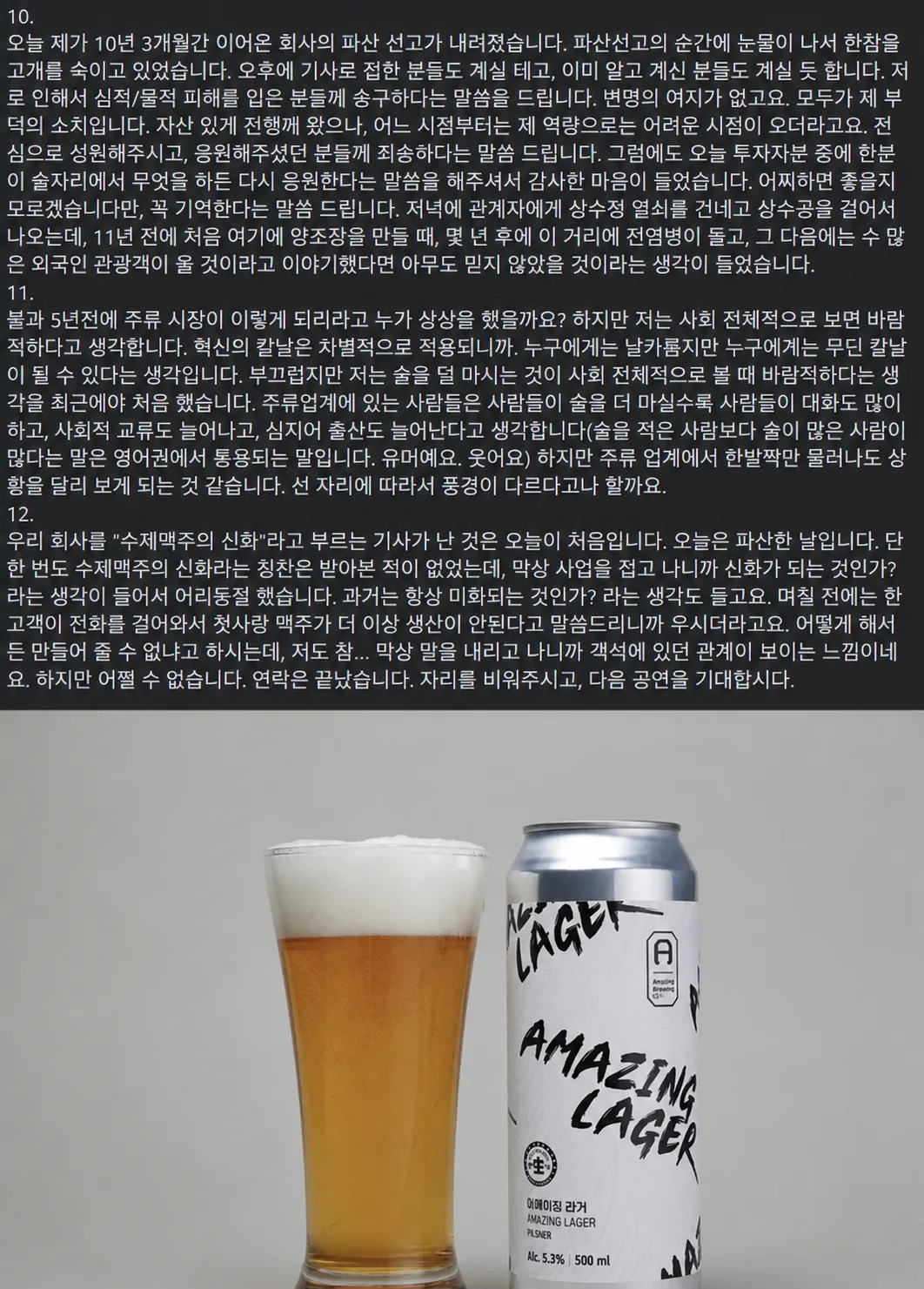
[Amazing Brewing Company CEO Kim Tae-kyung’s post on the bankruptcy © Seongsu Bible Official Instagram]
Notably, major global alcohol companies are also commonly facing difficulties. Constellation Brands, a leading North American alcohol company, saw its recent annual revenue decline by approximately 10% year-on-year to about ₩12.5 trillion, and the operating profit of Moët Hennessy, the spirits division of the world’s largest luxury group LVMH, plummeted 25% in 2025. Diageo of the UK, the world’s number one Scotch whisky company, is also experiencing a sharp drop in Asian market sales.
How Changes in Lifestyle Are Reshaping Alcohol Consumption
The decline in alcohol consumption both domestically and internationally is a result of changing lifestyles. According to Gallup, the recent downward trend in U.S. drinking rates is being driven by young people aged 18 to 34. The situation in South Korea is not much different. Based on the Korea Disease Control and Prevention Agency’s National Health Statistics, the monthly drinking rate in Korea was 57.1% in 2024, down 1.2% from the previous year. Among these, the daily alcohol intake of people in their 20s fell by over 30% year-on-year to 64.8g, making it not only the sole age group to show a decrease but also lower than the alcohol intake of people in their 60s.
Underlying this phenomenon is the practical reason of cutting spending amid high inflation, but more fundamentally, the wellness trend — which prioritizes ‘health and daily well-being’ above all else — is deeply embedded. Today’s younger generation is displaying strong fatigue toward the existing drinking culture of excessive consumption at the expense of the next day’s sleep, focus, and daily stability. The ‘Sober Curious’ culture of consciously drinking less or choosing non-alcoholic beverages can be seen as part of this vast wellness trend.
A Drinking Culture as ‘Sustainable Taste’
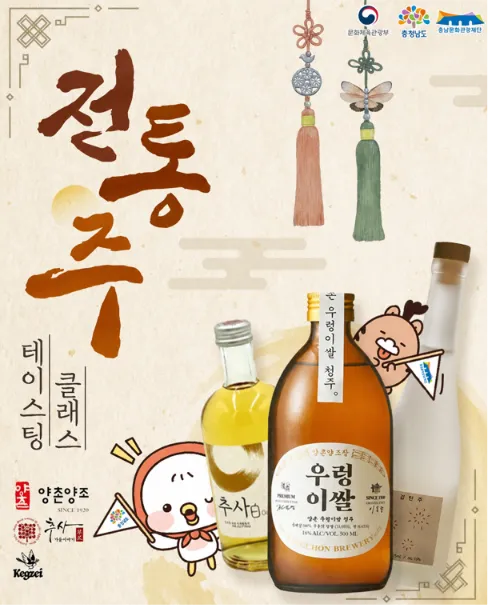
[Traditional liquor tasting class promotional poster ©Gaekje Brewery Official Instagram ]
Human history is inseparable from alcohol. There is even a theory that the very reason humanity began agriculture was to brew alcohol — to such an extent that alcohol transcends mere preference to become a core element of religion, social life, and ritual. Today, however, we are contemplating ways to enjoy alcohol in a relatively healthier and more sustainable manner. This shift could become an opportunity to reshape drinking culture. The alcohol market is already experimenting with this potential through the expansion of non-alcoholic and low-alcohol product lines, and a tasting-centered drinking culture in which small quantities are savored using the senses of smell and taste.
The era of a drinking culture in which pleasure is followed by regret or addiction harms one’s health is drawing to a close. What will take its place is a drinking culture as a ‘sustainable taste’ — one that enriches life while fully preserving one’s daily well-being.
by Editor N