
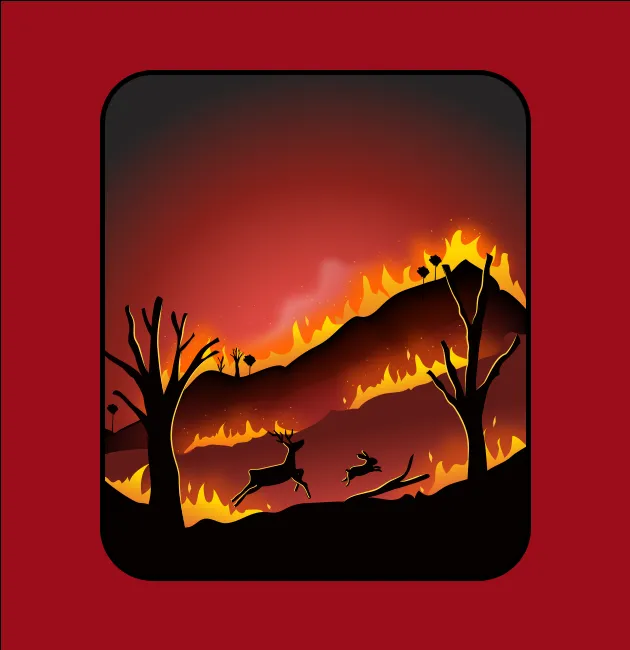
Korea has suffered serious human and economic damage from the worst wildfires in its history. The cause of the wildfires appears to be human error. Large wildfires also occurred in Japan, Thailand, and Chile. In the U.S., wildfires broke out in North Carolina, causing damage over an area eight times that of Yeouido. In this way, wildfire damage continued around the world. As reasons this Korean wildfire spread, environmental factors are also drawing attention—such as abnormal high temperatures due to the climate crisis, extremely dry weather, and typhoon-class winds generated by abnormal atmospheric-pressure patterns.
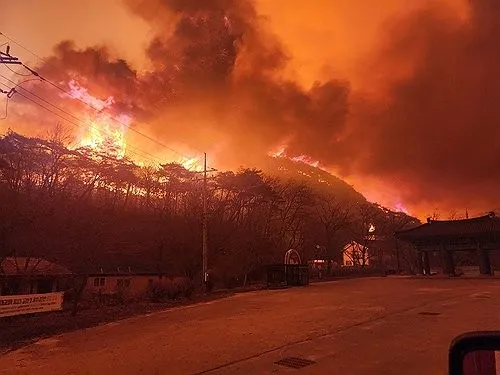
[Wildfires directly linked to the climate crisis ©Yonhap News]
This Korean wildfire began on March 21 in Uiseong-gun, North Gyeongsang Province, due to a grave-visitor's mistake. In Gimhae, South Gyeongsang Province, too, a fire spread during burning after grave maintenance. In Sancheong, North Gyeongsang Province, an ember caused by a brush cutter spread into a large fire. The causes are various, but the problem is why the wildfires grew so large. Given our topography, which originally has many mountains, once a fire breaks out, it is difficult for firefighting crews to approach. Also, with much wind, the "spot-fire" phenomenon—embers riding the wind and spreading far—commonly occurs.
But these are unchanging conditions. If there is something that has changed among our environmental conditions, it is that abnormal high temperatures have arisen in spring. Currently, Korea's temperatures are about 4.5 to 10 degrees higher than the annual average temperature of the 1990s. Not only in Korea, but the average temperature of major wildfire-damaged areas across East Asia showed figures about 2 degrees higher on average compared with recent decades.
The nonprofit climate-change research organization "Climate Central," in a report released on March 26, forecast that human-caused climate change will continue to increase wildfire risk in the future. In particular, viewed through the "Climate Shift Index (CSI)"—an indicator that shows the degree of climate change—high-temperature phenomena during the current wildfire-damage period occurred about five times more than before.
Not only abnormal high temperatures, but drought that continued from last winter—that is, dry weather and insufficient rainfall—is also cited as a cause of the large wildfires. The Yeongnam region had rainfall of only about 50% of an average year, and the minimum humidity was 14% in Sancheong and 17% in Uiseong, North Gyeongsang—conditions in which fire spreads easily. Amid this, the hot, dry winds that blew from the Taebaek and Sobaek Mountain ranges also made fire suppression difficult.
According to research by the "National Institute of Forest Science," if the temperature rises 1.5 degrees, the wildfire weather index increases by 8.6%, and if it rises 2 degrees, it climbs 13.5%. Large wildfires, which in the past were concentrated in Gangwon Province in April, now occur nationwide. Now is the time not only for much investment in wildfire prevention and the expansion of specialized personnel but also for long-term climate-change-mitigation efforts to be carried out together. Only then will it be possible to protect precious lives and forests.
by Editor N