
Every January, leaders from governments and businesses around the world gather in Davos, Switzerland to participate in the World Economic Forum. The 2024 WEF takes place over four days through January 19, and as in previous years, participants will discuss solutions to global challenges. This year's theme is "Rebuilding Trust."
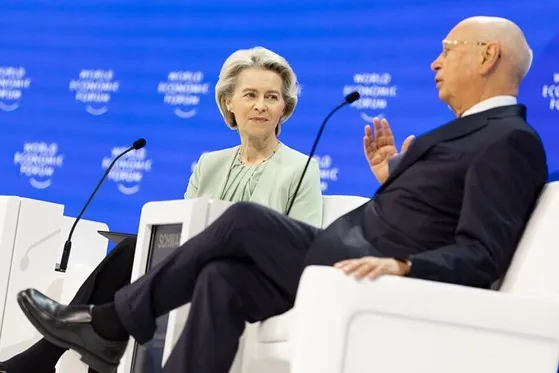
[European Commission President Ursula von der Leyen (left) speaking about the severity of disinformation. ©WEF]
Ongoing Efforts to Overcome Crises at the World Economic Forum
Last year's World Economic Forum focused heavily on "how to overcome the Polycrisis." There was a mountain of crises to address—COVID-19, the Ukraine-Russia war, economic recession and inflation, environmental issues, and more. This year's forum will once again explore ways to resolve global-scale crises. The polycrisis that persisted throughout 2023 remains unresolved, and has in fact led to prolonged economic recession and a severe climate crisis. This year, the WEF has dubbed this situation a "Permacrisis" and plans to seek both short-term strategies and long-term plans to overcome it.
The four key agenda items put forward by this year's WEF are: ① Achieving security and cooperation in a fragmented world, ② Creating growth and jobs for a new era, ③ Harnessing AI to drive the economy and society, and ④ Designing strategies for climate, nature, and energy. Among these, let us take a closer look at the WEF's "Centre for Nature and Climate," which corresponds to the fourth agenda item.
From Conference to Action: The Role of the Centre for Nature and Climate
The World Economic Forum takes place just once a year, for only five days. So how are the collaboration strategies discussed at the forum actually implemented? If the execution of decisions made at the forum were left solely to individual governments and corporations, global-scale economic cooperation would likely end up as mere words, and collaborative relationships would come to nothing. To prevent this and ensure substantive economic cooperation takes place, the WEF operates various centers. In other words, the WEF holds its annual meeting each January, and then continues to execute the matters discussed through its centers throughout the year.
If the forum is where government and business leaders gather to discuss agenda items, the centers are where the public and private sectors join forces to create synergies. The WEF operates ten centers (*) related to forum discussion topics. Among these, the Centre for Nature and Climate advances projects in which diverse stakeholders manage natural resources with the goal of achieving carbon neutrality. It encourages responsible use of land and oceans, and manages resources critical to us, such as food, water, and raw materials.
* The ten centers are: Centre for Advanced Manufacturing and Supply Chains, Centre for Cybersecurity, Centre for Energy and Materials, Center for Financial and Monetary Systems, Centre for Health and Healthcare, Centre for Regions, Trade and Geopolitics, Centre for the Fourth Industrial Revolution, Centre for the New Economy and Society, Centre for Urban Transformation, Centre for Nature and Climate
The Centre for Nature and Climate first established three solution goals: decarbonizing industry to achieve carbon neutrality, preparing for systemic transformation to protect nature, and managing resources for a better life. Core initiatives were also formed to execute each goal.
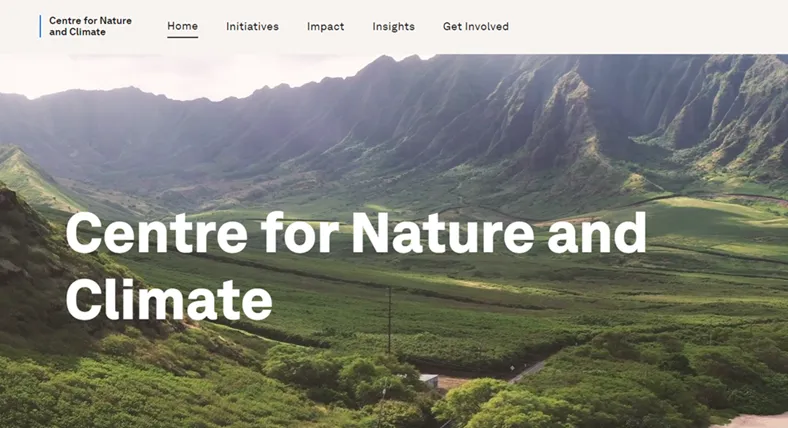
[The World Economic Forum's Centre for Nature and Climate webpage ©WEF]
The best-known initiative of the Centre for Nature and Climate in Korea is the "First Movers Coalition"—a coalition of companies that lead and pioneer on the world stage. As the initiative responsible for the Centre's first goal of industrial decarbonization, the companies belonging to the First Movers Coalition aim to halve carbon emissions by 2050. Starting with 35 member companies at its launch, the First Movers Coalition has grown into a major initiative of 95 companies in just two years. The WEF estimates that the efforts of its current member companies alone could reduce CO2-equivalent emissions by 29 million tons by 2030.
There is also a Korean company that has joined the coalition. "Hanwha Ocean" is a member, actively participating alongside familiar global names such as Apple, Coca-Cola, Microsoft, and General Motors. Hanwha Ocean was the first Korean company to join the First Movers Coalition, and Hanwha Vice Chairman Kim Dong-kwan is participating as a speaker at this year's WEF.
Another noteworthy initiative in the nature protection category is "1t.org." Named with the ambition to protect, restore, and grow one trillion trees by 2030. Trees and forests are vital resources that preserve biodiversity and combat the climate crisis. 1t.org encourages corporate participation to create a "forest restoration community" that everyone can join, and helps forge partnerships among local governments, businesses, and civil society. It also devotes efforts to fostering eco-preneurship so that companies can incorporate environmental considerations into their business activities. Over the past year, 85 companies across 65 countries have invested in 1t.org to preserve forests and committed to protecting eight billion trees.
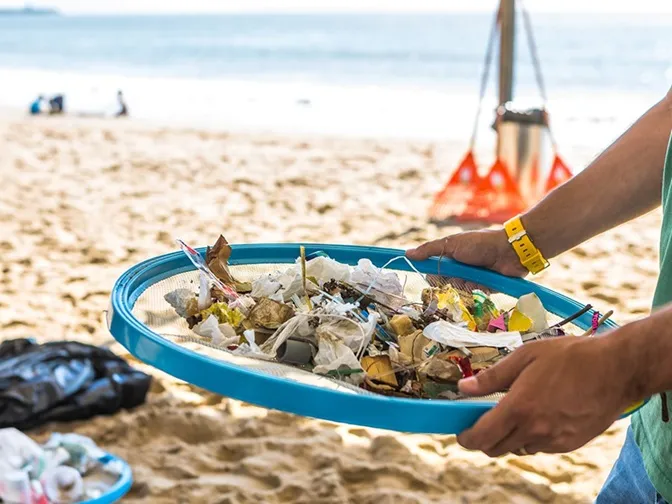
[Marine plastic waste filtered from a beach in Indonesia ©WEF]
According to the World Economic Forum, ocean plastic pollution is another critical issue requiring attention. Each year, 11 million tons of plastic waste flow into the world's oceans, and some projections suggest that by 2050, there could be more plastic than fish in the sea. The WEF operates the "Global Plastic Action Partnership" as one of its resource management initiatives. Launched in 2018, it seeks to break away from the take-make-waste model and find ways to turn plastic into a circulating resource. Currently, over 400 organizations participate in the initiative, and 13 countries have committed to joining the plastic action effort. Indonesia, which generates 6.8 million tons of plastic waste annually, has pledged to reduce ocean-bound plastic pollution by 70% by 2025. Vietnam has committed to a 75% reduction by 2030, and Ghana has pledged to eliminate ocean-bound plastic pollution entirely.
The Path Toward Inclusive Stakeholder Capitalism
To realize "inclusive stakeholder capitalism," the World Economic Forum demands that the governments and businesses partnered with each center "demonstrate real, tangible impact." While there are no explicit penalties for failing to keep promises, stakeholders share goals and actively participate by publishing their achievement rates each year. Let us look forward to seeing what direction of cooperation the World Economic Forum—which generates active collaboration among nations and corporations to solve vast global challenges—will propose this year.
by Editor N