
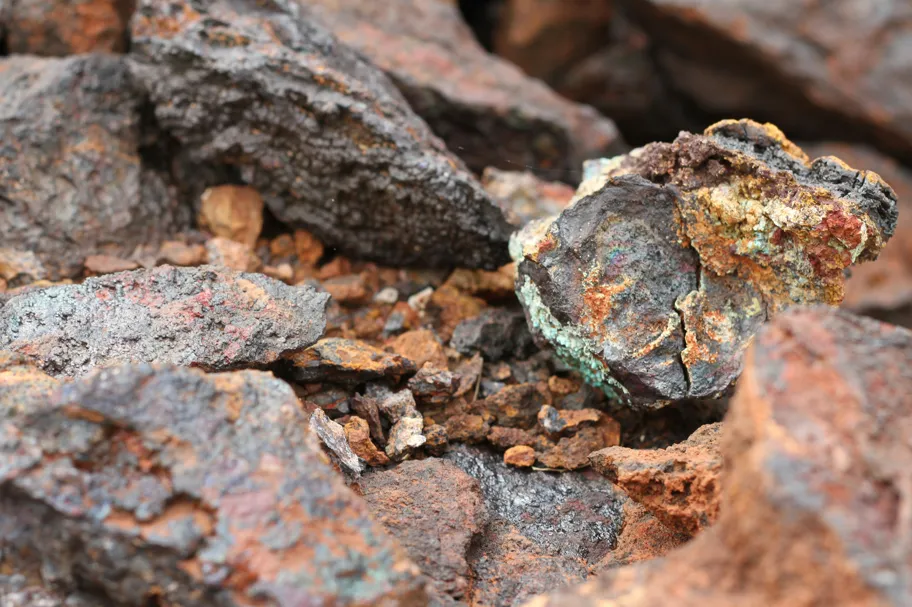
‘Critical Minerals’ are minerals so important to the economy that if their supply were cut off, entire related industries would be shaken. Smartphone batteries, electric vehicle motors, and semiconductor chips all require specific critical minerals in their manufacturing processes. The problem is that the distribution of these critical minerals is concentrated in only a few countries.
The International Energy Agency (IEA)’s ‘Global Critical Minerals Outlook 2025’ report projects that by 2035, China will supply over 60% of the world’s refined lithium and cobalt, and over 80% of battery-grade graphite and rare earth elements. The fact that the critical mineral supply chain is concentrated in a single country means that if that country regulates supply, other nations’ industries could grind to a halt.
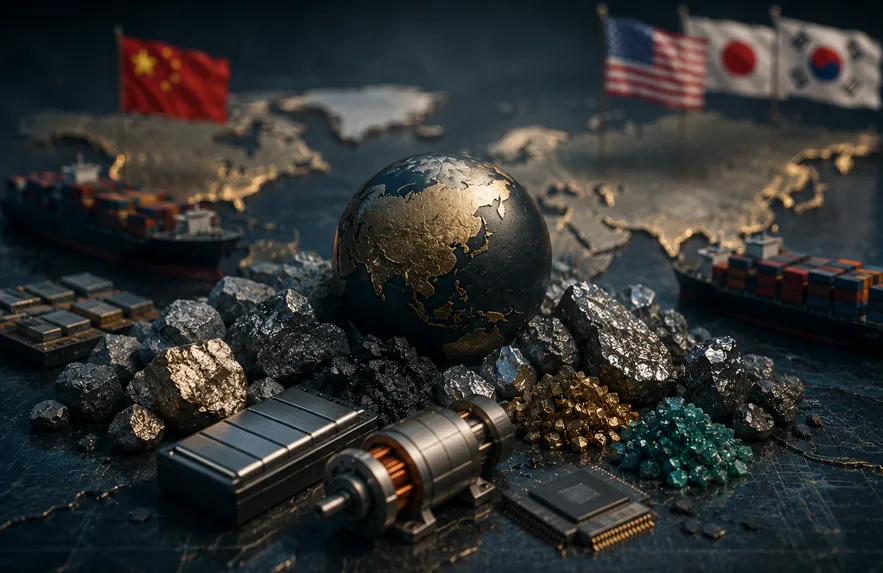
[Critical Minerals and Diplomacy © ESG.ONL]
From Raw Material to Diplomatic Weapon
When the United States blocked China’s exports of advanced semiconductor equipment, China responded by progressively expanding export controls on critical minerals to the U.S. Starting with gallium and germanium in 2023, China introduced an export licensing system for seven rare earth elements in 2025. In January 2026, citing the Japanese Prime Minister’s remarks ‘hinting at intervention in the event of a Taiwan contingency,’ it abruptly banned exports of dual-use items — goods usable for both civilian and military purposes — to Japan. Critical minerals have become not merely raw materials but diplomatic bargaining chips.
To reduce dependence on China, the United States chose a strategy of increasing domestic production of critical minerals while simultaneously joining hands with allies. In February 2026, it launched the Forum on Resource Geostrategic Engagement (FORGE), a trade consultative body ensuring stable mineral supply, with 56 participating countries including South Korea, Japan, and Australia.
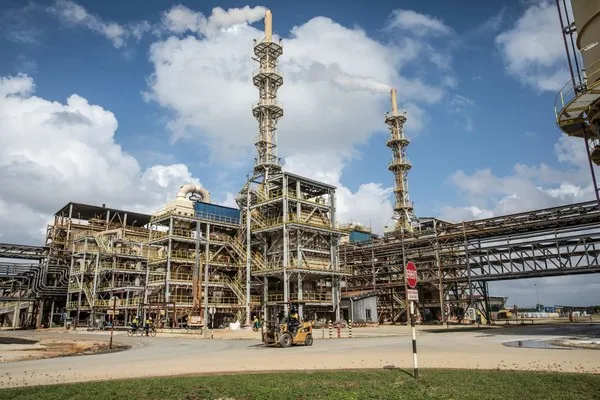
[View of the Malaysian refining and processing plant of Australian mining company Lynas © Lynas]
Japan has the most advanced experience in stabilizing the critical mineral supply chain. It all started during the 2010 China-Japan territorial dispute, when China blocked rare earth exports to Japan. Since then, Japan has quietly spent 15 years building a critical mineral supply chain that bypasses China, joining hands with Australian mining company Lynas to create a route in which rare earths mined in Australia are refined in Malaysia. A Japanese Ministry of Economy, Trade and Industry official once noted, “The United States and Europe are only now realizing the urgency of the rare earth issue. Japan learned its lesson from the relevant problem 15 years ago.”
Challenges for Domestic Critical Mineral Supply Chain Independence
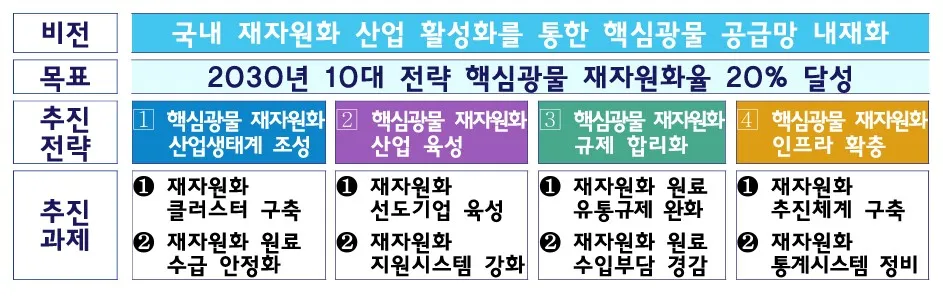
[Critical Mineral Re-Resource Recovery Activation Vision and Promotion Strategy © Government of the Republic of Korea]
Compared to the countries mentioned above, South Korea’s critical mineral supply chain structure is somewhat more complex. For a long time, the model has been to import raw materials from China, import processed materials from Japan, and then manufacture finished products such as semiconductors, batteries, and displays in South Korea. It is a structure where if China imposes export controls on Japan, the ripple effects could be transmitted like a domino to South Korea as well. In response, in 2023, the South Korean government set a target of reducing the import dependence on specific countries for critical minerals from the current level of around 80% to the 50% range by 2030. In January 2026, it officially recognized ‘re-resource recovery’ — recovering metals from waste batteries and other sources to reuse as industrial raw materials — as a critical mineral manufacturing industry and began fostering it. A 250 billion won Critical Mineral Supply Chain Stabilization Fund is also being established. South Korea holds the FORGE chairmanship until June 2026, positioning it to lead international cooperation on critical minerals.
That said, compared to Japan’s 15 years of preparation for stabilizing its critical mineral supply chain, South Korea still has a long way to go. It simultaneously needs to secure supply sources for various critical minerals, establish domestic facilities capable of directly refining and processing critical minerals, and systematically foster re-resource recovery companies, which are predominantly SMEs. Even a single smartphone we use every day contains dozens of types of critical minerals. We are living in an era where where those minerals come from and who controls them determines national competitiveness.
by Editor L