
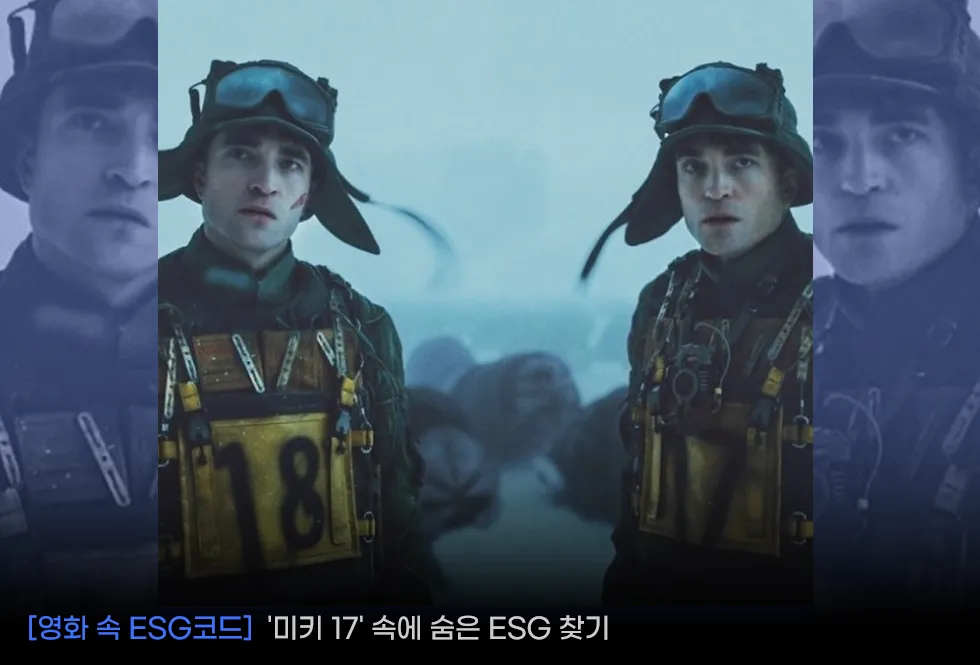
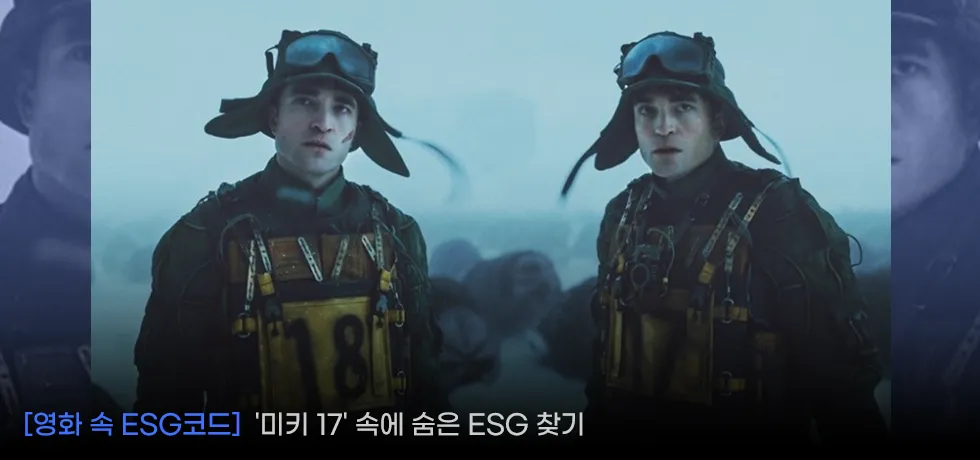
Director Bong Joon-ho's new film "Mickey 17" opened on February 28 amid much interest. This work, combining space-set SF with the director's characteristic black comedy, also drew attention for injecting blockbuster-scale capital of 118 million dollars (about 127.7 billion won), with Director Bong Joon-ho joining hands with America's Warner Bros.
Films with Human Clones as Material
Human clones are one of the major materials of SF films. Representative examples include "Blade Runner" (1982), about tracking "replicants," clones who have infiltrated Earth; "The Island" (2005), about clones made for the purpose of organ provision who attempt an escape; and "Moon" (2009), a story about an astronaut working at a lunar base and a clone.
"Mickey 17," another clone film, borrowed as its motif Edward Ashton's original novel "Mickey7," but it is a work that went through much adaptation. The protagonist Mickey, to avoid a loan shark demanding repayment of a debt incurred through business failure, volunteers to become a clone called an "Expendable." He is repeatedly deployed on dangerous missions to achieve the goals of "Kenneth Marshall," a politician seeking to colonize the ice planet "Niflheim," dying and coming back to life over and over. In the process, an accident occurs in which he falls into a crevasse where the "Creepers" — the natives of Niflheim, and from our standpoint alien life forms — lived. Due to this accident, an error occurs even though Mickey 17 is alive, and a new Mickey, Mickey 18, is created; the conflict that ensues is the gist of the film.
What story did Director Bong Joon-ho want to tell with the long-standing material of the human clone? The films preceding Mickey 17 explored clones in various ways within their respective eras' contexts. They mainly delved into ethical dilemmas, social class conflict, and the problem of human identity to sharpen their thematic consciousness. This context is contained in Mickey 17 too. Now let us look at this from an ESG perspective.
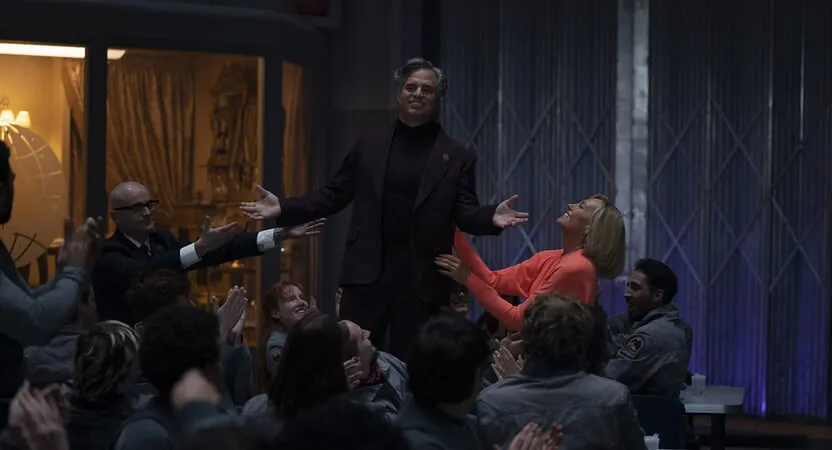
[Radical politician "Kenneth Marshall," revered like a religious cult leader © Warner Bros.]
Earth's Devastation and the Problem of Sustainability
Why did Mickey, who had to die and be revived as many as 17 times, have to leave Earth in the first place? The film is set in an era when interplanetary migration is possible. Humanity, saying it can no longer live having caused environmental problems on Earth, begins a journey of more than four years to find a new territory to conquer. Before Mickey boarded the spaceship, an overwhelming sandstorm raged outside the airport. Inside the airport, a photo of a radical politician revered at the level of a religious leader hung like a banner. The image of a reality facing a serious climate crisis and an extreme politician stimulating the anxious public psyche is not unfamiliar to us in the 2025 reality (which has not yet secured life beyond Earth) either.
Politician Kenneth Marshall's vision approaches the Expendable clones from the standpoint of a recyclable resource. Saying that "people" can be remade and used by extracting organic matter from trash to make human bodies, he self-praises its usefulness highly while entirely ignoring ethical problems such as the disregard for humans. Behavior in the same vein continues at the new settlement "Niflheim." As soon as the spaceship carrying the settlers lands on the alien planet, it seeks to encroach on and exploit the existing ecosystem, just as on Earth. The reality the director seeks to criticize is clear through the greedy villain who lightly ignores sustainable resource management and environmental problems including the ecosystem, even in a situation where, leaving an extreme crisis behind, they set out to build a new home.
Technological Advancement and Ethics, the Tragedy of Human Alienation
So then, was humanity itself — which aimed at survival and prosperity without concern for resources and the environment — happy? Mickey 17 depicts humans who, even if a world achieved through scientific attainment high enough to enable clone creation and interplanetary travel arrives, cannot help but think and act according to their innate humanity.
The setting in which Mickey is cloned retaining his memory each time he dies, and the look in Mickey's eyes and his expression reflected on screen each time, are the human ethical dilemma itself. Even to Mickey, who knows he will be revived, death was terror. But the Mickeys, trapped in an irrational structure, willingly submit to a reality where economic and technological logic comes first. If they do not follow the extremely controlled living and working environment for efficiency, they are cruelly excluded. In fact, even on Earth, Mickey — who dropped out for failing to produce results under the capitalist system — had no other choice. He merely lived day after day reaching death without any safety device, until the somewhat rebellious 18th Mickey found courage. Even so, Mickey 18 too is a being treated as a printout tumbling on the floor, printed from a machine as one of a scientist's routine tasks, a mere resource for a goal. The characters in the film ask the Mickeys what "death" feels like — as if asking the audience whether a situation where human dignity is annihilated is all right, whether there is no room to reflect.
Of course, it is not that the scientists, politicians, and philosophers in the film all failed to ponder the disregard for life. It is just that, before the economic and scientific gains to be obtained through technology, it took a lot of time to reach complete disposal. In such a situation, it is all too natural to view the intelligent life form "Creeper," which lived on the planet "Niflheim," with a focus on use value.
Still, there is hope. It is also a facet of humanity that the settlers — reminiscent of the cultural clashes of imperial colonies humanity has experienced on Earth — quickly shift their perception toward beings with the possibility of coexistence and set out to seek the common good. The scene that kindly shows the process of driving out corrupt forces and re-establishing the goals human society should pursue, in order to keep a minimum of humanity, makes us reflect on what our goals are.

[Spaceship passengers living under control and surveillance © Warner Bros.]
"Mickey 17," which depicts a fable in which, even amid the most painful and tragic moments, those who love and unite ultimately win. This film, true to a Bong Joon-ho film, throws out things to think about regarding the environment, society, and governance we face, not too heavily. Mickey 17 is a film like a good reference for exploring how we will prepare for the coming future, and what kind of future the present us are making a today for each day.
By Editor L