

The Day We First Used a Credit Card
In American novelist Edward Bellamy's work "Looking Backward," a future without currency appears. Instead, a single card containing a year's wages serves as people's means of payment. The first appearance of the credit card concept came from a novel depicting an unknown vision of the future. That concept became reality in 1949. American businessman Frank McNamara, drawing on an embarrassing experience of leaving his wallet in his hotel room before visiting a restaurant, devised a membership service: by connecting acquaintances with nearby restaurants, members could pay with just a membership card without cash and settle the total amount at the end of the month. This was the beginning of the "Diners Club"—and the beginning of the credit card services we still use at this very moment. Later, Mastercard and Visa, based on banking consortiums, introduced the revolving feature that allowed repayment after consumption. A cashless consumer lifestyle became possible. We will now explain how this story connects to ESG.
Environmental Challenges and Mastercard's Response
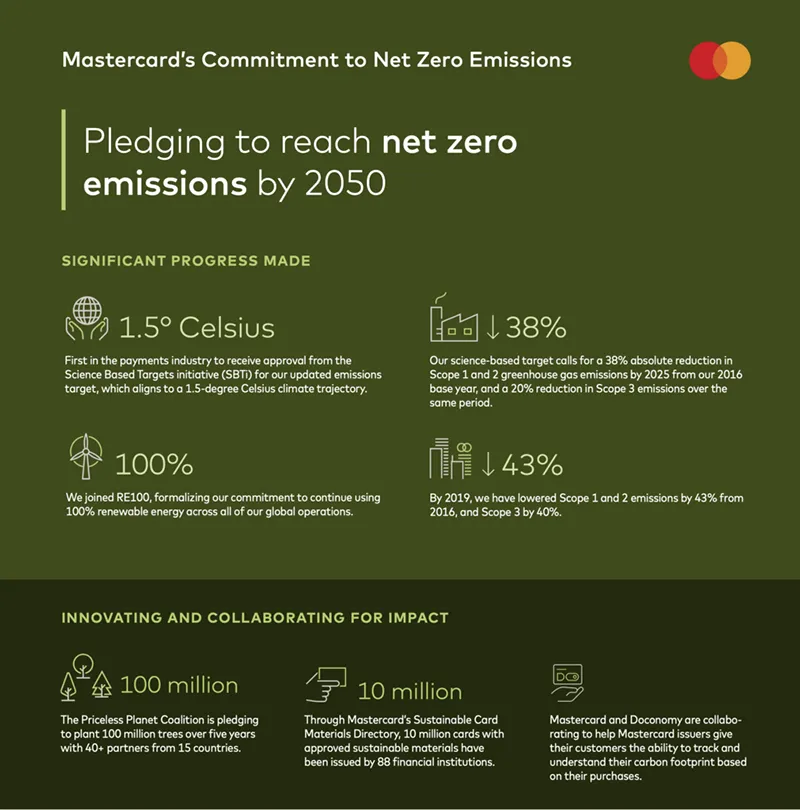
[Carbon Neutrality Goals Through 2050 ©Mastercard]
Mastercard is sharing its strategic moves to address the climate crisis. First, to combat global warming, the company has set targets in accordance with the Science Based Targets initiative (SBTI) and is actively responding to climate change. Furthermore, it has joined RE100, setting a goal of reducing Scope 2 (indirect) greenhouse gas emissions by 38% by 2025 compared to 2016 levels, and is disclosing its progress through sustainability reports. The company aims for enterprise-wide use of 100% renewable energy and is contributing to the global expansion of renewable energy adoption to achieve this.
As a card company, Mastercard also addresses environmental issues related to single-use plastics. When manufacturing its cards, Mastercard is developing cards made from sustainable materials such as bio-based materials, recycled plastics, and ocean-bound waste instead of conventional PVC plastic. Through this approach, the company can dramatically reduce the amount of plastic consumed in card production.
These efforts also include the establishment of the Priceless Planet Coalition, an organization aiming to plant 100 million trees. The coalition primarily runs a global campaign to offset carbon emissions and enhance biodiversity. While it engages in direct tree-planting activities for the environment, its greater emphasis is on bringing customers, partners, and employees on board, thereby fostering broader community engagement, awareness, and action.
Social Challenges and Mastercard's Response
Mastercard also has initiatives aimed at reducing social inequality. It seeks to strengthen financial accessibility worldwide and provide everyone with opportunities for inclusive growth. To this end, the company leverages innovative technology and partnerships to expand digital payment systems that anyone can easily use, and develops inclusive finance programs for communities with limited access to financial services. Alongside these solutions, Mastercard runs educational programs to enhance individual financial literacy, helping consumers better understand and manage their economic circumstances. Such education can improve the quality of personal financial decision-making and, in the long term, promote economic independence and financial well-being.

[Mastercard's Social Innovation Incubator (SII) poster, partnering with Women Choice to create employment opportunities for women across the Middle East and North Africa (MENA) region ©Mastercard]
In this context, Mastercard also operates social initiatives targeting small businesses and women-owned enterprises. It provides specialized payment solutions to help small businesses affected by the pandemic seamlessly integrate into the digital economy, and leverages analytical tools such as big data to help businesses understand market trends and develop appropriate business strategies. For women entrepreneurs, Mastercard provides financial services that improve access to capital and resources, while also offering a range of non-financial support including business consulting, networking opportunities, and leadership training programs.
With its declaration of a goal to bring 25 million women-owned businesses into the digital economy by 2025 as part of its ESG activities, Mastercard continues to invest resources and drive positive change toward the goal of economic empowerment for women-owned enterprises.
Governance Challenges and Mastercard's Response
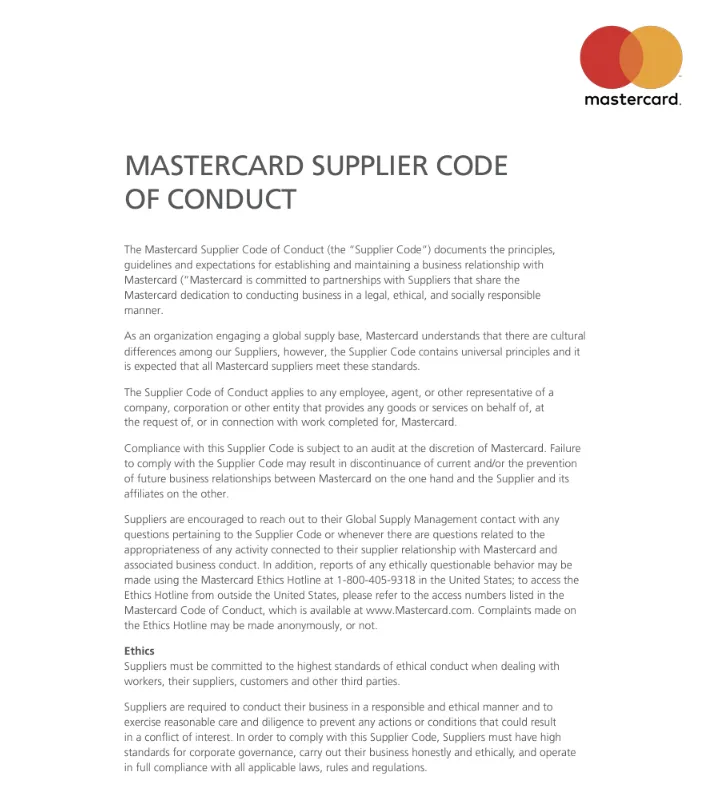
[Mastercard's Supplier Code of Conduct ©Mastercard]
Mastercard seeks to achieve sustainable growth by building trust both internally and externally. It upholds responsibility and transparency as core values and has established comprehensive regulations and a systematic governance structure, applying ethical standards to all areas of its business. The company has also formed an independent board of directors and specialized committees to enhance corporate governance transparency, and through its "Business Ethics and Compliance" program, it has built a practice framework that applies not only legal compliance but also corporate values and principles. This program encourages all employees to adhere to various rules and standards through ongoing education and rigorous internal controls, and includes a reporting system to handle violations promptly and fairly. Mastercard has also introduced a compensation system that links performance and compliance metrics for employees at all levels. Through a reward system based on ESG indicators, the company has reinforced ethical decision-making and demonstrated that fulfilling social responsibility is possible within the scope of business operations.
Built on these initiatives, Mastercard has strengthened its leadership position in the ESG space, which has led to the desirable outcome of enhancing long-term investor interests and the company's social value.
Moments in Life That Money Cannot Buy—Truly Priceless
Mastercard's communication message is exceptionally famous. The "Priceless" message made a powerful impression on people's minds because a financial services company was proposing something that money cannot buy. First introduced through a TV advertising campaign in 1997, this message encourages people to go beyond the simple experience of using goods and services made possible by a card, and instead create unique and unforgettable moments in life. Over time, this message elevated Mastercard's presence to an inseparable value in people's lives and became a brand asset and identity connecting consumers to Mastercard. Now is the time to pay attention to the "Priceless" ESG journey that Mastercard is about to unfold.