


[BLACKPINK concerts and Waterbomb, the link between K-culture and ESG ©ESG.ONL/ESG Today]
These days, the fervor for Netflix's original content "KPop Demon Hunters," which takes Korean idols as its subject, shows no sign of cooling. The film's insert song "Golden" rose to No. 1 on the Billboard Global 200 chart, and the Korean elements that appear in the film are also drawing much interest. Regarding "KPop Demon Hunters'" success, the assessment continues that—even though it is not a film planned by a Korean production company—its careful depiction of Korea's tradition and modern appearance shows that Korea's culture, including K-POP, holds a global standing.
As Korea's culture and arts draw the world's attention in this way, voices demanding responsible behavior are also gradually growing louder. Cases of entertainment agencies attempting ESG management—such as producing the albums of K-POP artists active worldwide with eco-friendly materials—have also become topics. Today, among the K-POP-related fields expanding their influence, we want to look at the ESG activities the performance industry has adopted.
Turning Fans' ESG Practice into a Piece of Content: BLACKPINK Concerts
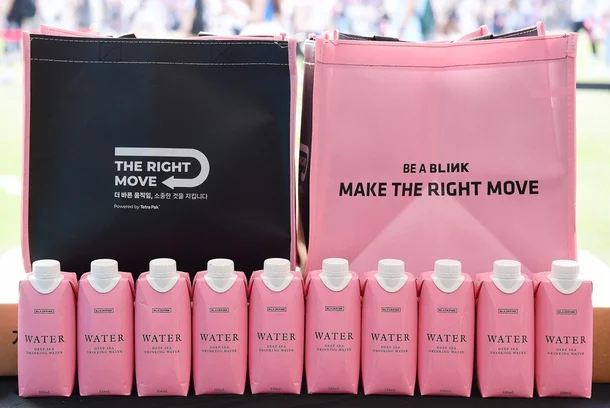
[The custom water pack from the collaboration between "Tetra Pak Korea" and BLACKPINK ©Tetra Pak Korea]
On July 5, BLACKPINK unveiled the new song "Jump" at their third world-tour concert "Deadline," announcing the resumption of the group's activities. As much as the group's activities after 2 years and 10 months, what drew attention was the pink water packs stacked to one side of the venue. The custom-designed water packs, produced through a collaboration between the aseptic-carton manufacturer "Tetra Pak Korea" and BLACKPINK, were special. "Coldplay," an artist that advocates sustainable performances, also sold water packs instead of plastic bottled water at its venues, but this is the first water pack with a design reflecting the artist's identity. Concertgoers naturally bought the water packs—which also carry the meaning of merch—rather than water in plastic bottles, and thanks to placing water-pack collection bins throughout the venue, a large quantity of water packs could be collected. Tetra Pak Korea plans to recycle the collected water packs into toilet paper and the like.
Tetra Pak Korea President Nils Hougaard assessed that "now, when the whole world is paying attention to K-POP, this collaboration was a case that realized, at a performance site, a new ESG-practice model where the entertainment industry meets sustainable packaging," and expressed the aspiration that "we will convey environmental messages to many people through various businesses and strategic collaborations." It is a case showing that when a performance's organizers create an appropriate environment, the audience, too, actively sets out to practice sustainable environmental protection.
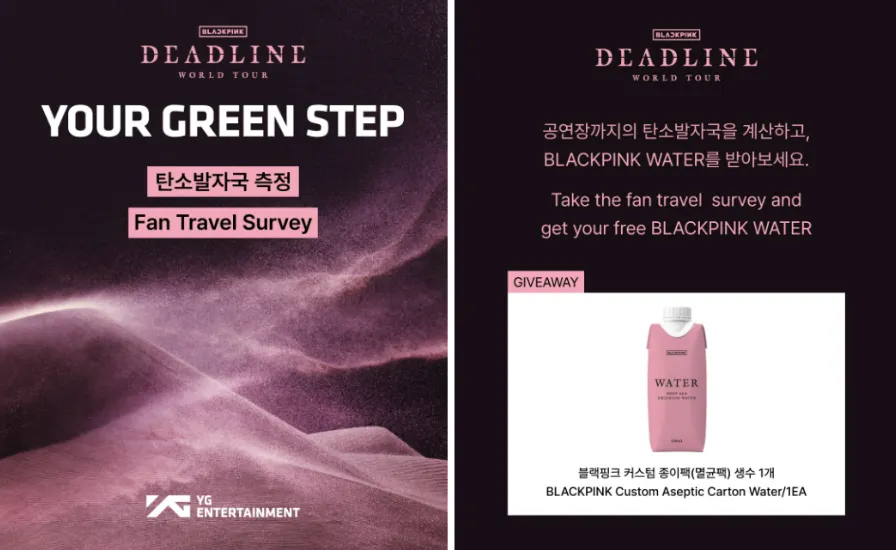
[Guidance on participating in the "YOUR GREEN STEP" carbon-footprint measurement ©YG Entertainment]
There is another sustainable activity that drew fans' participation: the "YOUR GREEN STEP" survey, which measures the carbon footprint an audience member leaves until arriving at the venue. This survey holds significance in identifying the greenhouse-gas emissions produced in the travel and lodging process an audience member undergoes to attend a performance, and in accumulating data to seek realistic and effective greenhouse-gas-reduction methods. In fact, at four performances that BLACKPINK's agency YG Entertainment organized from January 2024 to the first half of 2025, the factor that emitted the most greenhouse gases was "audience travel"—moving to the venue by plane, private car, public transport, and so on. The data will be used as basic statistics for composing sustainable performances, from direct services such as running shuttles for audiences to reducing the greenhouse-gas emissions arising from performances.
Why did BLACKPINK's agency YG Entertainment prepare such content for the concert? It is not simply for the social standing and positive influence of the company and the artist. If greenhouse-gas emissions do not decrease and hotter summers repeat every year, they are highly likely to affect the health and motivation of artists and fans participating in summer performances, music-video shoots, and various events. There could also be disruptions to actual management activities, such as employee safety accidents from outdoor activities and increased cooling costs at business sites. This is why even entertainment agencies—which seem relatively distant from responsibility for carbon emissions—cannot but pay attention to ESG.
Waterbomb, Changing by Turning Concerns Into a Stepping Stone
There is also a performance that becomes a hot potato every summer: "Waterbomb." Waterbomb, which fills the thirst of people seeking a cool and fun experience on a hot summer day, mobilizes a considerable amount of water per session. Thanks to this, audiences make unforgettable memories, but because the performance timing overlaps with periods when drought occurs, there is also considerable critical public opinion that it wastes water that should be used where it is really needed.
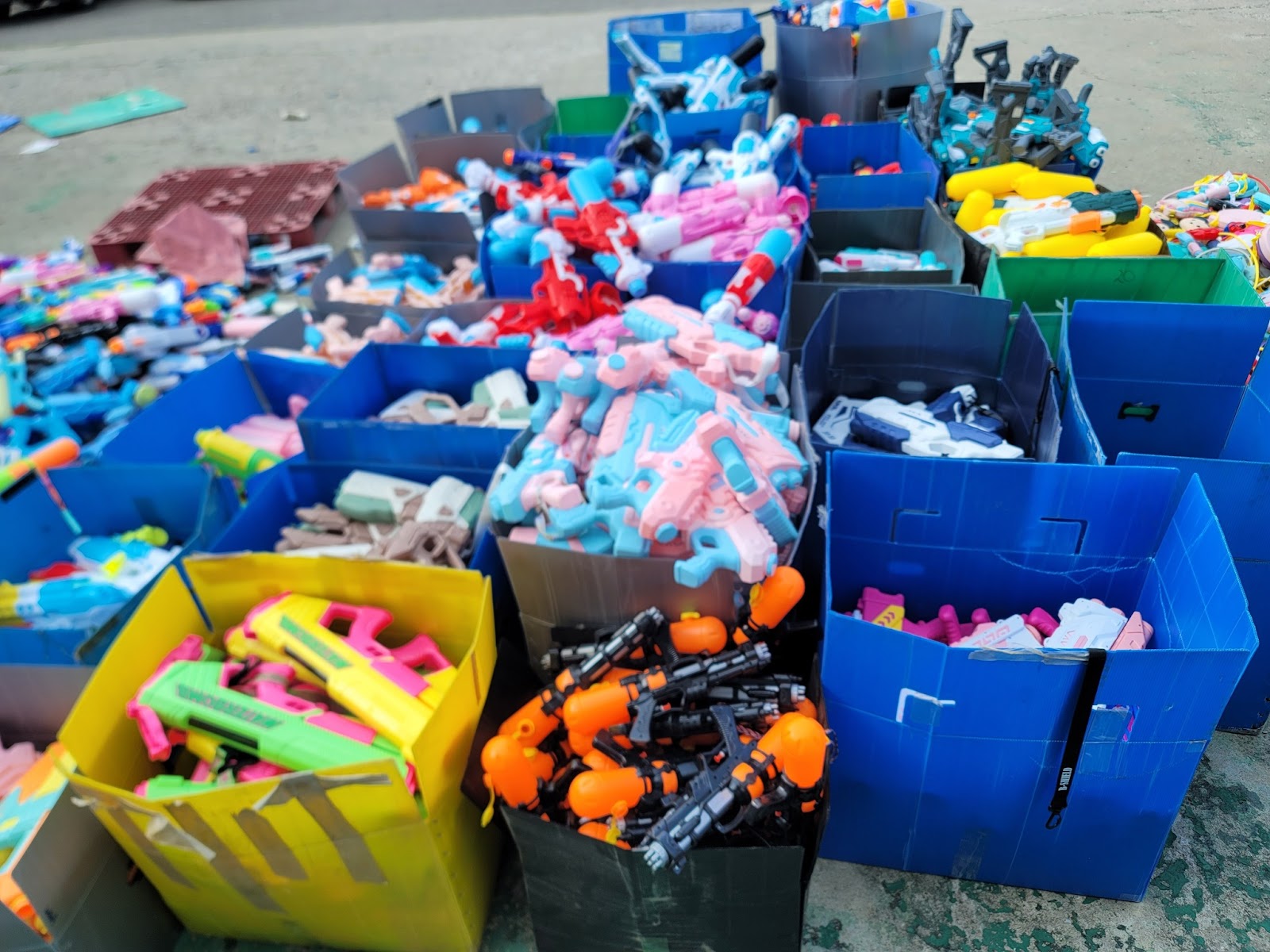
[The water guns left behind after the Waterbomb event ©Facebook of Park Jun-seong, Secretary-General of "TRU"]
The topic surrounding this year's Waterbomb was the water guns audiences left behind after the performance. A photo of the official water guns provided by the performance organizer "Made On" and the various kinds of water guns brought by audiences all stacked together became a topic on online communities and gave many people a shock. But this was also a form of sustainable performance that the Waterbomb organizers attempted. They donated the water guns left after the performance to "TRue" (an incorporated association; hereafter TRue), an environmental organization specializing in toy recycling. TRue is an environment-related NGO that collects toys no longer in use, holds bazaars for those still usable, or donates them to underserved groups. Toys that cannot be reused are disassembled and recycled into plastic "pellets" and plastic sheet material called "neol."
Of the water guns Waterbomb donated to TRue, after a sorting process, one-third will be donated to local children's centers and the like. Water guns hard to reuse are sorted by color and size and used as material for making neol. Waterbomb stated that it plans to use the neol recycled by TRue to make photo zones for performances it holds in the future. In effect, the trash generated at Waterbomb returns to the venue in a new form.
Made On is making its own efforts to prepare measures to resolve the various concerns surrounding Waterbomb. It stated that it published an Environmental-impact report analyzing problems such as water waste and the excessive trash left after performances, and that it is preparing a way to reuse water guns at each performance by building a water-gun rental system for future events. In addition, it plans to use water-saving devices and build a water-conservation system that measures water-resource-protection goals and results, creating a structure that evaluates those results. It is striving to make critical voices surrounding the performance an occasion for development.
Beyond this, musical, play, and opera performance troupes are also continuing ESG-direction efforts, such as operating shared warehouses that recycle props and set pieces discarded after performances, or replacing paper tickets with smart tickets. Performances and festivals that offer magical moments away from daily life. So that pleasant daily life can continue even after a performance that sings of life and love ends and the curtain falls, industry-level practice is continuing. It is a point where one anticipates in what form the influence of K-culture, which will grow even larger going forward, will bloom in ESG.
by Editor N